Deferment of the Manipur Decennial Census
#GS-2 #Indian Polity & Constitution #Governance & Social Justice #Current Events #National #Census #National Register of Citizens #Demographics #Manipur
Key takeaways
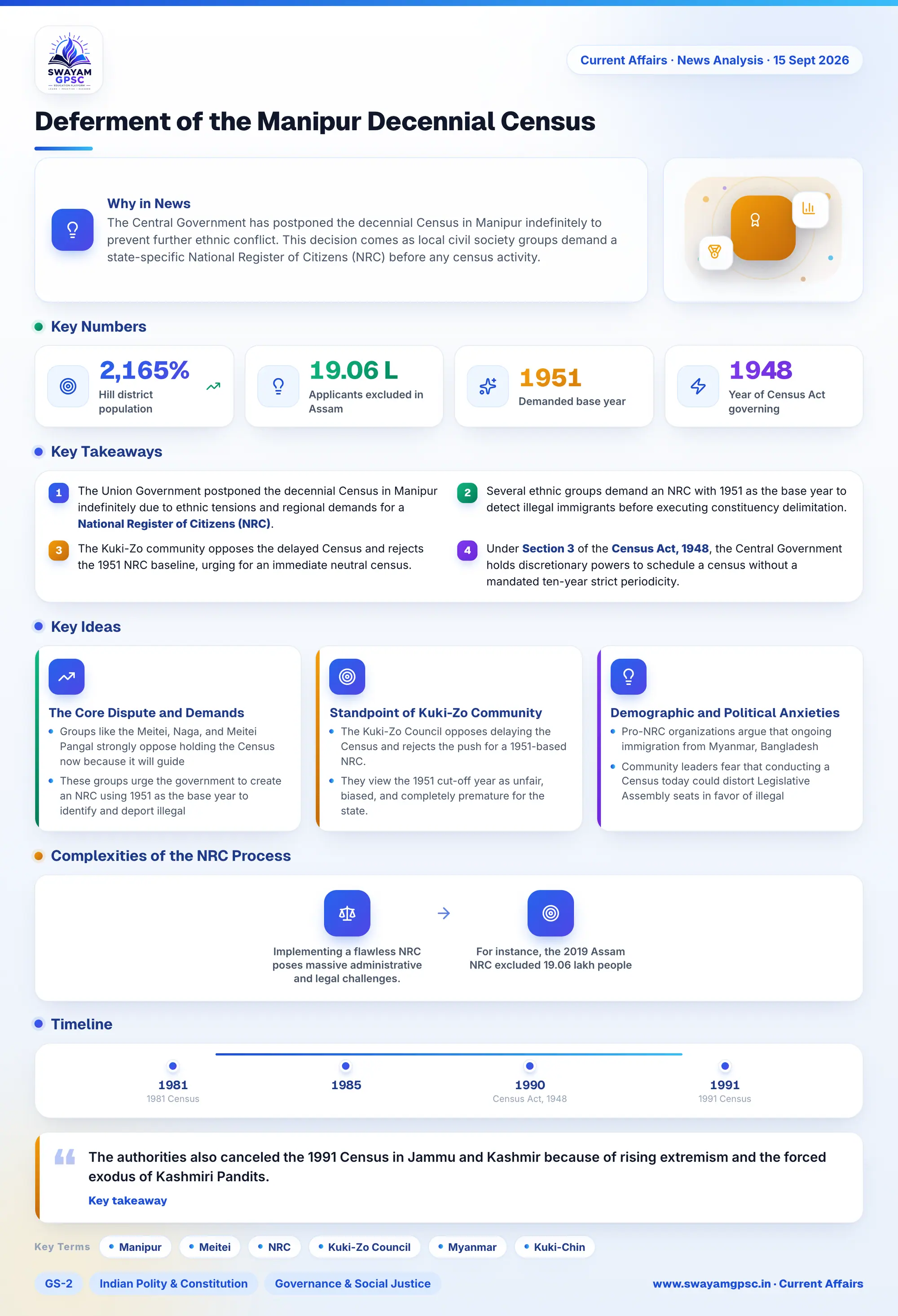
- The Union Government postponed the decennial Census in Manipur indefinitely due to ethnic tensions and regional demands for a National Register of Citizens (NRC).
- Several ethnic groups demand an NRC with 1951 as the base year to detect illegal immigrants before executing constituency delimitation.
- The Kuki-Zo community opposes the delayed Census and rejects the 1951 NRC baseline, urging for an immediate neutral census.
- Under Section 3 of the Census Act, 1948, the Central Government holds discretionary powers to schedule a census without a mandated ten-year strict periodicity.
- Regional censuses were previously deferred in Assam in 1981 and Jammu and Kashmir in 1991 owing to severe law and order disruptions.
Why in News
- The Central Government has postponed the decennial Census in Manipur indefinitely to prevent further ethnic conflict.
- This decision comes as local civil society groups demand a state-specific National Register of Citizens (NRC) before any census activity.
The Core Dispute and Demands
- Groups like the Meitei, Naga, and Meitei Pangal strongly oppose holding the Census now because it will guide constituency delimitation.
- These groups urge the government to create an NRC using 1951 as the base year to identify and deport illegal immigrants first.
Standpoint of Kuki-Zo Community
- The Kuki-Zo Council opposes delaying the Census and rejects the push for a 1951-based NRC.
- They view the 1951 cut-off year as unfair, biased, and completely premature for the state.
- The council demands a fair Census to provide true demographic details and counter false claims about illegal migration.
Demographic and Political Anxieties
- Pro-NRC organizations argue that ongoing immigration from Myanmar, Bangladesh, and Mizoram created a 2,165% population surge in hill districts since 1881.
- Community leaders fear that conducting a Census today could distort Legislative Assembly seats in favor of illegal residents.
Link to the Myanmar Crisis
- Demands for an NRC gained momentum after the military coup in Myanmar in February 2021.
- The arrival of Kuki-Chin refugees across unguarded borders deepened local fears and prompted the State Assembly to pass resolutions for a State Population Commission.
Complexities of the NRC Process
- Implementing a flawless NRC poses massive administrative and legal challenges.
- For instance, the 2019 Assam NRC excluded 19.06 lakh people, yet the Registrar General of India has not notified it as final, leaving it legally stuck.
Historical Precedents of Deferment
- India has deferred regional censuses twice before during severe local instability.
- The government skipped the 1981 Census in Assam due to anti-immigrant protests that ended with the Assam Accord of 1985.
- The authorities also canceled the 1991 Census in Jammu and Kashmir because of rising extremism and the forced exodus of Kashmiri Pandits.
Legal Basis for Census Deferment
- Section 3 of the Census Act, 1948 allows the Central Government to conduct a census whenever it deems necessary.
- Neither the Census Act, 1948 nor the Census Rules, 1990 legally require a strict ten-year timeline for conducting a census.