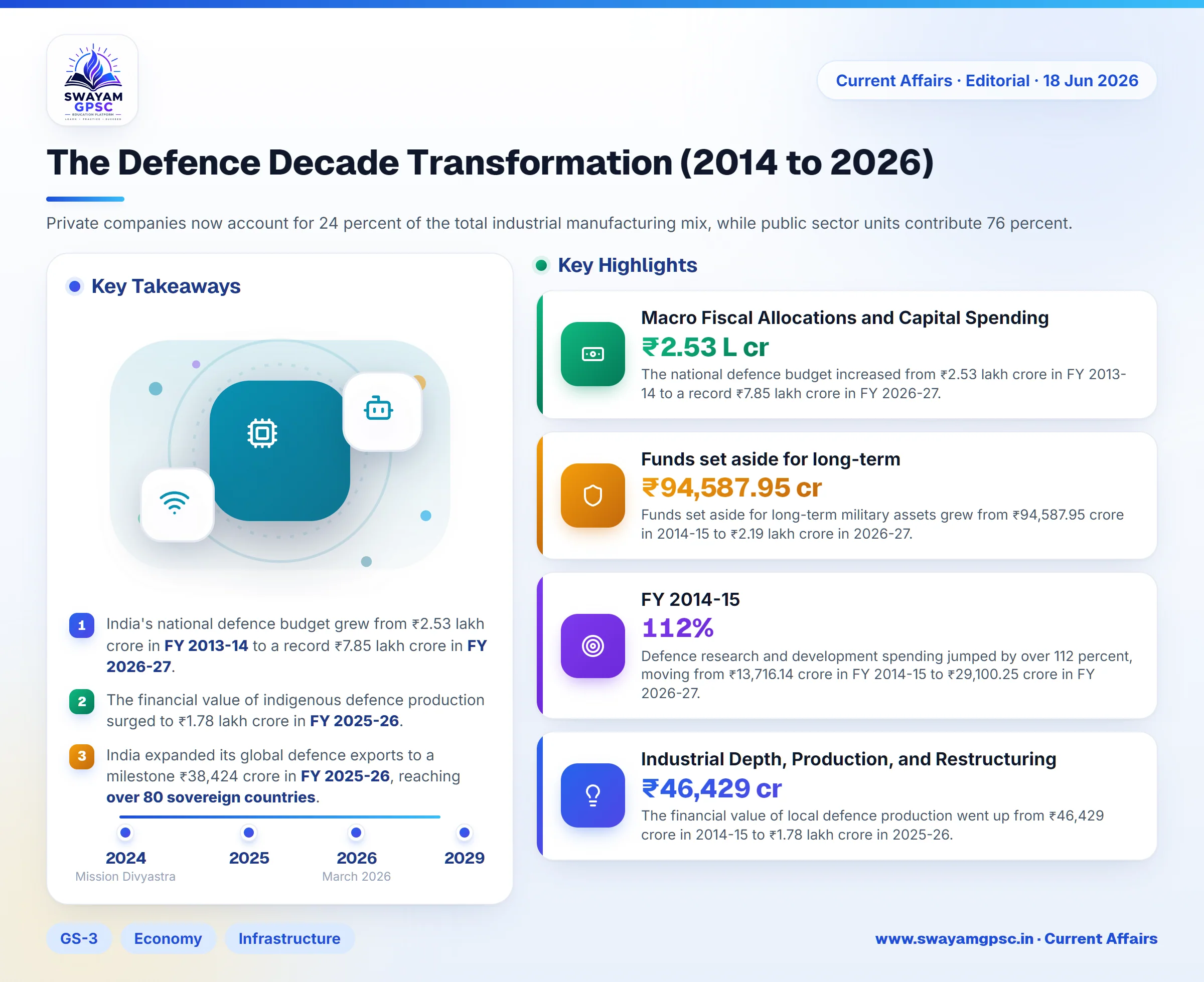
The Defence Decade Transformation (2014 to 2026)
#GS-3 #Economy #Infrastructure #Science & Technology #Current Events #National #India
Key takeaways
- India's national defence budget grew from ₹2.53 lakh crore in FY 2013-14 to a record ₹7.85 lakh crore in FY 2026-27.
- The financial value of indigenous defence production surged to ₹1.78 lakh crore in FY 2025-26.
- India expanded its global defence exports to a milestone ₹38,424 crore in FY 2025-26, reaching over 80 sovereign countries.
- The government stopped imports on 5,012 specialized parts through five Positive Indigenisation Lists to boost local manufacturing.
About The Defence Decade Transformation
- Over the past twelve years, India has changed its strategy from buying foreign military equipment to building things locally.
- Guided by Atmanirbhar Bharat and Make in India, the Ministry of Defence has removed old bureaucratic hurdles to create an open manufacturing system.
- This new approach helps local businesses and start-ups innovate and build modern military gear right inside the country.
Macro Fiscal Allocations and Capital Spending
- The national defence budget increased from ₹2.53 lakh crore in FY 2013-14 to a record ₹7.85 lakh crore in FY 2026-27.
- Funds set aside for long-term military assets grew from ₹94,587.95 crore in 2014-15 to ₹2.19 lakh crore in 2026-27.
- Defence research and development spending jumped by over 112 percent, moving from ₹13,716.14 crore in FY 2014-15 to ₹29,100.25 crore in FY 2026-27.
Industrial Depth, Production, and Restructuring
- The financial value of local defence production went up from ₹46,429 crore in 2014-15 to ₹1.78 lakh crore in 2025-26.
- Private companies now account for 24 percent of the total industrial manufacturing mix, while public sector units contribute 76 percent.
- The number of active defence manufacturing licenses rose from 258 in 2015 to 834 as of March 2026.
- In October 2021, the government closed the 200-year-old Ordnance Factory Board and split its factories into seven corporate public sector units.
- India received ₹6,670.59 crore in direct foreign investment in this sector by March 2026 after changing rules to allow up to 74 percent investment through the automatic route.
Exploding Global Export Footprints
- India's defence exports grew from ₹686 crore in FY 2013-14 to ₹38,424 crore in FY 2025-26.
- Locally made military items are now exported to over 80 sovereign countries around the world.
- The number of private manufacturing firms exporting defence products grew to 145 specialized entities.
- India used to import 65 to 70 percent of its military goods, but it now manufactures nearly 65 percent of its defence inventory at home.
Key Trends in Indian Defence Governance
- The iDEX initiative brought in small businesses and start-ups, signing 551 specific design contracts by March 2026.
- The Ministry of Defence stopped imports on 5,012 specialized parts through five Positive Indigenisation Lists.
- Dedicated industrial corridors helped secure investment commitments worth ₹42,057 crore in Uttar Pradesh and ₹32,699 crore in Tamil Nadu by April 2026.
- The Srijan DEEP portal keeps a secure database of over 41,000 verified suppliers.
- Advanced testing facilities under the DRDO were opened up to private aerospace companies through a unified portal.
Positive Indicators and Breakthrough Technological Milestones
- During Mission Shakti in 2019, India successfully destroyed a target satellite in low earth orbit to prove its anti-satellite capability.
- Under Mission Divyastra in 2024, India tested a long-range strategic missile system with multiple warheads.
- In 2026, India conducted a successful 12-minute ground test of a scramjet combustor using a new wind tunnel in Hyderabad.
- The Defence Acquisition Council approved major purchases like 97 Tejas Mk-1A fighter jets and 156 Prachand helicopters.
- In 2025, India completed the delivery of all six Kalvari-class Scorpene submarines built locally with French collaboration.
Challenges
- Moving complex laboratory designs created by the DRDO into mass production by private small businesses often faces delays.
- Negotiating technology-sharing agreements with foreign suppliers requires careful checks to protect domestic intellectual property.
- Finding and training enough skilled workers for precision military manufacturing remains a difficult task.
- Local factory construction can face delays due to state-level land rules and municipal building permissions.
Way Forward
- India must maintain active global outreach to reach its goal of ₹50,000 crore in annual defence exports by 2029.
- The new Defence Acquisition Procedure 2026 should make a 60 percent minimum indigenous content mandatory for all purchases.
- The government should use the newly created ₹500 crore fund to support deep-tech areas like artificial intelligence and drone swarms.
- India should use security frameworks like the India-US TRUST initiative and the MAHASAGAR doctrine to protect the Indo-Pacific region.