Deepening the India-Japan Strategic Partnership
#GS-2 #International Relations #Economy #Bilateral Relations #Infrastructure #Science & Technology #Energy
Key takeaways
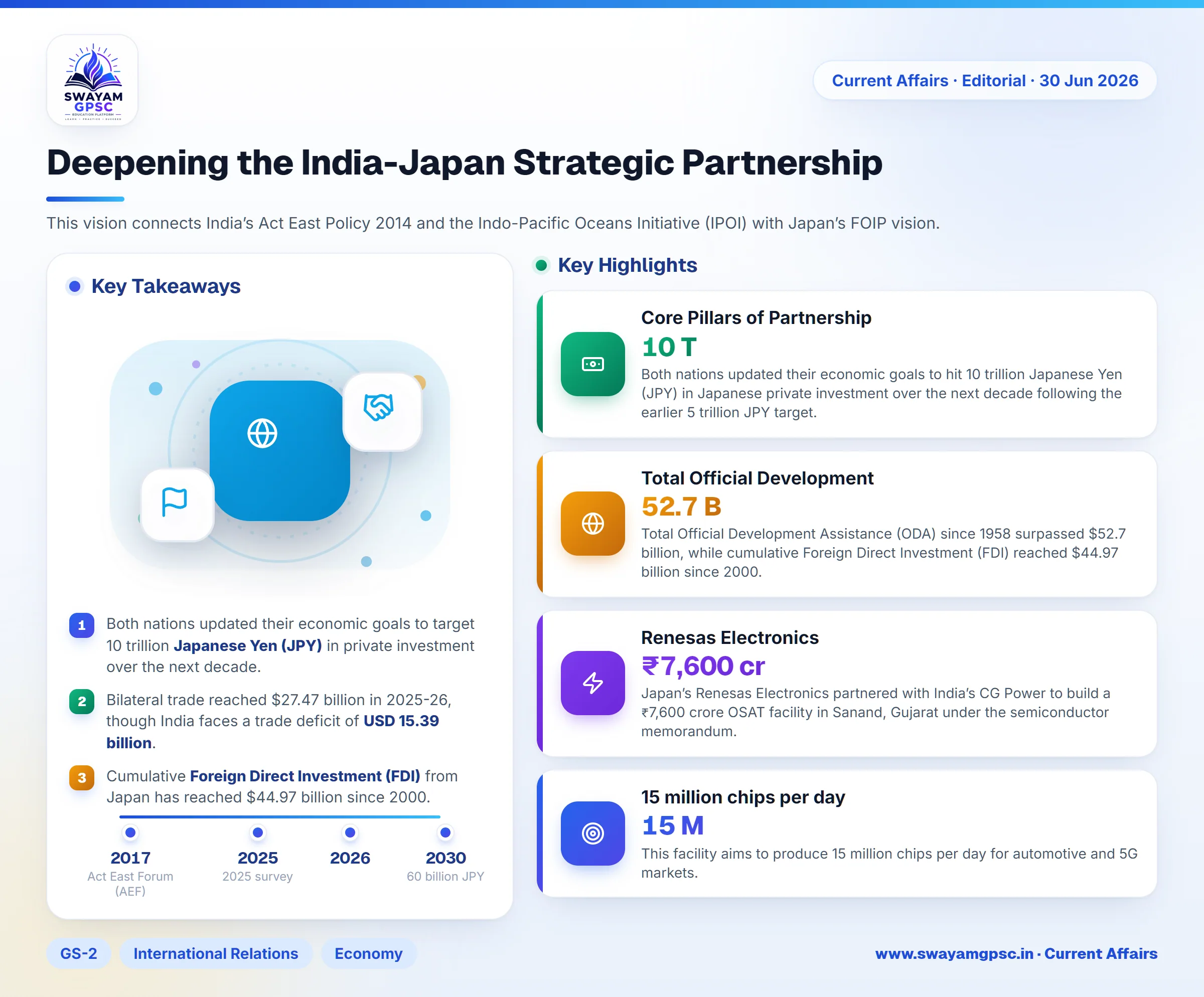
- Both nations updated their economic goals to target 10 trillion Japanese Yen (JPY) in private investment over the next decade.
- Bilateral trade reached $27.47 billion in 2025-26, though India faces a trade deficit of USD 15.39 billion.
- Cumulative Foreign Direct Investment (FDI) from Japan has reached $44.97 billion since 2000.
- Japan’s Renesas Electronics partnered with India’s CG Power to establish a ₹7,600 crore OSAT facility in Sanand, Gujarat.
- The Action Plan for India-Japan Human Resource Exchange targets sending 50,000 highly skilled Indian professionals to Japan.
Core Pillars of Partnership
- The India-Japan partnership spans across defence, technology, and infrastructure with a massive investment target.
- Both nations updated their economic goals to hit 10 trillion Japanese Yen (JPY) in Japanese private investment over the next decade following the earlier 5 trillion JPY target.
- Total Official Development Assistance (ODA) since 1958 surpassed $52.7 billion, while cumulative Foreign Direct Investment (FDI) reached $44.97 billion since 2000.
- The Japan Bank for International Cooperation’s 2025 survey ranked India as the top medium-term investment destination.
- Both countries share a commitment to maintain a Free and Open Indo-Pacific (FOIP) against revisionist powers.
- This vision connects India’s Act East Policy 2014 and the Indo-Pacific Oceans Initiative (IPOI) with Japan’s FOIP vision.
- As core members of the Quadrilateral Security Dialogue (Quad), India and Japan cooperate closely in maritime security and disaster response.
- Japan formally leads the Connectivity Pillar of India’s IPOI framework.
- Defence cooperation features regular drills like JIMEX, Dharma Guardian, and Veer Guardian, alongside the Malabar naval war games.
- India and Japan signed agreements for the UNICORN naval radar mast project to integrate stealth antenna structures on Indian warships.
- The Japan-India Economic Security Initiative and the trilateral Supply Chain Resilience Initiative (SCRI) help de-risk critical supply chains.
- Japan’s Renesas Electronics partnered with India’s CG Power to build a ₹7,600 crore OSAT facility in Sanand, Gujarat under the semiconductor memorandum.
- This facility aims to produce 15 million chips per day for automotive and 5G markets.
- Both countries established 11 officially recognized Japan Industrial Townships (JITs) across 8 Indian states hosting over 1,400 active Japanese companies.
- The India-Japan Digital Partnership (IJDP) focuses on deep tech, including Artificial Intelligence, 5G networks, and space exploration.
- The Japan-India AI Cooperation Initiative drives joint research in Large Language Models (LLMs).
- ISRO and JAXA are actively working on the Lunar Polar Exploration (LUPEX) mission to explore the Moon's South Pole.
- The bilateral Clean Energy Partnership (CEP) covers electric vehicles, solar energy, and battery storage systems.
- Japan is supporting India’s National Green Hydrogen Mission targeting 5 MMT of annual production by 2030, alongside a 60 billion JPY bioethanol project in Assam.
- The Act East Forum (AEF) established in 2017 drives the economic growth of India's North Eastern Region.
- JICA is funding massive road network projects in Assam, Meghalaya, and Mizoram, including the Dhubri-Phulbari bridge over the Brahmaputra River.
- The Action Plan for India-Japan Human Resource Exchange targets exchanging over 500,000 personnel.
- India sends 50,000 highly skilled Indian professionals to Japan under the Specified Skilled Worker (SSW) and TITP visa frameworks.
- The Japan-India Institute for Manufacturing (JIM) trains future workers using Japanese methods like Kaizen and 5S.
Strategic Divergence
- Bilateral trade volume grew 79% from $15.33 billion in 2020-21 to $27.47 billion in 2025-26, but trade remains highly uneven.
- India’s imports reached $21.43 billion while exports stood at $6.04 billion, resulting in a trade deficit of USD 15.39 billion.
- The India-Japan Comprehensive Economic Partnership Agreement (CEPA) eliminated tariffs on over 94% of items, but strict Japanese non-tariff barriers restrict Indian exports.
- Japan banned premium Indian mango imports in May 2026 after finding procedural lapses at treatment facilities.
- Japan is bound by the US-Japan Security Treaty as a formal treaty ally of the United States, treating the Quad as part of Western security architecture.
- India follows a multi-aligned framework, holding memberships in non-Western groups like BRICS and the Shanghai Cooperation Organisation (SCO).
- Japan remains a core member of the Regional Comprehensive Economic Partnership (RCEP), while India walked out to protect its domestic sectors.
- India’s immediate security challenges are continental along the Line of Actual Control (LAC), while Japan's threat perception is maritime in the Senkaku Islands and Taiwan Strait.
- India's Make in India initiative demands technology transfer for defense deals, but Japan lacks experience with local manufacturing requirements.
- Disagreements over pricing and technology sharing blocked India's purchase of Japan’s ShinMaywa US-2 amphibious aircraft.
- As a G7 nation, Japan enforces tight sanctions against Russia, whereas India continues deep defense and oil import ties with Moscow.
- The Asia-Africa Growth Corridor (AAGC) fails to rival China's Belt and Road Initiative (BRI) because of slow JICA bureaucracy and risk-averse private sectors.
Way Forward
- The India-Japan CEPA Joint Committee must remove non-tariff barriers and create mutual recognition agreements for Indian generic pharmaceuticals.
- India should offer plug-and-play manufacturing infrastructure and tax incentives to attract Japanese electronics component suppliers.
- Both nations should establish a joint sovereign AI fund to build localized Large Language Models for Asian industrial structures.
- Integrating Japan's aging crisis with India's young workforce will allow Indian health-tech startups to manage remote diagnostics for Japan.
- Creating a Digital Talent Corridor will help place Indian AI engineers directly into Japanese semiconductor firms.
- A dedicated bilateral framework for biogas-powered mobility should integrate Japanese automotive engineering with India's agricultural waste.
- The JBIC should fund midstream critical mineral processing plants inside India's Special Economic Zones to guarantee a steady supply of materials.
- Connecting Japan's 47 regional prefectures directly with Indian state governments will clear land and labor permits much faster.
- An India-Japan Tech IP Exchange will allow Indian startups to test prototypes in Japanese laboratories.
- Deploying joint initiatives combining Japanese maritime infrastructure financing with India's Digital Public Infrastructure (DPI) stacks will offer strong geoeconomic alternatives.