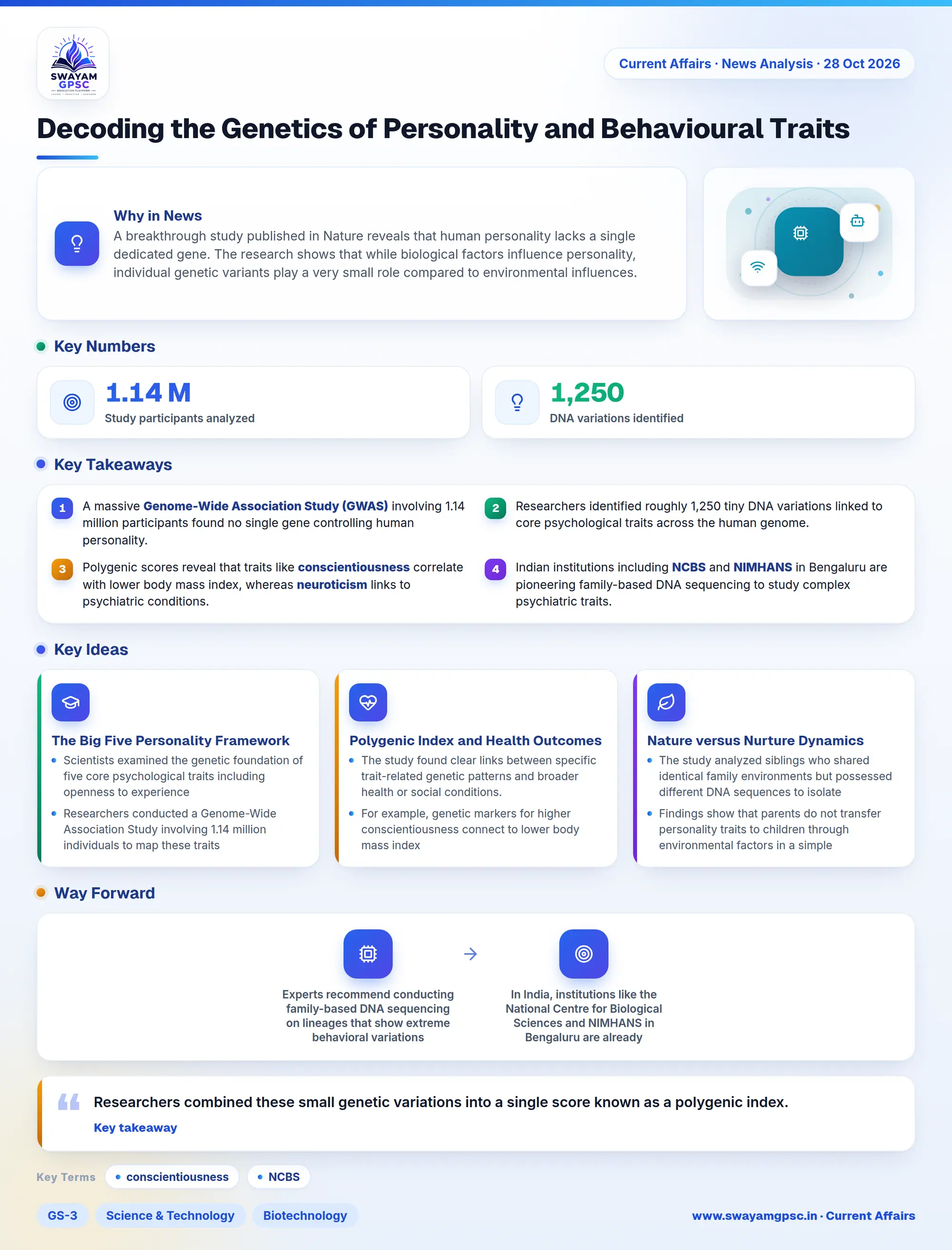
Decoding the Genetics of Personality and Behavioural Traits
#GS-3 #Science & Technology #Biotechnology #Rapid Fire CA #Quick Facts For Prelims
Key takeaways
- A massive Genome-Wide Association Study (GWAS) involving 1.14 million participants found no single gene controlling human personality.
- Researchers identified roughly 1,250 tiny DNA variations linked to core psychological traits across the human genome.
- Polygenic scores reveal that traits like conscientiousness correlate with lower body mass index, whereas neuroticism links to psychiatric conditions.
- Indian institutions including NCBS and NIMHANS in Bengaluru are pioneering family-based DNA sequencing to study complex psychiatric traits.
Why in News
- A breakthrough study published in Nature reveals that human personality lacks a single dedicated gene.
- The research shows that while biological factors influence personality, individual genetic variants play a very small role compared to environmental influences.
The Big Five Personality Framework
- Scientists examined the genetic foundation of five core psychological traits including openness to experience, conscientiousness, extraversion, agreeableness, and neuroticism.
- Researchers conducted a Genome-Wide Association Study involving 1.14 million individuals to map these traits across the human genome.
- The team identified approximately 1,250 tiny DNA variations that connect to different personality characteristics.
- This discovery proves that human behavioral traits form a complex phenotype influenced by scattered genetic patterns rather than a single gene or brain chemical.
Polygenic Index and Health Outcomes
- Researchers combined these small genetic variations into a single score known as a polygenic index.
- The study found clear links between specific trait-related genetic patterns and broader health or social conditions.
- For example, genetic markers for higher conscientiousness connect to lower body mass index, while neuroticism markers link to psychiatric conditions.
Nature versus Nurture Dynamics
- The study analyzed siblings who shared identical family environments but possessed different DNA sequences to isolate pure genetic influence.
- Findings show that parents do not transfer personality traits to children through environmental factors in a simple or direct way.
Macroscopic Application and Study Limitations
- Individual genetic testing offers very low predictive power when trying to foresee a person's specific personality.
- However, aggregate genetic data provides immense scientific value for population-level studies in psychology, biology, and social fields.
- A major drawback of this research stems from existing genomic databases, which overwhelmingly feature individuals of European ancestry.
- This lack of genetic diversity reduces the accuracy of personality predictions for populations with different ancestral backgrounds.
Way Forward
- Experts recommend conducting family-based DNA sequencing on lineages that show extreme behavioral variations to fix data gaps.
- In India, institutions like the National Centre for Biological Sciences and NIMHANS in Bengaluru are already leading family-based genomic research for psychiatric disorders.