Data Centres in India: Infrastructure, Policies, and Growth
#GS-3 #Economy #Infrastructure #Science & Technology #IT & Computers #Achievements of Indians in Science & Technology #Current Events #National
Key takeaways
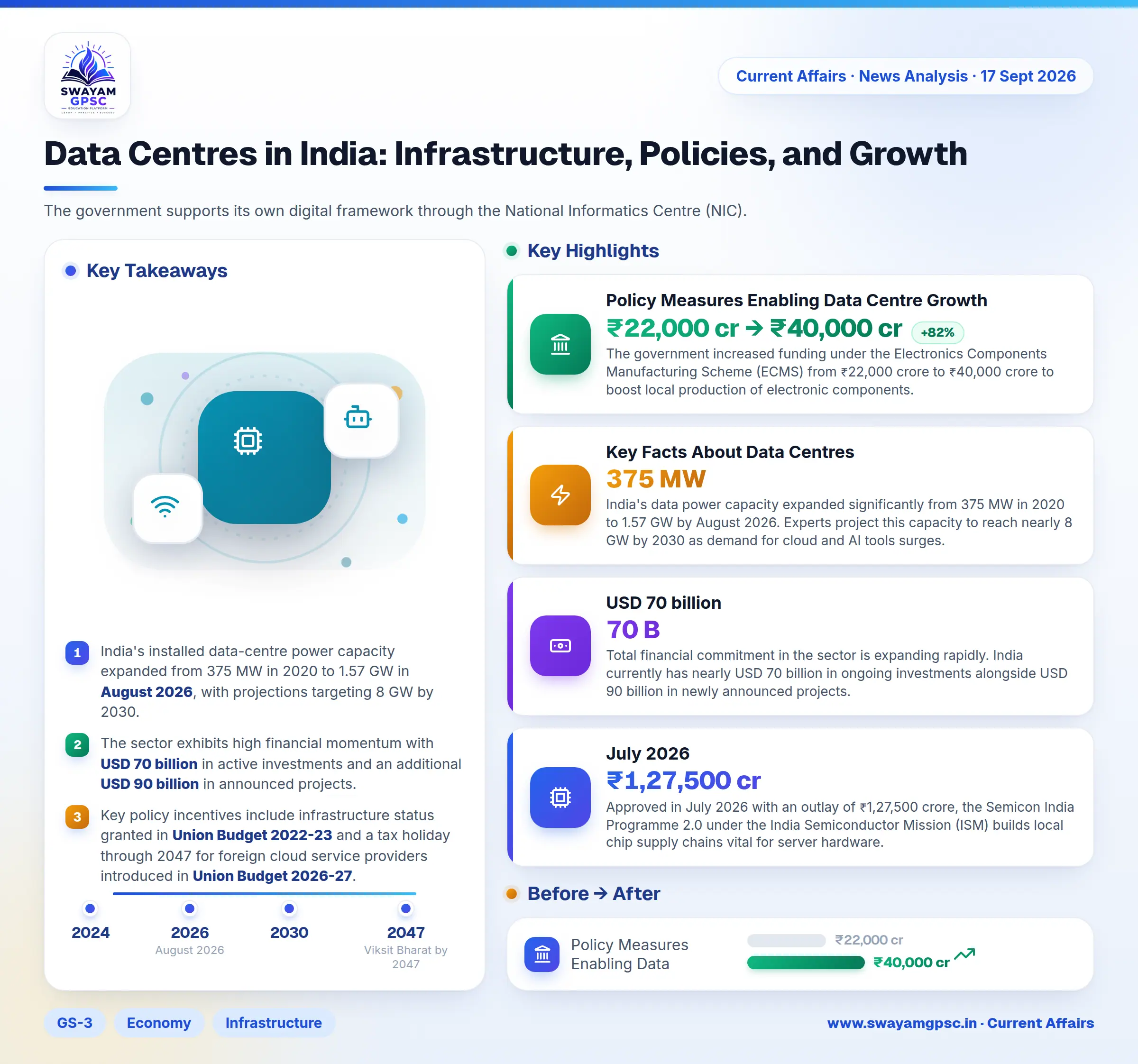
- India's installed data-centre power capacity expanded from 375 MW in 2020 to 1.57 GW in August 2026, with projections targeting 8 GW by 2030.
- The sector exhibits high financial momentum with USD 70 billion in active investments and an additional USD 90 billion in announced projects.
- Key policy incentives include infrastructure status granted in Union Budget 2022-23 and a tax holiday through 2047 for foreign cloud service providers introduced in Union Budget 2026-27.
- Data centre power demand is estimated to reach 17 GW by 2031-32, prompting clean energy transitions via the SHANTI Act and Bureau of Energy Efficiency (BEE) codes.
Why in News
- Data centres are rapidly becoming essential infrastructure for India's growing digital economy. They support everyday digital services, e-Governance programs, cloud computing, and advanced technology operations securely.
- As every economic sector moves toward digital solutions, the demand for fast computing power, massive storage capacity, and reliable connectivity is rising quickly across the country.
Key Facts About Data Centres
- A data centre is a physical facility that houses high-performance computing systems, data storage hardware, and networking gear to process and distribute large volumes of digital information safely.
- These facilities form the backbone of modern digital applications. They power essential activities like online banking, digital government portals, electronic payment systems, cloud platforms, and Artificial Intelligence (AI) tools.
- India's data power capacity expanded significantly from 375 MW in 2020 to 1.57 GW by August 2026. Experts project this capacity to reach nearly 8 GW by 2030 as demand for cloud and AI tools surges.
- Total financial commitment in the sector is expanding rapidly. India currently has nearly USD 70 billion in ongoing investments alongside USD 90 billion in newly announced projects.
- The government supports its own digital framework through the National Informatics Centre (NIC). NIC operates major National Data Centres in Delhi, Pune, Hyderabad, and Bhubaneswar, alongside 37 smaller facilities across state capitals.
Key Technologies Powering Data Centres
- Modern facilities bring together server hardware, high-speed networks, robust power systems, advanced cooling setups, and security controls to maintain continuous service delivery.
- Uninterrupted operations require reliable power round the clock. Facilities use Uninterruptible Power Supplies (UPS) for immediate power backup during flickers, while diesel generators and distribution networks manage long outages.
- Massive computing generates intense heat that can damage equipment. Facilities control temperatures using Heating, Ventilation and Air Conditioning (HVAC) setups, controlled airflow pathways, and liquid cooling systems.
- High-density server hardware executes digital commands, while storage arrays using Hard Disk Drives (HDDs) and Solid-State Drives (SSDs) preserve huge datasets securely.
- Comprehensive security architecture protects physical assets and internal network traffic from unauthorized physical intrusion and sophisticated cyber threats.
- Specialized networking hardware like enterprise routers, fiber-optic lines, and high-speed switches connect internal systems together and link the facility to external internet backbones.
- Automated management software monitors equipment health continuously. Systems use server virtualization to run multiple virtual environments on one physical server, optimizing hardware utilization and workload distribution.
Digital Request Processing Chain
- The process begins when a user launches a mobile application, checks account balances, or requests a digital document, generating a network request aimed at a remote facility.
- Before reaching internal computing units, the incoming signal passes through strict security layers that block cyber threats and prevent unauthorized network access.
- Intelligent load balancers analyze traffic and direct incoming tasks evenly across available servers. This step avoids system congestion and maintains fast response times.
- Application servers calculate the necessary logic for the request. They often communicate with other software components using an Application Programming Interface (API) to complete complex tasks.
- Dedicated database servers fetch the specific stored files or records needed for the user request and pass the information back to application servers.
- Once processing finishes, the system sends the formatted response back across high-speed networks directly to the user's personal device screen.
- This standard request workflow moves smoothly through seven structured phases: Connect, Receive, Network, Process, Store, Secure, and Respond.
Policy Measures Enabling Data Centre Growth
- In Union Budget 2022-23, the central government added data centres to the official Harmonized List of Infrastructure.
- Obtaining official infrastructure status allows data centre operators to secure long-term, low-cost commercial loans on par with major sectors like highways and airports.
- To attract foreign investment, Union Budget 2026-27 announced a long-term tax holiday running from Tax Year 2026-27 through 2046-47 for notified foreign cloud providers using domestic infrastructure.
- Approved in July 2026 with an outlay of ₹1,27,500 crore, the Semicon India Programme 2.0 under the India Semiconductor Mission (ISM) builds local chip supply chains vital for server hardware.
- The government launched the IndiaAI Mission with a dedicated budget of ₹10,371.92 crore to develop domestic AI infrastructure, which directly drives high-performance computing demand.
- The government increased funding under the Electronics Components Manufacturing Scheme (ECMS) from ₹22,000 crore to ₹40,000 crore to boost local production of electronic components.
- The PLI Scheme 2.0 for IT Hardware offers financial incentives for domestic manufacturing of servers, aiming to reduce import dependency and strengthen local technology manufacturing.
Strategies Supporting Sustainable Growth
- Data centre expansion places high demands on power grids and water supplies. Estimates from the Central Electricity Authority (CEA) indicate power demand from this sector could reach 17 GW by 2031-32.
- The government encourages operators to adopt green power through targeted frameworks such as the Green Energy Open Access Rules, the Green Energy Corridor Scheme, and the National Green Hydrogen Mission.
- Clean power integration is further supported by the National Programme on High Efficiency Solar PV Modules and the long-standing Solar Park Scheme.
- Parliament introduced the Sustainable Harnessing and Advancement of Nuclear Energy for Transforming India (SHANTI) Act to supply baseline nuclear energy to tech sectors and foster deployment of Small Modular Reactors (SMRs).
- Technical committee LITD 31 under the Bureau of Indian Standards (BIS) creates technical efficiency benchmarks specifically tailored for cloud platforms and data infrastructure.
- The Bureau of Energy Efficiency (BEE) enforces updated building standards through the Energy Conservation Building Code (ECBC), 2017 and the Energy Conservation and Sustainable Building Code (ECSBC), 2024.
- Facility operators are adopting cutting-edge thermal management methods, including direct-to-chip liquid cooling, adiabatic systems, and immersion cooling, to lower power and water usage.
- Water usage in cooling towers remains closely monitored, with groundwater abstraction regulated strictly under national guidelines from the Ministry of Jal Shakti.
Conclusion
- Data infrastructure serves as the fundamental engine behind India's digital transformation, empowering public governance, financial technology, and technological self-reliance.
- By aligning renewable energy usage with strategic industrial policies, India can establish a secure, sovereign, and sustainable digital infrastructure system to fulfill the vision of Viksit Bharat by 2047.