Critical Minerals and India's Strategic Power
#GS-3 #Economy #Infrastructure #Science & Technology #Environment #Climate Change #National #Critical Minerals
Key takeaways
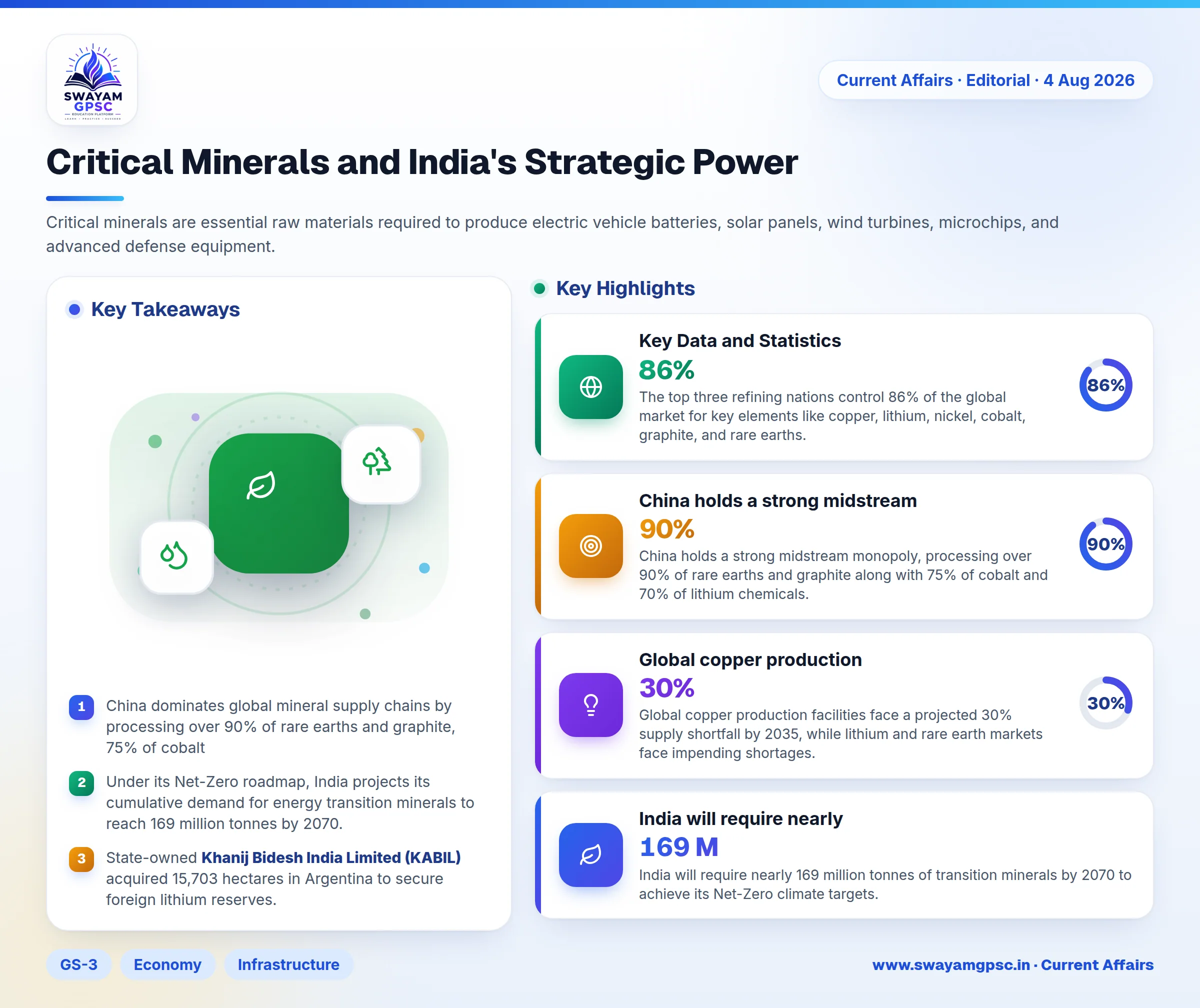
- China dominates global mineral supply chains by processing over 90% of rare earths and graphite, 75% of cobalt, and 70% of lithium chemicals.
- Under its Net-Zero roadmap, India projects its cumulative demand for energy transition minerals to reach 169 million tonnes by 2070.
- State-owned Khanij Bidesh India Limited (KABIL) acquired 15,703 hectares in Argentina to secure foreign lithium reserves.
- The government launched a Rs 1,500 crore incentive scheme for mineral recycling and authorized direct auctions for 24 critical mineral blocks under the amended MMDR Act.
Why in News
- Recent policy studies show that critical minerals now drive national defense, industrial growth, and clean energy plans across the world.
What Are Critical Minerals?
- Critical minerals are essential raw materials required to produce electric vehicle batteries, solar panels, wind turbines, microchips, and advanced defense equipment.
- A few nations control the mining and processing of these elements, making mineral access a key driver of geopolitical power and economic self-reliance.
Key Data and Statistics
- The top three refining nations control 86% of the global market for key elements like copper, lithium, nickel, cobalt, graphite, and rare earths.
- China holds a strong midstream monopoly, processing over 90% of rare earths and graphite along with 75% of cobalt and 70% of lithium chemicals.
- Global copper production facilities face a projected 30% supply shortfall by 2035, while lithium and rare earth markets face impending shortages.
- India will require nearly 169 million tonnes of transition minerals by 2070 to achieve its Net-Zero climate targets.
Need for Critical Minerals Security for India
- India needs a steady mineral supply to manufacture solar panels, wind turbines, grid storage systems, and electric vehicle batteries for its 2070 climate goals.
- Domestic high-tech factories require these minerals as core inputs for microchips, advanced displays, consumer devices, and 5G telecom gear.
- Defense manufacturers rely on specialized mineral alloys and permanent magnets to build radar networks, missile guidance systems, military aircraft, and satellites.
- Building strong supply lines protects the Indian economy against foreign export bans, such as China restricting its graphite and rare earth sales.
- Establishing local refining capacity helps India capture industrial value domestically instead of depending heavily on foreign mineral imports.
Structural Constraints and Challenges
- India holds unrefined reserves of copper, graphite, and monazite, but it lacks the chemical processing plants and smelters required for high-purity refining.
- Mining firms in India focus mostly on shallow surface exploration due to long environmental approval delays and low private investment.
- Local battery cell production remains heavily reliant on imported primary lithium, cobalt, and nickel.
- Electronic waste and battery recycling systems remain weak because collection channels are fragmented and recycling technologies are still evolving.
- Mining projects in remote or ecologically delicate areas face steep logistics costs and poor transport infrastructure.
Policy Initiatives Taken So Far
- The government created the National Critical Mineral Mission (NCMM) to run 1,200 exploration projects by 2030-31 while supporting recycling and overseas mining.
- State-owned firm Khanij Bidesh India Limited (KABIL) secured 15,703 hectares of land in Argentina to explore and develop lithium reserves.
- Parliament updated the Mines and Minerals (Development and Regulation) Act to allow the Central Government to auction 24 critical mineral blocks directly.
- Officials approved a Rs 1,500 crore incentive plan for mineral recycling and proposed dedicated Rare Earth Corridors across four coastal states.
- India joined the Quad Critical Minerals Initiative and signed the India-U.S. Strategic Critical Minerals Cooperation Framework in May 2026 to secure foreign supply lines.
Way Forward
- The government should give midstream mineral refining infrastructure status and launch Production Linked Incentive schemes to build local smelting facilities.
- India must create national strategic mineral stockpiles of refined lithium and rare earth oxides to shield local industries from global supply shocks.
- Geologists should release high-resolution surveys, simplify clearances, and offer financial support to reduce investment risks for private mining companies.
- Authorities must strictly enforce Extended Producer Responsibility rules under the Battery Waste Management Rules to feed electronic waste into recycling plants.
- Diplomatic teams should expand partnerships through platforms like FORGE and Pax Silica to acquire advanced processing technologies from allied nations.
Conclusion
- Access to critical minerals now decides a nation's military strength, industrial competitiveness, and clean energy progress.
- India must expand its domestic refining capabilities rapidly to turn raw reserves and foreign alliances into long-term technological independence.