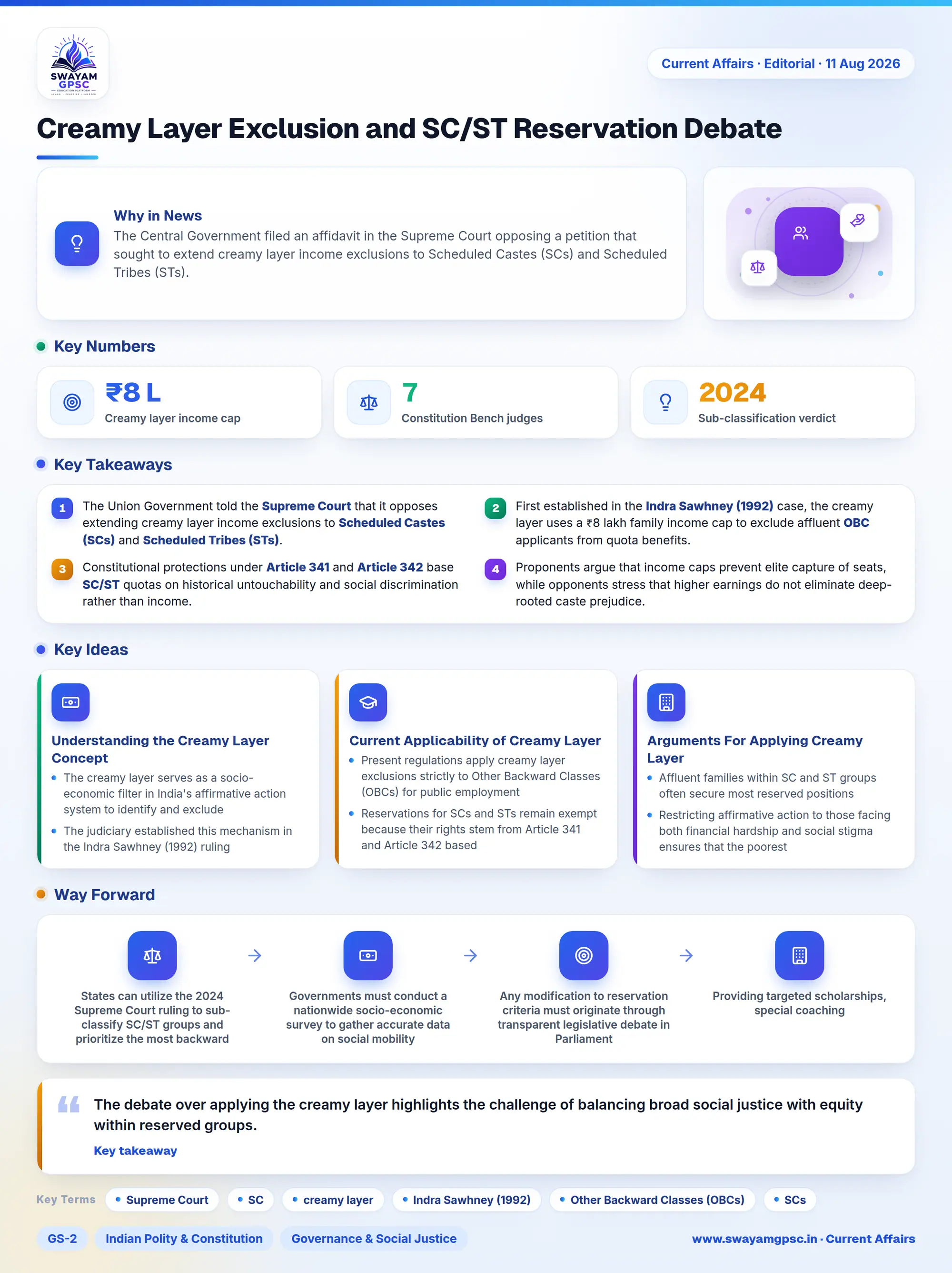
Creamy Layer Exclusion and SC/ST Reservation Debate
#GS-2 #Indian Polity & Constitution #Governance & Social Justice #Constitution #Social Justice #Vulnerable Sections
Key takeaways
- The Union Government told the Supreme Court that it opposes extending creamy layer income exclusions to Scheduled Castes (SCs) and Scheduled Tribes (STs).
- First established in the Indra Sawhney (1992) case, the creamy layer uses a ₹8 lakh family income cap to exclude affluent OBC applicants from quota benefits.
- Constitutional protections under Article 341 and Article 342 base SC/ST quotas on historical untouchability and social discrimination rather than income.
- Proponents argue that income caps prevent elite capture of seats, while opponents stress that higher earnings do not eliminate deep-rooted caste prejudice.
Why in News
- The Central Government filed an affidavit in the Supreme Court opposing a petition that sought to extend creamy layer income exclusions to Scheduled Castes (SCs) and Scheduled Tribes (STs).
- This response reaffirms the government's stance that income-based filters should not apply to constitutional quotas designed for SC and ST communities.
Understanding the Creamy Layer Concept
- The creamy layer serves as a socio-economic filter in India's affirmative action system to identify and exclude wealthy individuals within a reserved category.
- The judiciary established this mechanism in the Indra Sawhney (1992) ruling, setting benchmark limits like a ₹8 lakh annual family income threshold to direct benefits to poorer citizens.
Current Applicability of Creamy Layer Rules
- Present regulations apply creamy layer exclusions strictly to Other Backward Classes (OBCs) for public employment and educational admissions.
- Reservations for SCs and STs remain exempt because their rights stem from Article 341 and Article 342 based on historical social backwardness and untouchability.
- Judicial precedents in Indra Sawhney (1992) and Ashoka Kumar Thakur (2008) explicitly affirmed that the creamy layer doctrine does not apply to SCs or STs.
- A 7-judge Constitution Bench in 2024 allowed state-level sub-classification within SCs and STs, during which four judges individually supported extending creamy layer principles.
Arguments For Applying Creamy Layer to SCs and STs
- Affluent families within SC and ST groups often secure most reserved positions, leaving poorer rural candidates with fewer opportunities.
- Restricting affirmative action to those facing both financial hardship and social stigma ensures that the poorest individuals receive priority.
- Multiple Supreme Court judges in the 2024 verdict noted that families achieving social mobility should step aside for less fortunate community members.
- Economic mobility provides families with educational capital, which reduces their vulnerability to systemic social barriers.
- Introducing an income threshold prevents families from relying perpetually on reservations across generations, similar to OBC and EWS frameworks.
Arguments Against Applying Creamy Layer to SCs and STs
- Quotas for SCs address historical untouchability, while ST quotas target geographical isolation, meaning neither criteria depends on income.
- Higher family income does not shield individuals from caste prejudice in housing, marriage markets, or administrative workplace environments.
- Under Article 341 and Article 342, Parliament alone holds the legal authority to alter Presidential lists, meaning courts cannot modify them directly.
- Enforcing income caps could lead to unfilled seats in higher-level government positions and academic posts due to a shortage of eligible applicants.
- Targeted developmental welfare schemes already use income criteria, making financial filters inside constitutional quotas redundant.
Way Forward
- States can utilize the 2024 Supreme Court ruling to sub-classify SC/ST groups and prioritize the most backward communities without blanket income bans.
- Governments must conduct a nationwide socio-economic survey to gather accurate data on social mobility before introducing major quota policy changes.
- Any modification to reservation criteria must originate through transparent legislative debate in Parliament rather than court mandates.
- Providing targeted scholarships, special coaching, and better infrastructure will help first-generation learners compete effectively for reserved seats.
- Authorities must strictly enforce constitutional safeguards to eliminate social prejudice and workplace bias against marginalized groups.
Conclusion
- The debate over applying the creamy layer highlights the challenge of balancing broad social justice with equity within reserved groups.
- While advocates aim to prevent elite capture, the government maintains that caste-based exclusion cannot be solved by looking at income alone.
- Ensuring true representation while protecting constitutional dignity requires reliable empirical data, legislative consensus, and targeted support for disadvantaged communities.