Constitutional Imperative of Marital Autonomy and Legal Reforms
#GS-1 #Indian Society #Vulnerable Sections #GS-2 #Indian Polity & Constitution #Constitution #Judiciary #Good Governance #Social Justice #Economy #Current Events #National
Key takeaways
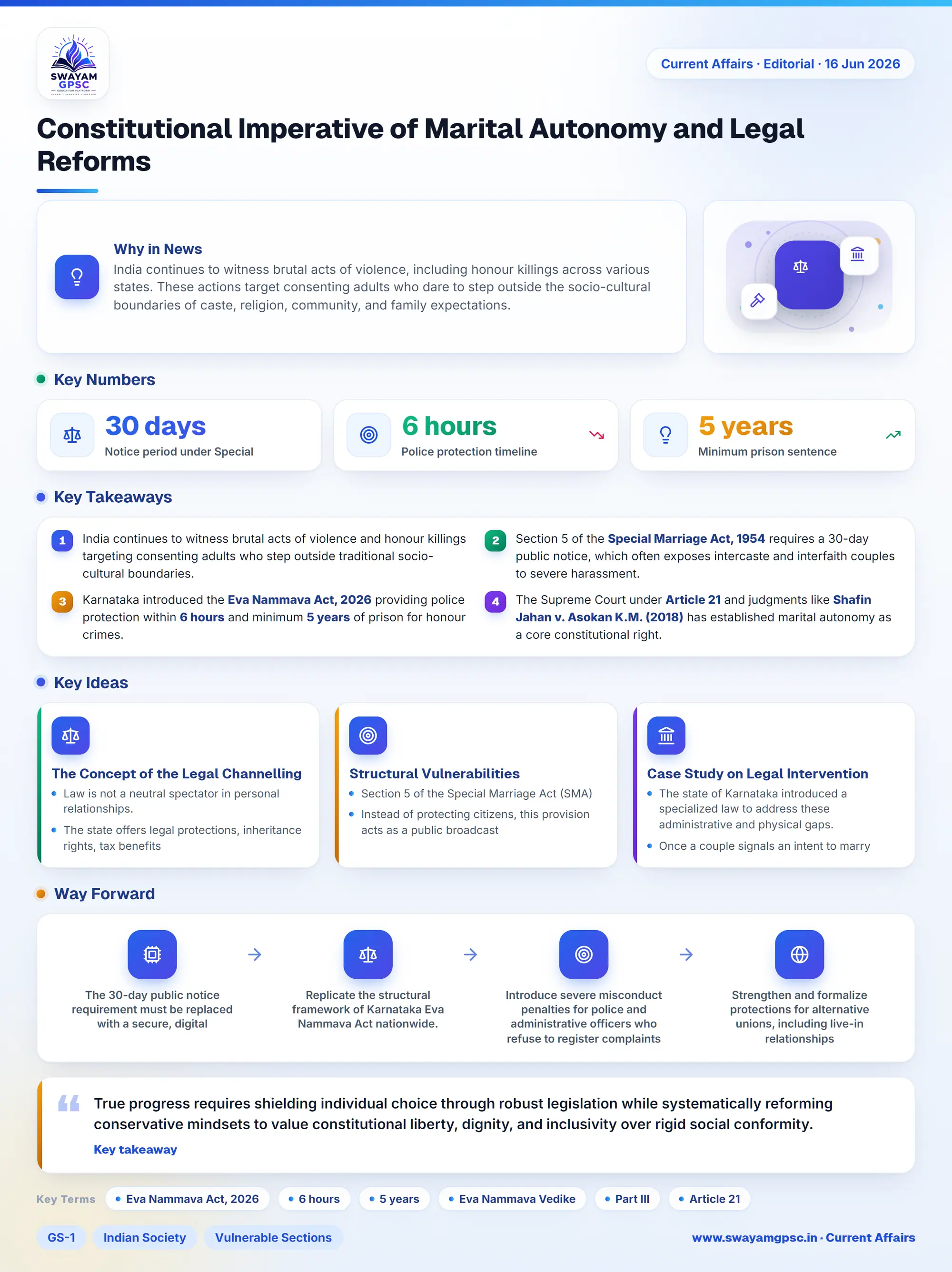
- India continues to witness brutal acts of violence and honour killings targeting consenting adults who step outside traditional socio-cultural boundaries.
- Section 5 of the Special Marriage Act, 1954 requires a 30-day public notice, which often exposes intercaste and interfaith couples to severe harassment.
- Karnataka introduced the Eva Nammava Act, 2026 providing police protection within 6 hours and minimum 5 years of prison for honour crimes.
- The Supreme Court under Article 21 and judgments like Shafin Jahan v. Asokan K.M. (2018) has established marital autonomy as a core constitutional right.
Why in News
- India continues to witness brutal acts of violence, including honour killings across various states.
- These actions target consenting adults who dare to step outside the socio-cultural boundaries of caste, religion, community, and family expectations.
- This crisis highlights a deep tension between traditional, community-enforced rules and the individual freedoms promised by the Indian Constitution.
The Concept of the Legal Channelling Effect
- Law is not a neutral spectator in personal relationships. It exercises a channelling effect by actively steering individuals toward socially preferred types of unions.
- The state offers legal protections, inheritance rights, tax benefits, and medical decision-making powers primarily to married couples, leaving live-in partnerships or alternative adult unions vulnerable.
- In India, this channelling effect doesn't just promote marriage, it reinforces endogamy.
- The legal and administrative machinery makes homogeneous marriages seamless while penalizing unions that challenge traditional structures.
Structural Vulnerabilities of the Special Marriage Act
- Section 5 of the Special Marriage Act (SMA), 1954 requires couples to give a 30-day public notice of their intent to marry. These details are displayed openly outside the Marriage Officer registrar premises.
- Instead of protecting citizens, this provision acts as a public broadcast, exposing intercaste and interfaith couples to surveillance by vigilante groups, family members, and community actors.
- A progressive statute designed to bypass religious personal laws effectively acts as a tool for conservative forces to track down, threaten, and separate couples before their marriage is solemnized.
Case Study on Legal Intervention
- The state of Karnataka introduced a specialized law to address these administrative and physical gaps. Named after the inclusive philosophy of 12th-century social reformer Basavanna, the Eva Nammava Act, 2026 creates a robust institutional shield.
- Once a couple signals an intent to marry, the District Magistrate must direct local police to extend physical protection within 6 hours.
- The law blocks retaliatory criminal or civil complaints filed by angry family members or community leaders against the couple.
- The statute sets a minimum of 5 years of prison for honour-based crimes, while criminalizing community tactics like social boycotts, excommunication, and economic blockades.
- It sets up an Eva Nammava Vedike in each district, alongside state-funded safe houses, providing a physical, economic, and psychological bridge to safety.
Constitutional Foundations of Marital Choice
- The judiciary has systematically established that an individual right to choose their life partner is non-negotiable under Part III of the Constitution.
- Under Article 21, the Supreme Court views personal autonomy, dignity, privacy, and choice as core elements of a meaningful life.
- In Shafin Jahan v. Asokan K.M. (2018), the Apex Court held that the right to marry a person of one choice is intrinsic to individual liberty.
- In Shakti Vahini v. Union of India (2018), the court ruled that Khap Panchayats or families have absolutely zero authority to scuttle or attack an adult couple choice.
Way Forward
- The 30-day public notice requirement must be replaced with a secure, digital, and completely private verification process to prevent vigilante groups from accessing personal information.
- Replicate the structural framework of Karnataka Eva Nammava Act nationwide. Every district should feature specialized fast-track courts, independent help forums, and protected safe houses.
- Introduce severe misconduct penalties for police and administrative officers who refuse to register complaints, act as passive onlookers, or cooperate with aggressive family members.
- Strengthen and formalize protections for alternative unions, including live-in relationships, to reduce absolute legal dependence on traditional marriage structures.
Conclusion
- True progress requires shielding individual choice through robust legislation while systematically reforming conservative mindsets to value constitutional liberty, dignity, and inclusivity over rigid social conformity.