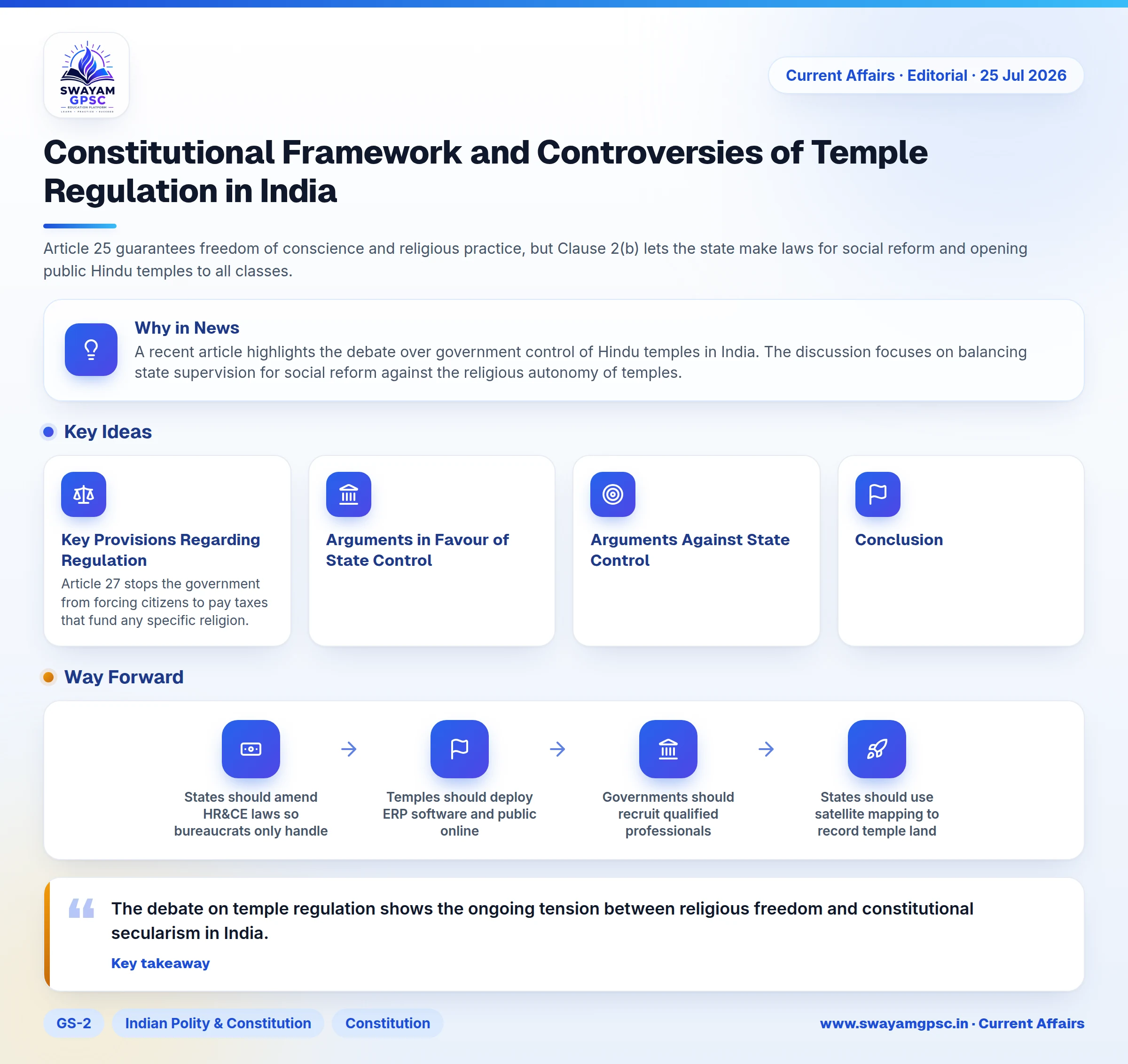
Constitutional Framework and Controversies of Temple Regulation in India
#GS-2 #Indian Polity & Constitution #Constitution #Governance & Social Justice #Regulatory Bodies #Indian Society #Social Justice #Current Events #National #Secularism #Temple Management
Why in News
- A recent article highlights the debate over government control of Hindu temples in India.
- The discussion focuses on balancing state supervision for social reform against the religious autonomy of temples.
- Experts argue that while government control prevents financial misuse, excessive bureaucratic interference hurts temple management.
Key Provisions Regarding Regulation of Temples in India
- Article 25 guarantees freedom of conscience and religious practice, but Clause 2(b) lets the state make laws for social reform and opening public Hindu temples to all classes.
- Article 26 gives religious groups the fundamental right to establish institutions, manage religious affairs, and acquire property according to law.
- Article 27 stops the government from forcing citizens to pay taxes that fund any specific religion.
- Entry 28 of the Concurrent List in the Seventh Schedule empowers state legislatures to pass laws for managing public religious institutions.
- States have enacted specific laws like the Tamil Nadu Hindu Religious and Charitable Endowments Act, 1959 and the Karnataka Hindu Religious Institutions and Charitable Endowments Act, 1997.
- These state laws establish Departments of Endowments led by a Commissioner to appoint Executive Officers, form boards, and audit temple funds.
- In the Shirur Mutt Case, 1954, the Supreme Court introduced the essential religious practices doctrine to separate secular administration from core religious rituals.
- In the Pannalal Bansilal Pitti vs. State of Andhra Pradesh, 1996 case, the court upheld ending hereditary trusteeship because managing property is a secular task.
- In the Stanislaus vs. State of Madhya Pradesh, 1977 case, the Supreme Court ruled that the right to propagate religion under Article 25(1) excludes forced conversions.
- Many public petitions in the Supreme Court challenge state control laws under Article 14, Article 19, Article 25, and Article 26 for violating fundamental rights.
Arguments in Favour of State Control
- Unlike Western secularism that maintains a strict separation between church and state, Indian secularism allows government action for social reform.
- Dr. B.R. Ambedkar warned the Constituent Assembly that unlimited religious protection would block social reform and endanger civil rights.
- State oversight acts as a historical tool to stop caste discrimination by guaranteeing temple entry for marginalized communities.
- Article 25(2)(a) and Article 25(2)(b) clearly give the state power to regulate financial and economic activities linked to religious practices.
- The Supreme Court consistently supports constitutional morality over claims of group autonomy that enforce entry restrictions.
- State oversight helps prevent the theft, misuse, and bad management of vast temple wealth and public trust property.
Arguments Against State Control
- Heavy government oversight turns bureaucrats into managers of holy shrines even though they lack theological training.
- Comprehensive state management laws violate Article 26, which guarantees religious groups the right to manage their own spiritual affairs.
- State-appointed boards face criticism for taking temple income and land revenue to pay general state administrative costs.
- Bureaucracy and corruption often lead to the neglect and loss of priceless idols, ancient architecture, and temple property.
- Using money from wealthy temples to support poor ones goes against the original donor's intent to serve a specific deity.
- The government regulates Hindu temples heavily while minority institutions enjoy full autonomous governance under Article 30.
Way Forward
- States should amend HR&CE laws so bureaucrats only handle financial audits while religious boards manage daily rituals and traditional festivals.
- Temples should deploy ERP software and public online dashboards to display daily donations, expenditures, and land leases transparently.
- Governments should recruit qualified professionals, such as chartered accountants and structural engineers, onto temple management boards using merit-based criteria.
- States should use satellite mapping to record temple land and set up police heritage cells to stop illegal land encroachments.
- Independent panels should grant administrative control back to verified community trusts if a temple maintains clean financial audits for consecutive years.
- State governments should fund small rural temples directly from state budgets instead of taking money from major pilgrimage centers.
Conclusion
- The debate on temple regulation shows the ongoing tension between religious freedom and constitutional secularism in India.
- Achieving a fair solution requires transparent financial audits, professional management, and protecting core religious traditions.