The Conservation Journey and Future Challenges of the Asiatic Lion
#GS-3 #Environment #Biodiversity #Wildlife #Gujarat #Current Events
Key takeaways
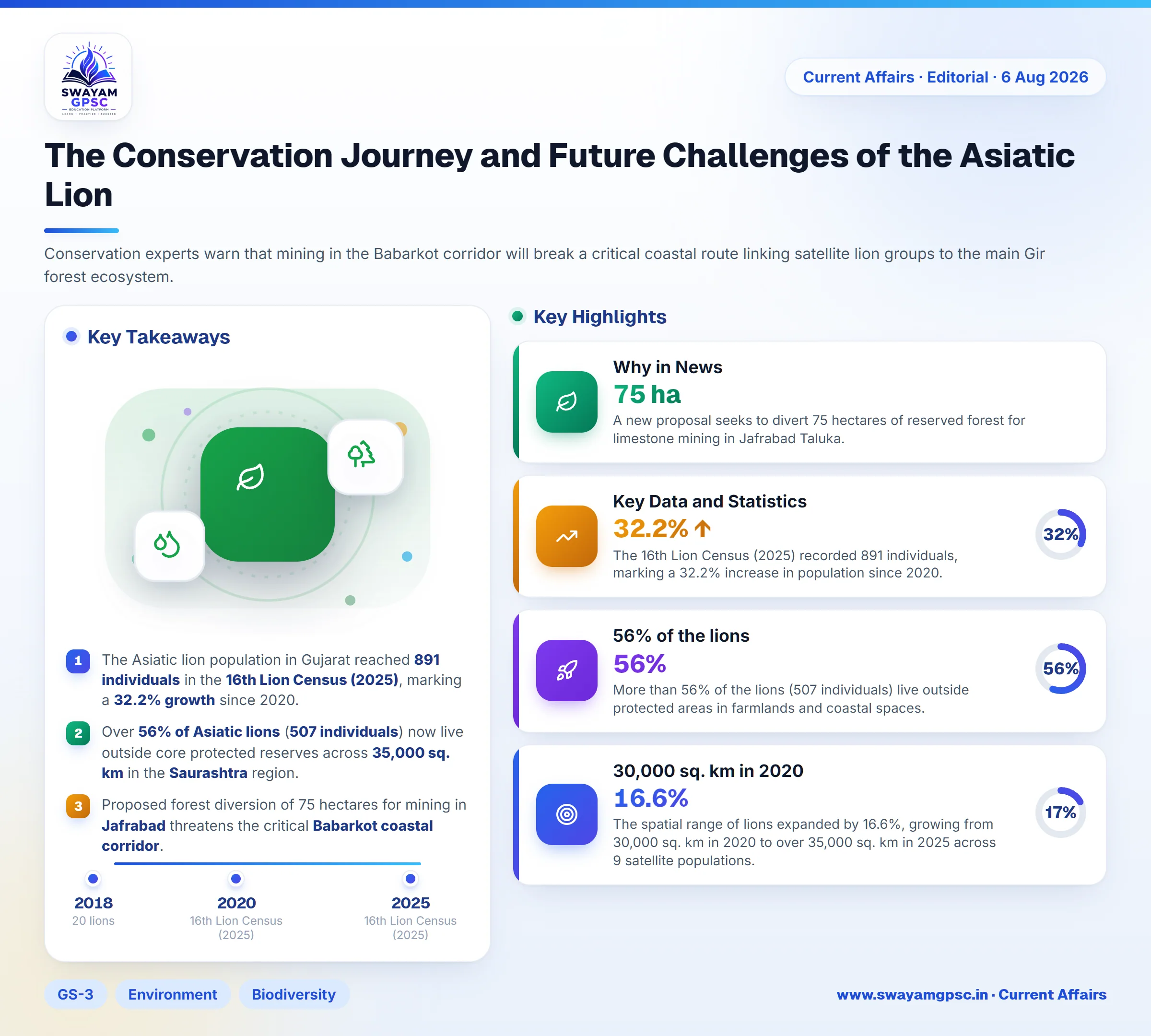
- The Asiatic lion population in Gujarat reached 891 individuals in the 16th Lion Census (2025), marking a 32.2% growth since 2020.
- Over 56% of Asiatic lions (507 individuals) now live outside core protected reserves across 35,000 sq. km in the Saurashtra region.
- Proposed forest diversion of 75 hectares for mining in Jafrabad threatens the critical Babarkot coastal corridor.
- The single-location distribution leaves lions vulnerable to epidemics like the 2018 Canine Distemper Virus, highlighting the urgent need for secondary habitats like Barda Wildlife Sanctuary and Kuno National Park.
Why in News
- A new proposal seeks to divert 75 hectares of reserved forest for limestone mining in Jafrabad Taluka.
- Conservation experts warn that mining in the Babarkot corridor will break a critical coastal route linking satellite lion groups to the main Gir forest ecosystem.
About the Asiatic Lion Recovery
- The population of the Asiatic lion (Panthera leo persica) grew from nearly 100 to 150 individuals in the 1960s to more than 800 lions today.
- All wild Asiatic lions currently live inside the Saurashtra region of Gujarat. Protecting safe movement corridors outside sanctuaries remains essential for their survival.
Key Data and Statistics
- The 16th Lion Census (2025) recorded 891 individuals, marking a 32.2% increase in population since 2020.
- More than 56% of the lions (507 individuals) live outside protected areas in farmlands and coastal spaces.
- The spatial range of lions expanded by 16.6%, growing from 30,000 sq. km in 2020 to over 35,000 sq. km in 2025 across 9 satellite populations.
- The IUCN Red List updated the Asiatic lion status from Critically Endangered to Endangered, recognizing it as the world's only stable wild subpopulation.
Historical Journey of Lion Conservation
- The Nawab of Junagadh banned lion hunting in the early 20th century when numbers dropped below 20 to 50 individuals. This royal protection saved the last breeding lions in the Gir forests.
- The government notified the Gir Wildlife Sanctuary in 1965 to create a protected core habitat. Official boundaries expanded over subsequent decades to reduce human pressure.
- Conservation management shifted focus from isolated parks to the larger Greater Gir landscape, including riverbeds, grasslands, and crop fields. Authorities officially recognized coastal regions like Babarkot and Jafrabad as movement corridors.
- Local communities played a key role through peaceful coexistence. Maldhari pastoralists and local farmers allow lions to move across their private crop fields and orchards without retaliation.
Key Conservation Initiatives
- The government launched Project Lion to improve habitat safety, increase prey availability, track lion movements, and manage satellite populations.
- Authorities developed the Barda Wildlife Sanctuary as a dedicated secondary habitat to encourage natural dispersal and establish a safe backup population.
- Officials set up a Hi-Tech Monitoring Unit at Sasan-Gir using satellite telemetry and GPS collars. They also opened the National Wildlife Referral Centre in Junagadh for specialized healthcare.
- The department recruited local residents as Vanya Prani Mitras and trained trackers to monitor lions continuously and resolve human-wildlife conflicts.
Challenges
- Keeping the entire wild population in one continuous region makes lions vulnerable to fatal disease outbreaks. For instance, the 2018 Canine Distemper Virus (CDV) outbreak killed over 20 lions, followed by recurring babesiosis infections.
- Diverting forest land for industrial activity breaks important migration paths. The proposed 75-hectare limestone mine in Jafrabad threatens to isolate the Babarkot coastal population.
- Human infrastructure creates physical hazards for dispersing lions. Many lions suffer accidental deaths by falling into open farm wells, colliding with trains, or hitting spiked city gates.
- Political delays have stalled plans to create an independent second habitat outside Gujarat. Translocating lions to Kuno National Park in Madhya Pradesh remains pending despite Supreme Court directions.
Way Forward
- Authorities should notify crucial movement corridors like Babarkot as eco-sensitive zones to prevent harmful mining and land diversion.
- The government must speed up the creation of secondary habitats in Barda WLS and Kuno National Park to protect the species against viral epidemics.
- Health agencies need to expand regular disease monitoring, vaccinate domestic dogs in nearby villages, and provide rapid veterinary treatment.
- Local authorities must build protective walls around open farm wells, install safety fences along railway tracks, and provide fast compensation for livestock losses.
Conclusion
- Dedicated protection over six decades restored Asiatic lion numbers from near extinction to almost 900 individuals.
- Long-term survival now depends on protecting dispersal corridors from industrial expansion, establishing secondary habitats, and maintaining vigilant disease monitoring.