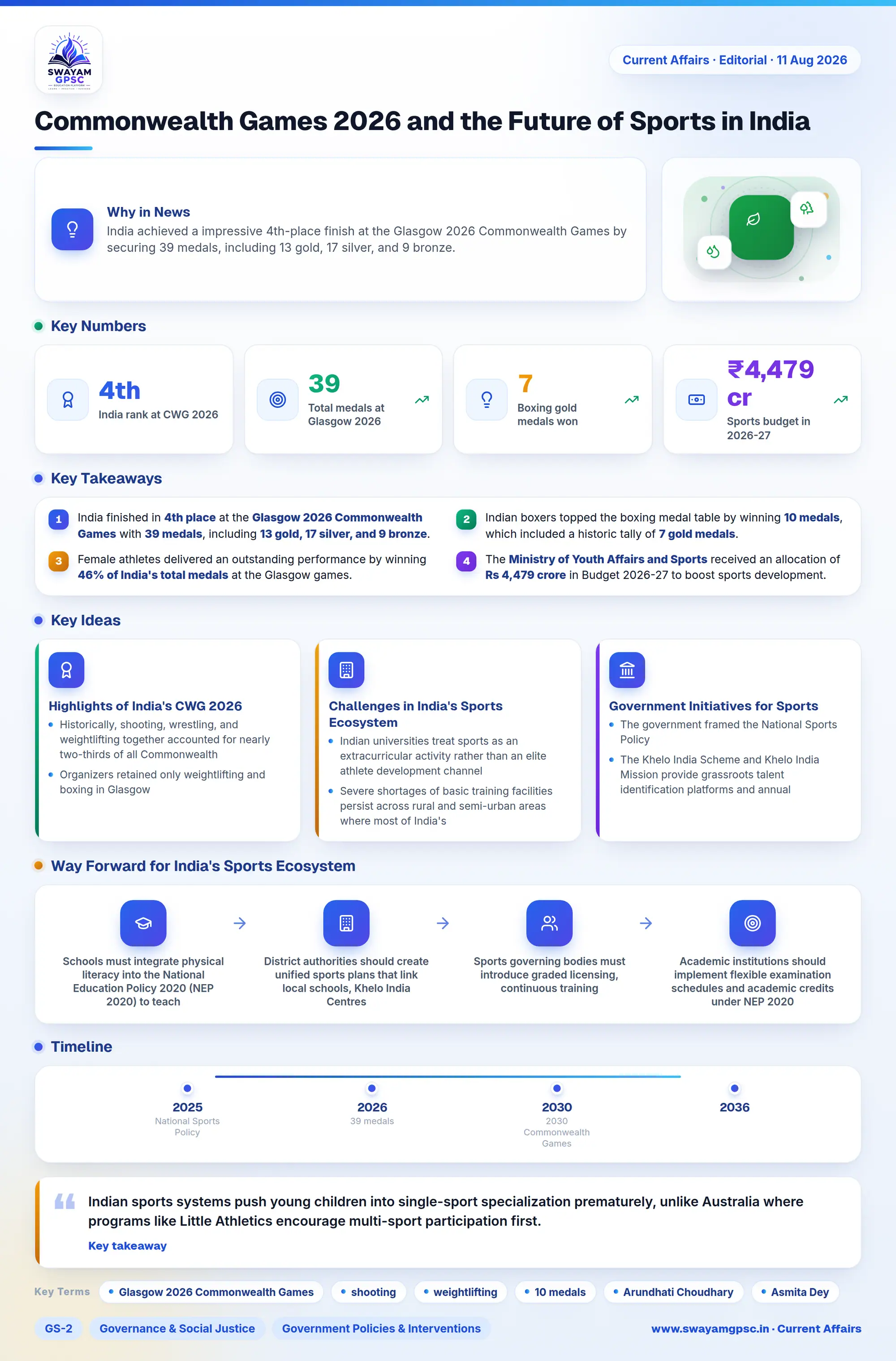
Commonwealth Games 2026 and the Future of Sports in India
#GS-2 #Governance & Social Justice #Government Policies & Interventions #Current Events #National #Sports Ecosystem #Commonwealth Games 2026 #Khelo India
Key takeaways
- India finished in 4th place at the Glasgow 2026 Commonwealth Games with 39 medals, including 13 gold, 17 silver, and 9 bronze.
- Indian boxers topped the boxing medal table by winning 10 medals, which included a historic tally of 7 gold medals.
- Female athletes delivered an outstanding performance by winning 46% of India's total medals at the Glasgow games.
- The Ministry of Youth Affairs and Sports received an allocation of Rs 4,479 crore in Budget 2026-27 to boost sports development.
- Implementation of the National Sports Policy, 2025 aims to prepare India to bid for and host the 2036 Olympic Games.
Why in News
- India achieved a impressive 4th-place finish at the Glasgow 2026 Commonwealth Games by securing 39 medals, including 13 gold, 17 silver, and 9 bronze.
- This performance proved remarkable because event organizers excluded several traditional medal-winning disciplines like shooting, wrestling, badminton, table tennis, and hockey.
Highlights of India's CWG 2026 Performance
- Historically, shooting, wrestling, and weightlifting together accounted for nearly two-thirds of all Commonwealth Games medals won by India.
- Organizers retained only weightlifting and boxing in Glasgow, making India's fourth-place rank far more valuable than raw medal comparisons suggest.
- Indian boxers created history by winning 10 medals, which included an unprecedented 7 gold medals.
- India topped the boxing medal table for the first time and set a record for the highest boxing gold tally by any nation in a single Commonwealth Games.
- Boxer Arundhati Choudhary, a three-time Khelo India gold medalist, won the women's 70-kg Commonwealth title.
- In judo, Asmita Dey became India's first Commonwealth Games champion, while Harsh Singh secured a second gold medal.
- Distance runner Gulveer Singh became the first Indian track-and-field athlete to win 2 individual medals at a single Commonwealth Games.
- Decathlete Tejaswin Shankar earned India's first Commonwealth Games medal in the decathlon event.
- Female athletes contributed 46% of India's Glasgow medal tally, showing massive growth since Ami Ghia and Kanwal Thakar Singh won India's first women's medal in 1978.
- Para-athletes won 7 medals across 6 integrated para-sports, building on India's record 29 medals at the Paris Paralympics 2024.
- More than 63,000 athletes have participated in Khelo India Games since 2018, proving that domestic platforms now connect directly to international podiums.
Challenges in India's Sports Ecosystem
- Indian sports systems push young children into single-sport specialization prematurely, unlike Australia where programs like Little Athletics encourage multi-sport participation first.
- Indian universities treat sports as an extracurricular activity rather than an elite athlete development channel, unlike higher education systems in Western nations.
- Severe shortages of basic training facilities persist across rural and semi-urban areas where most of India's population lives.
- Elite schemes like the Target Olympic Podium Scheme (TOPS) concentrate funds heavily on established champions, creating support gaps at the grassroots level.
- Union Budget 2026-27 allocated Rs 4,479 crore to the Ministry of Youth Affairs and Sports, which remains low given India's large population and global sporting goals.
- The commercial dominance of cricket absorbs corporate sponsorships and media attention, leaving Olympic disciplines like swimming, rowing, and gymnastics underfunded.
- Many non-cricket athletes face severe financial instability, such as 2018 Asian Games bronze medalist Harish Kumar who had to run a tea stall for livelihood.
- Societal pressures force students to choose academics over athletics early due to a lack of career security for retired sports professionals.
- National Sports Federations struggle with administrative inefficiencies, political interference, and delayed funding approvals.
- Most state-run sports academies lack full-time sports scientists, physiotherapists, and data analysts compared to modern facilities like the Inspire Institute of Sport (IIS).
Government Initiatives for Sports Development
- The government framed the National Sports Policy, 2025 to establish a structured long-term roadmap for international sporting excellence.
- The Khelo India Scheme and Khelo India Mission provide grassroots talent identification platforms and annual competitive tournaments across India.
- The Target Olympic Podium Scheme (TOPS) delivers customized training, equipment, and financial support directly to elite Olympic medal prospects.
- Parliament passed the National Sports Governance Act, 2025 to improve transparency and administrative accountability across sports federations.
- The National Anti-Doping Act, 2022 provides a comprehensive legal framework for fair play and anti-doping compliance in Indian athletics.
- The Fit India Movement promotes physical fitness and active lifestyles across schools, offices, and local communities.
Way Forward for India's Sports Ecosystem
- Schools must integrate physical literacy into the National Education Policy 2020 (NEP 2020) to teach fundamental movement skills like running, jumping, and balance during primary years.
- District authorities should create unified sports plans that link local schools, Khelo India Centres, and private academies into shared regional hubs.
- Sports governing bodies must introduce graded licensing, continuous training, and stable employment contracts for coaches across all sports.
- Academic institutions should implement flexible examination schedules and academic credits under NEP 2020 to help student-athletes balance study and training.
- State governments need to construct multidisciplinary training facilities in Tier-2 and Tier-3 cities, similar to the Veer Savarkar Sports Complex in Ahmedabad.
- Developing regional infrastructure will create world-class surfaces needed to host major international events like the 2030 Commonwealth Games and the 2036 Olympic Games.
- Sports programs must provide safe transport, female coaches, changing facilities, and universal accessibility to increase long-term participation among women and para-athletes.