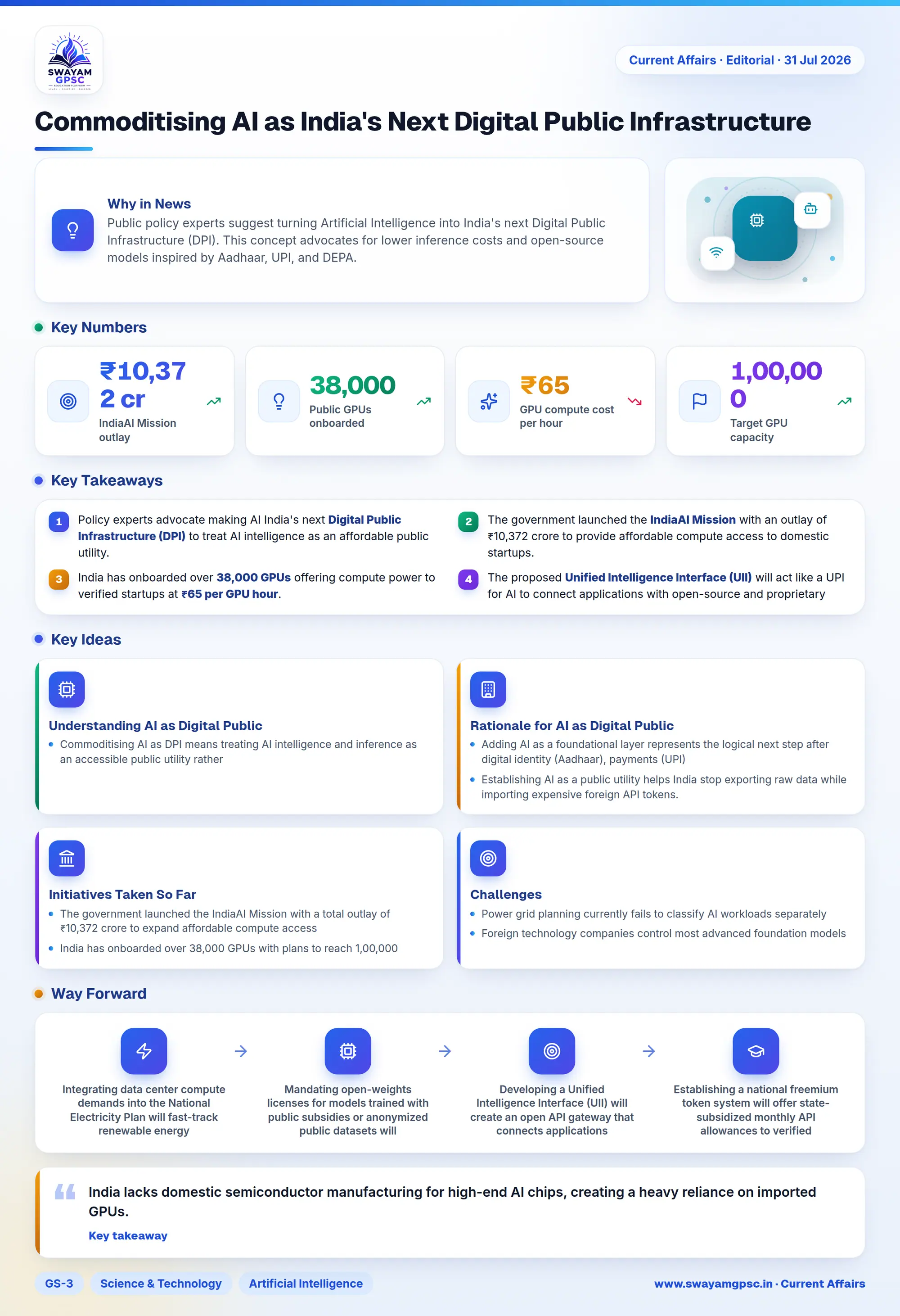
Commoditising AI as India's Next Digital Public Infrastructure
#GS-3 #Science & Technology #Artificial Intelligence #GS-2 #Governance & Social Justice #E-Governance #Current Events #National #Digital Public Infrastructure #IndiaAI Mission #BHASHINI #Unified Intelligence Interface
Key takeaways
- Policy experts advocate making AI India's next Digital Public Infrastructure (DPI) to treat AI intelligence as an affordable public utility.
- The government launched the IndiaAI Mission with an outlay of ₹10,372 crore to provide affordable compute access to domestic startups.
- India has onboarded over 38,000 GPUs offering compute power to verified startups at ₹65 per GPU hour.
- The proposed Unified Intelligence Interface (UII) will act like a UPI for AI to connect applications with open-source and proprietary models.
Why in News
- Public policy experts suggest turning Artificial Intelligence into India's next Digital Public Infrastructure (DPI).
- This concept advocates for lower inference costs and open-source models inspired by Aadhaar, UPI, and DEPA.
Understanding AI as Digital Public Infrastructure
- Commoditising AI as DPI means treating AI intelligence and inference as an accessible public utility rather than a costly commercial product.
Rationale for AI as Digital Public Infrastructure
- Adding AI as a foundational layer represents the logical next step after digital identity (Aadhaar), payments (UPI), and data sharing (DEPA).
- Establishing AI as a public utility helps India stop exporting raw data while importing expensive foreign API tokens.
- Lowering compute and inference costs provides democratic access to advanced AI tools for rural healthcare, local education, and small businesses.
- Reducing foundational model costs shifts economic value toward application developers, where India holds its greatest software strength.
- Utilizing open-source architecture prevents domestic startups from depending completely on foreign technology giants and their pricing policies.
Initiatives Taken So Far
- The government launched the IndiaAI Mission with a total outlay of ₹10,372 crore to expand affordable compute access for startups.
- India has onboarded over 38,000 GPUs with plans to reach 1,00,000, offering compute access at roughly ₹65 per GPU hour.
- Initiatives like BHASHINI build public datasets and translation models across official languages to enable multilingual AI tools.
Challenges
- India lacks domestic semiconductor manufacturing for high-end AI chips, creating a heavy reliance on imported GPUs.
- Power grid planning currently fails to classify AI workloads separately, leading to energy shortages for compute infrastructure.
- Foreign technology companies control most advanced foundation models, creating long-term strategic reliance on proprietary systems.
- AI training data remains heavily skewed toward Western contexts, resulting in a shortage of structured regional language datasets.
- Domestic developers face high dollar-denominated token costs when renting foreign models, which restricts large-scale experimentation.
Way Forward
- Integrating data center compute demands into the National Electricity Plan will fast-track renewable energy supply and lower power costs.
- Mandating open-weights licenses for models trained with public subsidies or anonymized public datasets will ensure shared access.
- Developing a Unified Intelligence Interface (UII) will create an open API gateway that connects applications to various AI models.
- Establishing a national freemium token system will offer state-subsidized monthly API allowances to verified startups and students.
- Reallocating a small portion of existing industrial and agricultural subsidies into token entitlements will boost AI skilling and research.
Conclusion
- Converting AI into an open-source public utility transforms India from a raw data provider into an application innovation hub.
- Combining compute access, Indic language models, and a Unified Intelligence Interface ensures inclusive economic growth through advanced technology.