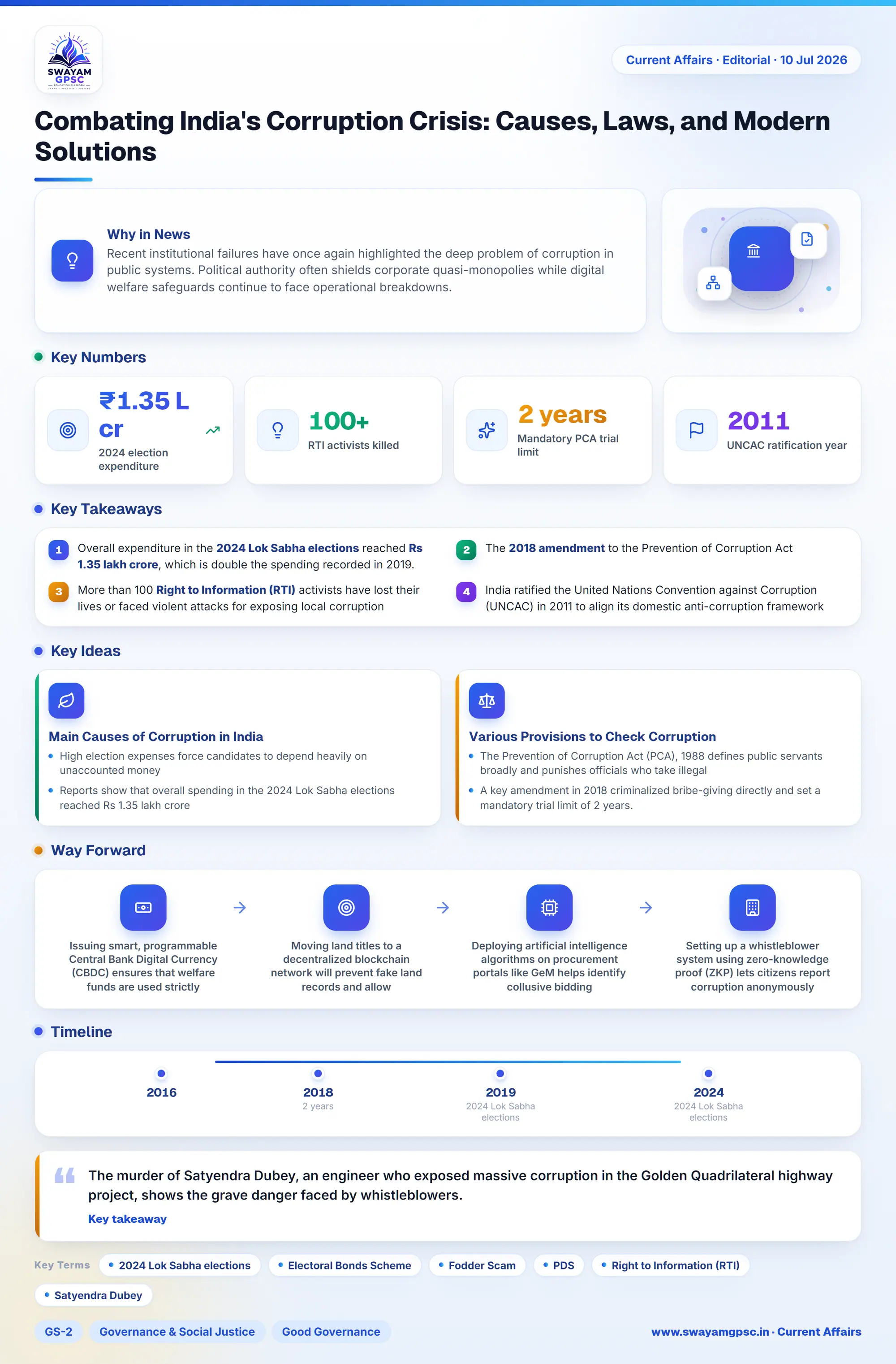
Combating India's Corruption Crisis: Causes, Laws, and Modern Solutions
#GS-2 #Governance & Social Justice #Good Governance #Regulatory Bodies #E-Governance #RTI #Transparency & Accountability #Statutory Bodies #Government Policies & Interventions
Key takeaways
- Overall expenditure in the 2024 Lok Sabha elections reached Rs 1.35 lakh crore, which is double the spending recorded in 2019.
- The 2018 amendment to the Prevention of Corruption Act, 1988 made bribe-giving a statutory offense and established a mandatory trial timeframe of 2 years.
- More than 100 Right to Information (RTI) activists have lost their lives or faced violent attacks for exposing local corruption across India.
- India ratified the United Nations Convention against Corruption (UNCAC) in 2011 to align its domestic anti-corruption framework with international standards.
- Implementing programmable Central Bank Digital Currency (CBDC) and blockchain land registries can help eliminate leakages caused by middlemen in government schemes.
Why in News
- Recent institutional failures have once again highlighted the deep problem of corruption in public systems.
- Political authority often shields corporate quasi-monopolies while digital welfare safeguards continue to face operational breakdowns.
- These systemic issues erode the moral leadership needed to drive effective anti-corruption reforms across the country.
Main Causes of Corruption in India
- High election expenses force candidates to depend heavily on unaccounted money, creating a political environment driven by corporate favours.
- Reports show that overall spending in the 2024 Lok Sabha elections reached Rs 1.35 lakh crore, which is more than double the Rs 60,000 crore spent in 2019.
- The Supreme Court struck down the Electoral Bonds Scheme in 2024 because anonymous donations hidden from citizens enabled corporate bribery.
- Complex government rules give bureaucrats wide discretionary powers, encouraging officials to demand bribes to clear administrative delays.
- The Coal Block Allocation Scam (2012) happened because a screening committee used subjective criteria instead of competitive open bidding.
- Slow legal proceedings weaken the deterrence of laws like the Prevention of Corruption Act (PCA), 1988.
- The Fodder Scam from the 1990s took over two decades of legal trials before courts finally convicted key high-profile accused individuals.
- Public procurement contracts lack independent oversight, allowing private vendors and corrupt officials to inflate costs jointly.
- During the 2010 Commonwealth Games (CWG) Scam, officials inflated execution costs and awarded contracts through fraudulent tendering processes.
- Intermediaries and administrative loopholes divert grains, funds, and wages intended for poor households in state welfare programs.
- Local officials created fake identities in programs like PDS and MGNREGA, while middlemen continue demanding illegal fees for issuing DBT cards.
- Delayed implementation of rules under the Whistleblowers Protection Act, 2014 leaves citizens and public servants without safety when reporting crimes.
- Human rights groups report that over 100 Right to Information (RTI) activists and whistleblowers have been killed or assaulted across India.
- The murder of Satyendra Dubey, an engineer who exposed massive corruption in the Golden Quadrilateral highway project, shows the grave danger faced by whistleblowers.
- Political authority is frequently used to protect specific corporate entities, creating quasi-monopolies that destroy free market competition.
- Regulatory capture damages investor confidence and discourages legitimate private investments across the country.
- Public frustration fails to turn into strong anti-corruption movements because citizens feel cynical about past political promises.
- Anti-corruption movements also suffer from a lack of credible alternative leadership and strong media coverage.
Various Provisions to Check Corruption in India
- The Prevention of Corruption Act (PCA), 1988 defines public servants broadly and punishes officials who take illegal gratification.
- A key amendment in 2018 criminalized bribe-giving directly and set a mandatory trial limit of 2 years.
- The Prevention of Money Laundering Act (PMLA), 2002 grants powers to the Enforcement Directorate (ED) to attach assets linked to financial crimes.
- The Lokpal and Lokayuktas Act, 2013 created statutory anti-corruption ombudsmen at the central and state levels to investigate top officials.
- The Fugitive Economic Offenders Act, 2018 allows authorities to confiscate all domestic and foreign assets of economic offenders even before conviction.
- The Benami Transactions (Prohibition) Amendment Act, 2016 stops individuals from holding unaccounted black money through property held in another person's name.
- The Central Vigilance Commission (CVC) acts as the main integrity agency supervising vigilance administration under the CVC Act, 2003.
- The Central Bureau of Investigation (CBI) investigates major public corruption cases under the Delhi Special Police Establishment Act, 1946.
- The Enforcement Directorate (ED) investigates money laundering and financial crimes under the Ministry of Finance.
- The Comptroller and Auditor General (CAG) audits all government expenditures as a constitutional authority under Article 148.
- The Right to Information (RTI) Act, 2005 allows citizens to access government records and reduces official secrecy.
- The Centralized Public Grievance Redress and Monitoring System (CPGRAMS) offers an online portal for citizens to lodge complaints against corrupt demands.
- Integrating Direct Benefit Transfer (DBT) with Aadhaar sends benefits like PM-KISAN directly to bank accounts, eliminating middlemen.
- The Government e-Marketplace (GeM) standardizes public procurement through transparent online bidding.
- India ratified the United Nations Convention against Corruption (UNCAC) in 2011 to improve international asset recovery and extradition.
Way Forward
- Issuing smart, programmable Central Bank Digital Currency (CBDC) ensures that welfare funds are used strictly for designated items like subsidies.
- Moving land titles to a decentralized blockchain network will prevent fake land records and allow self-executing transactions.
- Deploying artificial intelligence algorithms on procurement portals like GeM helps identify collusive bidding and shell companies in real time.
- Setting up a whistleblower system using zero-knowledge proof (ZKP) lets citizens report corruption anonymously and receive digital token rewards.
- Displaying public file processing times and tracking officer performance through integrity scores encourages faster service delivery.
- Following the Indrajit Gupta Committee (1998) recommendations on state election funding will reduce political dependence on private corporations.
- Mandating digital political donations makes party finances public and transparent.
- Expanding community-led social audits gives local councils the authority to inspect infrastructure projects and pause payments for poor work.