Climate-Proofing India's Food System for Nutrition Security
#GS-3 #Economy #Agriculture #Environment #Climate Change #Food Security #Infrastructure
Key takeaways
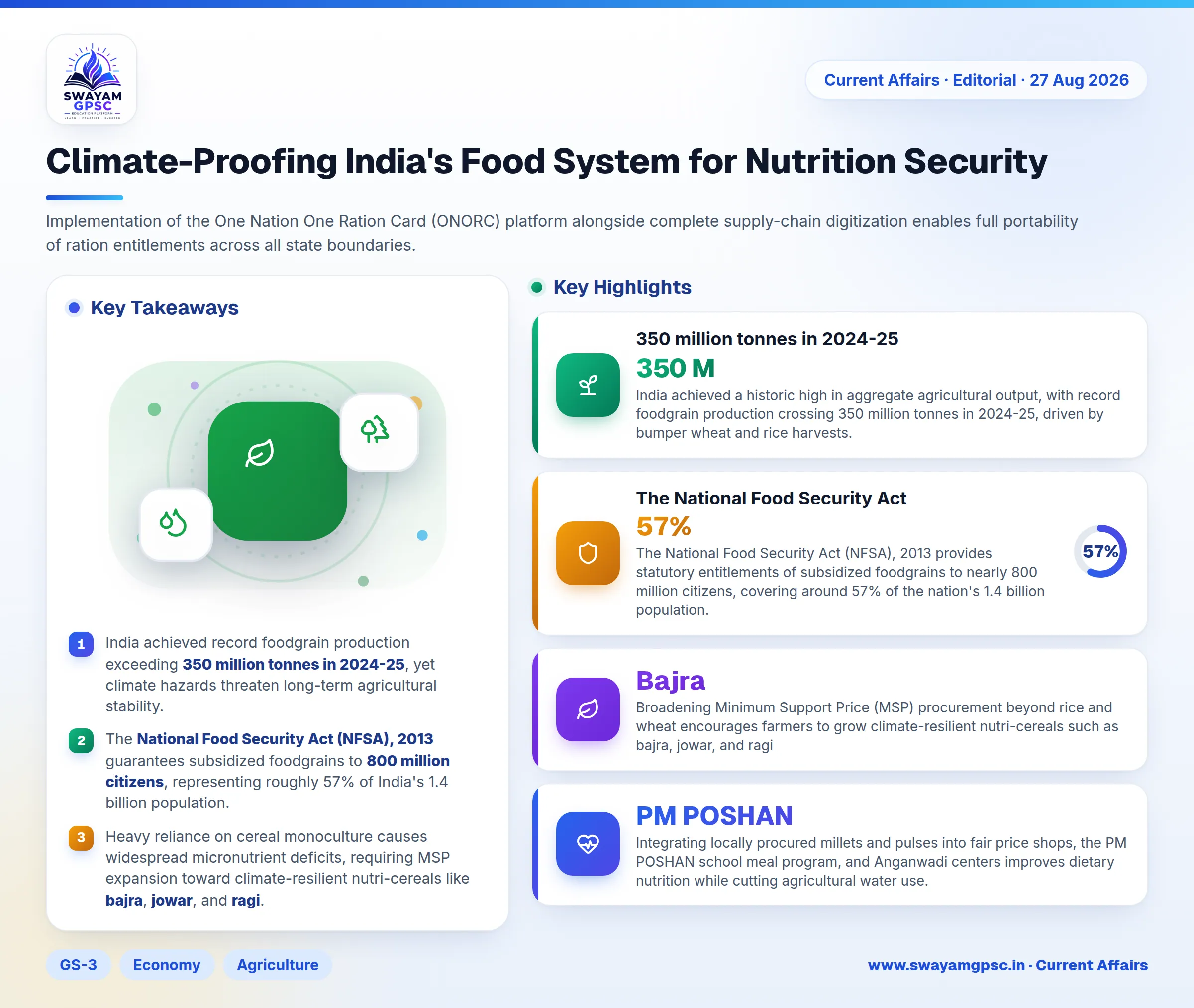
- India achieved record foodgrain production exceeding 350 million tonnes in 2024-25, yet climate hazards threaten long-term agricultural stability.
- The National Food Security Act (NFSA), 2013 guarantees subsidized foodgrains to 800 million citizens, representing roughly 57% of India's 1.4 billion population.
- Heavy reliance on cereal monoculture causes widespread micronutrient deficits, requiring MSP expansion toward climate-resilient nutri-cereals like bajra, jowar, and ragi.
- Modernizing storage with flood-proof silos and incorporating IMD weather forecasting into dynamic stock management are essential to prevent post-harvest losses.
Why in News
- India maintains strong overall foodgrain production and buffer reserves, yet it faces growing threats from extreme temperatures, erratic monsoon patterns, and severe groundwater depletion.
- Building a climate-resilient food system is necessary to protect agricultural output, stabilize supply chains, and shield the public distribution network from environmental shocks.
- Climate-proofing involves redesigning national policies on farming, procurement, storage, and distribution rather than relying solely on cereal monoculture for simple calorie counting.
- The approach embeds climate risk forecasting, crop diversification like millets and oilseeds, water-smart farming practices, and resilient infrastructure directly into the statutory framework of the National Food Security Act (NFSA), 2013.
Key Data and Statistics
- India achieved a historic high in aggregate agricultural output, with record foodgrain production crossing 350 million tonnes in 2024-25, driven by bumper wheat and rice harvests.
- The National Food Security Act (NFSA), 2013 provides statutory entitlements of subsidized foodgrains to nearly 800 million citizens, covering around 57% of the nation's 1.4 billion population.
- Implementation of the One Nation One Ration Card (ONORC) platform alongside complete supply-chain digitization enables full portability of ration entitlements across all state boundaries.
Challenges and Climate Vulnerabilities
- Rising pre-monsoon heatwaves create terminal heat stress that impairs wheat grain filling, while unexpected unseasonal rains damage standing rabi crops before harvest.
- Volatile monsoon shifts between extended dry spells and sudden flash floods place severe stress on rainfed agriculture while exhausting groundwater aquifers used for irrigation.
- Traditional open-plinth and unconditioned storage facilities suffer extensive damage, grain spoilage, and fungal contamination during intense heatwaves and flood events.
- Deficits in refrigerated transport networks and cold-chain logistics lead to high post-harvest losses in fruits, vegetables, and dairy during severe summer heat spikes.
- Over-reliance on cereal monoculture within public food distribution creates micronutrient deficiencies and hidden hunger despite meeting overall daily calorie needs.
Core Pillars of a Resilient Food System
- Broadening Minimum Support Price (MSP) procurement beyond rice and wheat encourages farmers to grow climate-resilient nutri-cereals such as bajra, jowar, and ragi, alongside pulses and oilseeds suited to local ecological zones.
- Integrating locally procured millets and pulses into fair price shops, the PM POSHAN school meal program, and Anganwadi centers improves dietary nutrition while cutting agricultural water use.
- Constructing modern, climate-controlled, flood-proof storage silos and expanding cold-chain networks prevents grain decay and preserves perishable agricultural produce during climate disasters.
- Linking seasonal climate predictions from the India Meteorological Department (IMD) directly with dynamic buffer management, MSP targets, and local district contingency planning improves response speed.
- Promoting sustainable farming practices like drip micro-irrigation, drought-tolerant seed varieties, and weather-indexed crop insurance under PM Fasal Bima Yojana strengthens farm resilience.
Way Forward
- Updating the NFSA monitoring framework allows officials to track heat exposure, water table levels, storage stability, and dietary diversity alongside standard grain distribution metrics.
- Expanding traditional grain reserves into a dynamic climate buffer combines multi-crop storage stocks, dynamic insurance coverage, and decentralized watershed management systems.
- Mobilizing funds through sovereign green bonds and international adaptation funds channels targeted investments into farm-level climate technologies like micro-irrigation and solar cold storage.
- Facilitating research partnerships between ICAR, state agricultural universities, and private agri-tech firms speeds up the development of biofortified, heat-resistant seed lines.
- Encouraging low-emission farming practices like Alternate Wetting and Drying (AWD) and Direct Seeded Rice (DSR) lowers agricultural methane emissions while conserving critical groundwater resources.
Conclusion
- India's transition from historical food shortages to record foodgrain harvests demonstrates strong institutional capability and agricultural capacity.
- Addressing worsening climate risks requires a clear policy shift from focusing solely on basic calorie availability to securing long-term, climate-resilient nutrition security.
- Diversifying crop procurement, modernizing storage infrastructure, and integrating real-time weather analytics into the PDS will safeguard national food security and support farmer livelihoods.