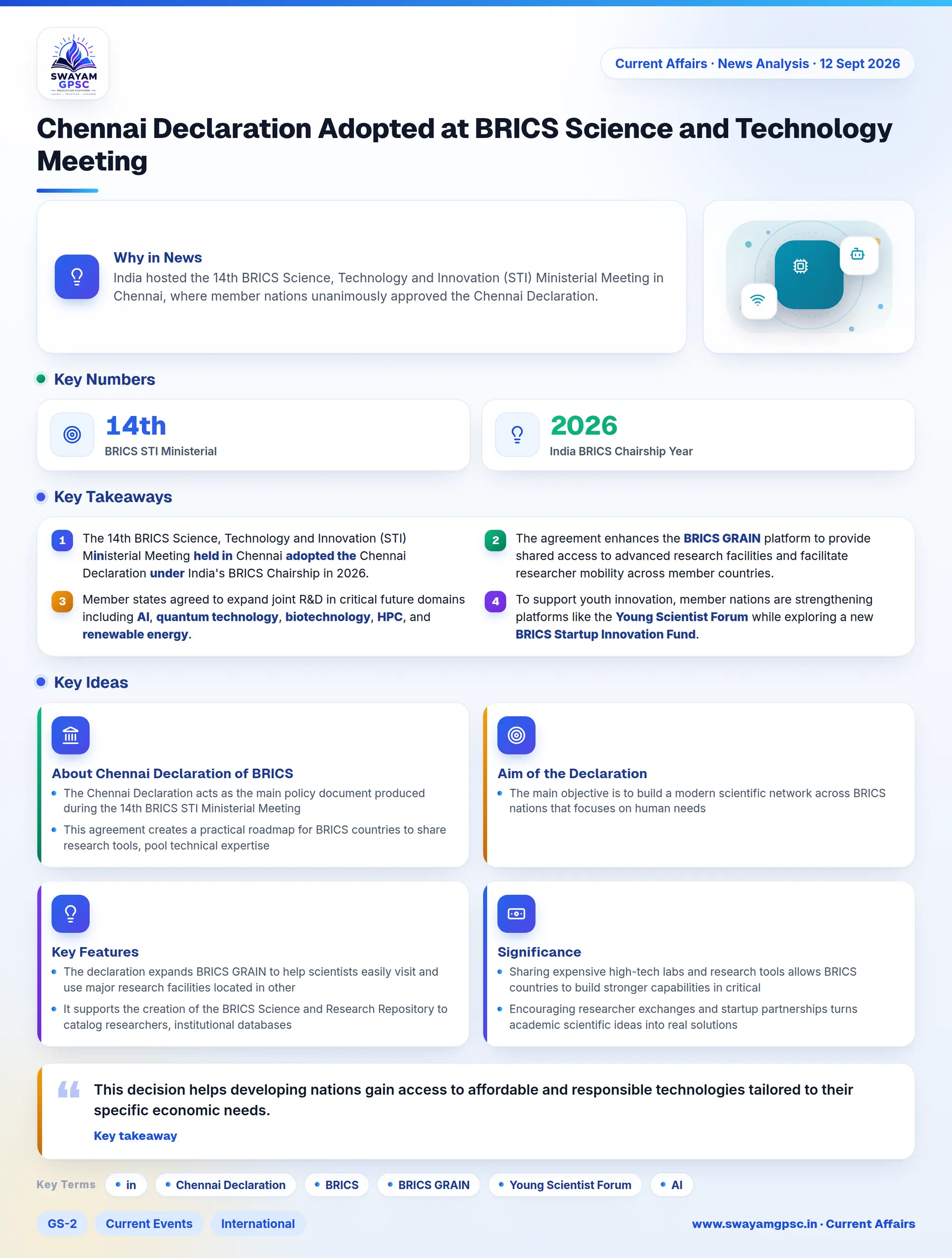
Chennai Declaration Adopted at BRICS Science and Technology Meeting
#GS-2 #Current Events #International #GS-3 #Science & Technology #Artificial Intelligence #Biotechnology #Energy #Environment #Sustainable Development
Key takeaways
- The 14th BRICS Science, Technology and Innovation (STI) Ministerial Meeting held in Chennai adopted the Chennai Declaration under India's BRICS Chairship in 2026.
- The agreement enhances the BRICS GRAIN platform to provide shared access to advanced research facilities and facilitate researcher mobility across member countries.
- Member states agreed to expand joint R&D in critical future domains including AI, quantum technology, biotechnology, HPC, and renewable energy.
- To support youth innovation, member nations are strengthening platforms like the Young Scientist Forum while exploring a new BRICS Startup Innovation Fund.
Why in News
- India hosted the 14th BRICS Science, Technology and Innovation (STI) Ministerial Meeting in Chennai, where member nations unanimously approved the Chennai Declaration.
About Chennai Declaration of BRICS
- The Chennai Declaration acts as the main policy document produced during the 14th BRICS STI Ministerial Meeting under India's BRICS Chairship in 2026.
- This agreement creates a practical roadmap for BRICS countries to share research tools, pool technical expertise, and drive scientific innovation together.
Aim of the Declaration
- The main objective is to build a modern scientific network across BRICS nations that focuses on human needs and sustainable development through joint research and talent exchange.
Key Features
- The declaration expands BRICS GRAIN to help scientists easily visit and use major research facilities located in other member countries.
- It supports the creation of the BRICS Science and Research Repository to catalog researchers, institutional databases, and technical infrastructure across member states.
- It enhances youth programs like the Young Scientist Forum, Young Innovator Prize, and Youth Startup Platform, while looking to establish a BRICS Startup Innovation Fund.
- It increases joint work in emerging technical areas such as AI, HPC, quantum technology, biotechnology, nanotechnology, geospatial technology, renewable energy, and ocean science.
Significance
- This decision helps developing nations gain access to affordable and responsible technologies tailored to their specific economic needs.
- Sharing expensive high-tech labs and research tools allows BRICS countries to build stronger capabilities in critical future technologies.
- Encouraging researcher exchanges and startup partnerships turns academic scientific ideas into real solutions for practical everyday challenges.
Relevance in UPSC and GPSC Examinations
- For GS Paper II (International Relations), this topic provides key insights into BRICS partnerships, multilateral diplomacy, India's BRICS Chairship, and science diplomacy.
- For GS Paper III (Science & Technology), it covers collaborative developments in AI, quantum technology, biotechnology, HPC, research infrastructure, and startup hubs.
- For GS Paper III (Environment), it highlights international cooperation in renewable energy, climate sustainability, ocean science, and disaster management.
- For the Essay paper, it offers strong facts for topics on technology for human good, Global South cooperation, and sustainable innovation.