Charting a New Course in India-Indonesia Strategic Relations
#GS-2 #Governance & Social Justice #GS-3 #Economy #Infrastructure #Current Events #International #Bilateral Groupings & Agreements #Effect of Policies & Politics of Countries on India's Interests #Indian Diaspora
Key takeaways
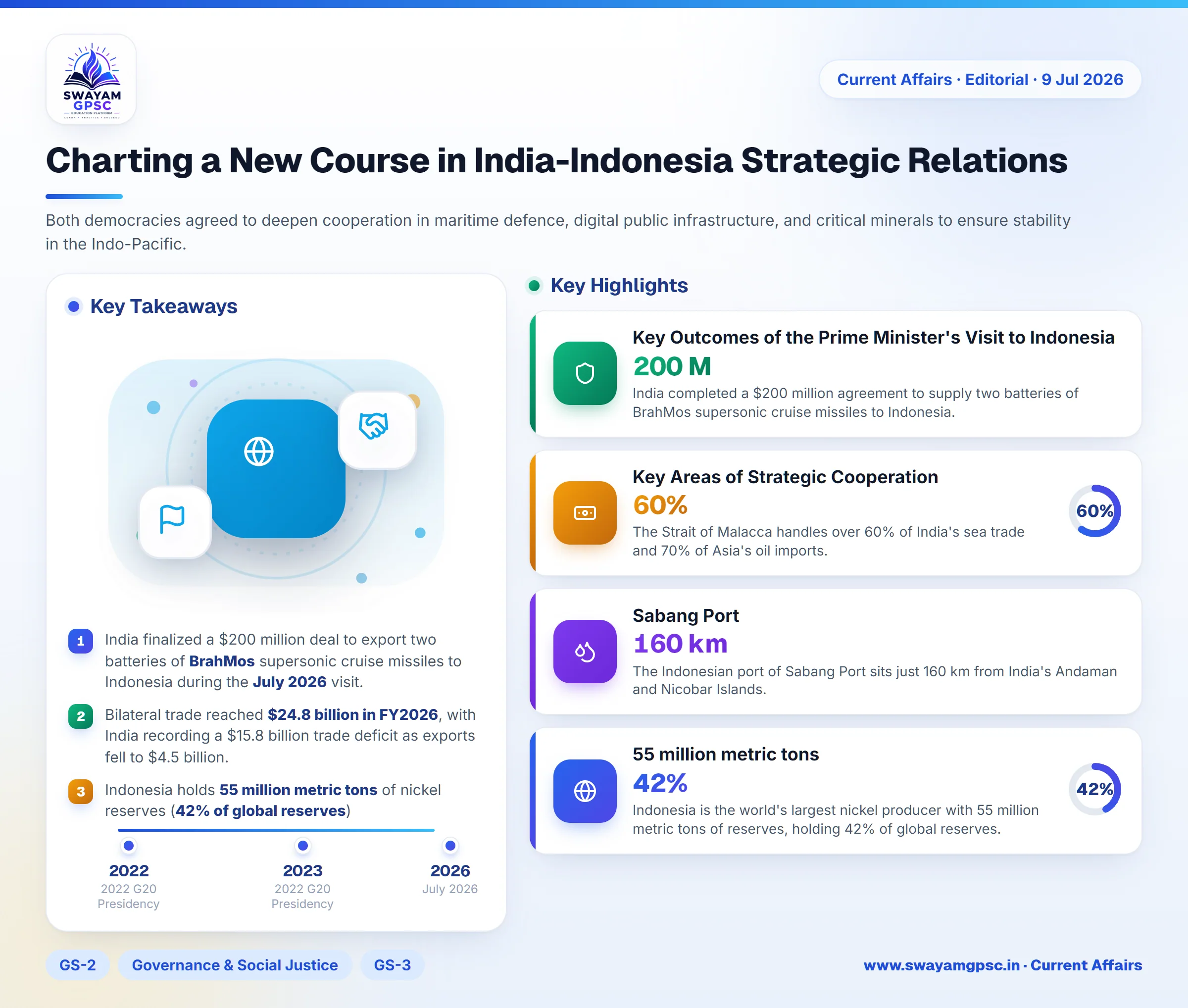
- India finalized a $200 million deal to export two batteries of BrahMos supersonic cruise missiles to Indonesia during the July 2026 visit.
- Bilateral trade reached $24.8 billion in FY2026, with India recording a $15.8 billion trade deficit as exports fell to $4.5 billion.
- Indonesia holds 55 million metric tons of nickel reserves (42% of global reserves), making it critical for India's electric vehicle battery supply chain.
- The Strait of Malacca carries over 60% of India's sea trade and lies just 160 km from India's Andaman and Nicobar Islands near Sabang Port.
Why in News
- In July 2026, the Indian Prime Minister made an official state visit to Indonesia.
- This visit upgraded the bilateral partnership into a modern strategic alliance.
- Both democracies agreed to deepen cooperation in maritime defence, digital public infrastructure, and critical minerals to ensure stability in the Indo-Pacific.
Key Outcomes of the Prime Minister's Visit to Indonesia
- India completed a $200 million agreement to supply two batteries of BrahMos supersonic cruise missiles to Indonesia.
- Indonesia became the third country to import BrahMos missiles, after the Philippines and Vietnam.
- Both nations signed an Air-to-Air Missile Cooperation Agreement to integrate indigenous Astra missile systems.
- An arrangement was finalized between BAKAMLA RI and the Indian Coast Guard to boost maritime safety.
- India and Indonesia signed an MoU on steel supply chains and created a joint venture between SAIL and PT. Krakatau Steel.
- This joint venture will study setting up a stainless-steel slab manufacturing facility inside Indonesia.
- An agreement was signed between NFTDC, Midwest Ltd., and PT. Perusahaan Mineral Nasional to secure rare earths and critical minerals.
- Indonesia invited Indian partnership for the strategic development of Sabang Port, including ship repair, cruise facilities, and energy services.
- The RBI and Bank Indonesia advanced local currency frameworks to settle cross-border trade in local currencies.
- Indonesia launched the Indonesia Open Network (ION) e-commerce platform using India's ONDC model to support MSMEs.
- Both countries concluded a comprehensive MoU to strengthen cooperation in telecommunications technologies and services.
- India and Indonesia extended their framework agreement on peaceful space exploration.
- Indonesia confirmed tracking support for India's Gaganyaan Mission through the Biak TTC facility under the BRIN-ISRO framework.
- Officials held formal talks on civil nuclear energy applications in medicine, research, agriculture, water management, and nuclear safety.
- Both leaders highlighted the Red and White Cooperative Network to streamline pharmaceutical distribution in Indonesia.
- The CDSCO of India and BPOM of Indonesia signed an MoU on medical product regulation and workforce training.
- Both nations agreed to renew the Marine and Fisheries Cooperation MoU to protect fertilizer supply and food security.
- Leaders inaugurated restored structures at the Prambanan Temple Compounds, a UNESCO World Heritage site restored by the ASI.
- Both countries designated 2026-2027 as the Tagore-Dewantara Year to celebrate 100 years since Rabindranath Tagore's visit in 1927.
- The National Museum of India gifted a replica of the 9th-century Nalanda Copper Plate to the Muara Jambi museum.
- Indonesia welcomed a proposal by IIM Bangalore to open an international branch campus in East Java.
- Indonesia announced its intent to join the IBCA, while India recognized Indonesia's World Mangrove Centre and ITPC.
- Indonesia backed India's 2026 BRICS Chairship, while both nations committed to pushing for UNSC reforms and adhering to UNCLOS 1982.
Key Areas of Strategic Cooperation
- Indonesia controls major maritime chokepoints including the Strait of Malacca, Sunda Strait, and Lombok Strait.
- The Strait of Malacca handles over 60% of India's sea trade and 70% of Asia's oil imports.
- India maintains freedom of navigation in these waters through joint IND-INDO CORPAT patrols with Indonesia.
- The Indonesian port of Sabang Port sits just 160 km from India's Andaman and Nicobar Islands.
- Developing Sabang Port gives the Indian Navy access to a deep-water harbour and acts as a counterweight to Chinese naval expansion.
- Indonesia is the world's largest nickel producer with 55 million metric tons of reserves, holding 42% of global reserves.
- Access to Indonesian minerals helps India manufacture Advanced Chemistry Cell (ACC) batteries for electric vehicles.
- Indonesia is India's second-largest trade partner in ASEAN with bilateral trade reaching $24.8 billion.
- Indonesia supplies essential Crude Palm Oil (CPO) and metallurgical coal to support India's power and steel sectors.
- Aligning the AOIP with India's IPOI preserves regional balance and prevents external dominance in Southeast Asia.
- The Biak TTC station in Indonesia provides critical tracking during the launch phases of India's Gaganyaan Mission.
- The diplomatic transition from Indonesia's 2022 G20 Presidency to India's 2023 G20 Presidency strengthened Global South advocacy.
- The Local Currency Transaction (LCT) framework between RBI and Bank Indonesia allows direct trade settlement in rupees and rupiah.
- Interlinking India's UPI with Indonesia's QRIS lowers cross-border payment costs for businesses and tourists.
Challenges
- Bilateral trade reached $24.8 billion in FY2026, but India faces a heavy trade deficit of $15.8 billion.
- India's exports to Indonesia fell from $10 billion in FY2023 to $4.5 billion in FY2026.
- Indonesia centralized palm oil exports under state agency Danantara Sumberdaya Indonesia (DSI), creating supply uncertainty for Indian refiners.
- India imports 60% of its edible oil, making domestic retail prices sensitive to export policy changes in Jakarta.
- Indonesia's ban on raw nickel exports forces foreign companies to process minerals inside Indonesian borders.
- Indian pharmaceutical exports face long regulatory delays at Indonesia's drug authority BPOM.
- Agricultural exports like buffalo meat and dairy face restrictive SPS quotas, keeping trade far below the $50 billion target.
- Chinese firms dominate Indonesia's nickel processing at sites like Morowali Industrial Park, while Indian investment stands at $1.56 billion.
- Bilateral trade relies on the AITIGA agreement, which suffers from a low utilization rate of 30-40% due to complex rules.
- Indonesia follows a Bebas-Aktif non-aligned foreign policy and views minilateral groupings like the Quad with caution.
Way Forward
- India and Indonesia can launch a joint Blue Carbon initiative using ISRO satellite technology to protect coastal ecosystems.
- Both nations can create a joint defence MRO hub in Indonesia to service military aircraft and missile systems.
- Indian firms can setup co-processing facilities in Indonesia to refine rare earth elements and manufacture battery packs.
- An India-ASEAN Digital Trade Sandbox at the new IIM Bangalore campus can build digital applications for MSMEs.
- Connecting Sabang Port and Great Nicobar under a shared framework will boost shipping, tourism, and repair services.
- Establishing an Ayur-Jamu Consortium can combine Ayurveda and Jamu traditions with modern biotechnology to export certified medicines globally.
Conclusion
- The India-Indonesia partnership serves as a key anchor for Indo-Pacific stability and Global South diplomacy.
- Expanding ties in defence, digital infrastructure, and critical minerals will help both democracies overcome economic imbalances and secure a multipolar region.