Charting India's Global Shipbuilding Roadmap
#GS-2 #GS-3 #Governance & Social Justice #Economy #Infrastructure #Growth & Development #Government Policies & Interventions
Key takeaways
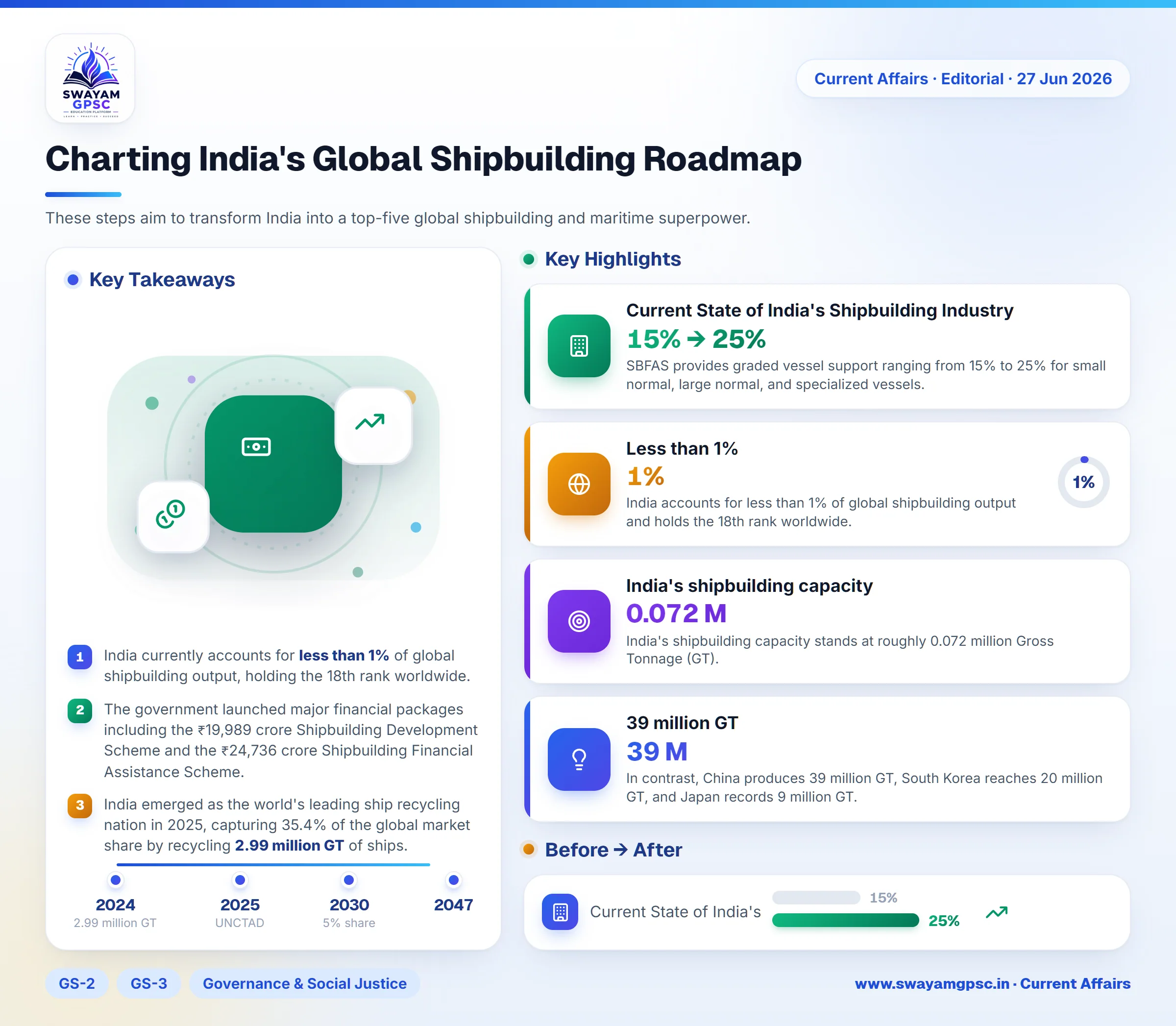
- India currently accounts for less than 1% of global shipbuilding output, holding the 18th rank worldwide.
- The government launched major financial packages including the ₹19,989 crore Shipbuilding Development Scheme and the ₹24,736 crore Shipbuilding Financial Assistance Scheme.
- India emerged as the world's leading ship recycling nation in 2025, capturing 35.4% of the global market share by recycling 2.99 million GT of ships.
- Under the Maritime Amrit Kaal Vision 2047, India aims to capture a 5% share of the global shipbuilding market by 2030 and enter the top five nations by 2047.
Why in News
- A recent editorial published in the Hindu explores how India can collaborate with Korea to build its maritime capabilities.
- The article focuses on attracting foreign direct investments and setting up local ancillary industry clusters.
- Specialized joint ventures can help bridge technical and financial gaps in the domestic maritime sector.
- These steps aim to transform India into a top-five global shipbuilding and maritime superpower.
Current State of India's Shipbuilding Industry
- India accounts for less than 1% of global shipbuilding output and holds the 18th rank worldwide.
- India's shipbuilding capacity stands at roughly 0.072 million Gross Tonnage (GT).
- In contrast, China produces 39 million GT, South Korea reaches 20 million GT, and Japan records 9 million GT.
- Domestic yards mostly build specialized defense vessels, coastal cargo ships, and port crafts.
- Under the Maritime Amrit Kaal Vision 2047, the government plans to invest ₹3 lakh crore in shipbuilding clusters.
- India aims to capture a 5% share of the global shipbuilding market by 2030 to enter the top ten nations.
- The long-term goal is to reach the top five shipbuilding nations globally by 2047.
- This expansion roadmap is projected to generate about 22 lakh direct and indirect jobs across industrial corridors.
- According to a UNCTAD report, India became the world's leading ship recycling nation in 2025.
- India achieved its Maritime India Vision (MIV) 2030 target early by capturing 35.4% of the global market share in 2025.
- Indian yards recycled 2.99 million GT of ships in 2025, which is a nearly 60% surge from the 1.86 million GT recorded in 2024.
- The Recycling of Ships Act, 2019 aligns domestic yards with the Hong Kong International Convention for the Safe and Environmentally Sound Recycling of Ships.
- More than 115 facilities at the Alang Ship Breaking Yard (Gujarat) comply with the Hong Kong Convention after India ratified it in 2019.
- The Shipbuilding Development Scheme (SbDS) is a ₹19,989 crore initiative focused on long-term capacity creation.
- SbDS establishes an India Ship Technology Centre under the Indian Maritime University alongside greenfield and brownfield projects.
- Greenfield shipbuilding clusters receive 100% capital support through a 50:50 Centre-State special purpose vehicle under SbDS.
- Existing brownfield shipyards get 25% capital assistance for critical infrastructure upgrades like dry docks and shiplifts.
- The Credit Risk Coverage Framework under SbDS offers government-backed insurance for pre-shipment, post-shipment, and vendor-default risks.
- The Shipbuilding Financial Assistance Scheme (SBFAS) allocates ₹24,736 crore to set up a National Shipbuilding Mission.
- SBFAS provides graded vessel support ranging from 15% to 25% for small normal, large normal, and specialized vessels.
- The Shipbreaking Credit Note gives ship owners a credit equal to 40% of the scrap value when scrapping vessels at Indian yards.
- SBFAS aims to support ₹96,000 crore in projects over the next decade to stimulate domestic manufacturing.
- The Maritime Development Fund (MDF) provides ₹25,000 crore to finance ship acquisitions and boost Indian-flagged cargo share up to 20% by 2047.
- The MDF aims to generate up to ₹1.5 lakh crore investment in the shipping sector by 2030.
- Large ships received official infrastructure status in September 2025 to lower borrowing costs and improve access to long-term capital.
- India is setting up the National Shipbuilding & Heavy Industries Park, Tamil Nadu Limited (NSHIP-TN) as its first major special purpose vehicle at Thoothukudi (Tuticorin).
- Mega-shipbuilding and repair clusters are also mapped out across Andhra Pradesh, Gujarat via the Deendayal Port expansion, Maharashtra, and Odisha.
Role of the Shipbuilding Industry in India's Economic Development
- Known as the mother of heavy engineering, shipbuilding offers a massive economic multiplier effect where every invested unit returns 1.8 times to the economy.
- Shipbuilding drives the Make in India and Atmanirbhar Bharat initiatives by creating high demand for steel, electrical equipment, and electronics.
- Every direct shipyard job creates a cascading 6.4 times multiplier effect across ancillary industries.
- The Maritime Revitalization Package is expected to unlock 4.5 million GT of capacity, create nearly 30 lakh jobs, and attract Rs.4.5 lakh crore in investments.
- Only about 20% of India's trade cargo currently moves on India-flagged or India-owned vessels.
- Paying billions of dollars annually in freight charges to foreign entities drains India's foreign exchange reserves.
- Expanding domestic yards under the Shipbuilding Development Scheme (SbDS) helps plug balance of payments vulnerabilities.
- Commercial and naval capacities are structurally intertwined, making a strong commercial base vital for a sustained blue-water navy.
- Indian yards have successfully delivered major platforms like Cochin Shipyard Limited (CSL) building INS Vikrant and Mazagon Dock Shipbuilders Limited (MDL) executing Project 75.
- Public shipyards are developing green tugs and alternative-fuel vessels using electric propulsion, hydrogen fuel cells, and methanol dual-fuel technologies.
- Mormugao Port became the country's first green port under the Green Port Certification Programme by setting up a 3 MW solar power plant.
- With an 11,098 km coastline, India transports nearly 95% of international trade by volume and around 70% by value via maritime routes.
- Trade routes cross vital global transit choke points like the Malacca Strait, Strait of Hormuz, and Bab-el-Mandeb strait.
- According to the World Bank, inland water transport costs just ₹1.2 per ton-kilometer, compared to ₹1.4 by rail and ₹2.28 by road.
Challenges
- Shipbuilding requires long gestation cycles where working capital eats up 25% to 35% of the total construction cost.
- Indian shipbuilders face steep domestic interest rates averaging 10-10.5%, while competitors enjoy 5-6% in South Korea and 4-8% in China.
- Indian yards suffer from high commercial bank premiums and collateral requirements for performance and refund guarantees.
- China provides direct sovereign refund guarantees for specific vessel classes, putting Indian private yards at a major disadvantage.
- Although India is the 2nd-largest crude steel producer, domestic mills struggle to supply consistent shipbuilding-grade steel plates.
- Local yards face batch-to-batch variations in mechanical properties and limited class approvals from the International Association of Classification Societies (IACS).
- The Shipbuilding Financial Assistance Scheme (SBFAS) requires at least 30% domestic content, forcing yards to balance local sourcing rules against quality needs.
- Domestic shipping companies often prefer buying 2nd-hand foreign vessels or ordering directly from foreign yards due to high initial local costs.
- Prolonged project execution timelines make Indian yards uncompetitive against rapid East Asian builders.
- Delays in receiving imported components like marine propulsion engines stall assembly phases and attract heavy financial penalties.
- Despite 7-9% of international maritime traffic passing within 300 nautical miles of its coast, India captures less than 1% of the global ship MRO market.
- Indian shipowners routinely bypass local dry docks to sail their vessels to Singapore, Colombo, Dubai, or China for maintenance.
Way Forward
- India should designate major shipbuilding hubs like NSHIP at Tuticorin as specialized Maritime Special Economic Zones (MSEZs) with automatic export status.
- A single-window portal managed with Lloyd’s Register can automate carbon accounting and ESG certification during fabrication.
- The Maritime Development Fund (MDF) should create a sovereign Vessel-as-a-Service (VaaS) leasing platform to fund keel-laying directly.
- A dedicated Production Linked Incentive (PLI) Scheme for Marine Aggregates should offer cashbacks to global Tier-1 suppliers setting up local units.
- The Ministry of Shipping should mandate ecosystem upgrades through the India Ship Technology Centre to adopt laser cutting and Digital Twin modeling.
- Designating autonomous coastal shipping corridors between JNPA Mumbai and Cochin Port will support testing for Maritime Autonomous Surface Ships (MASS) using NavIC tracking.
- Extending financial grants to domestic steel mills to process scrap steel into IACS-certified marine plates will create a closed-loop circular economy.