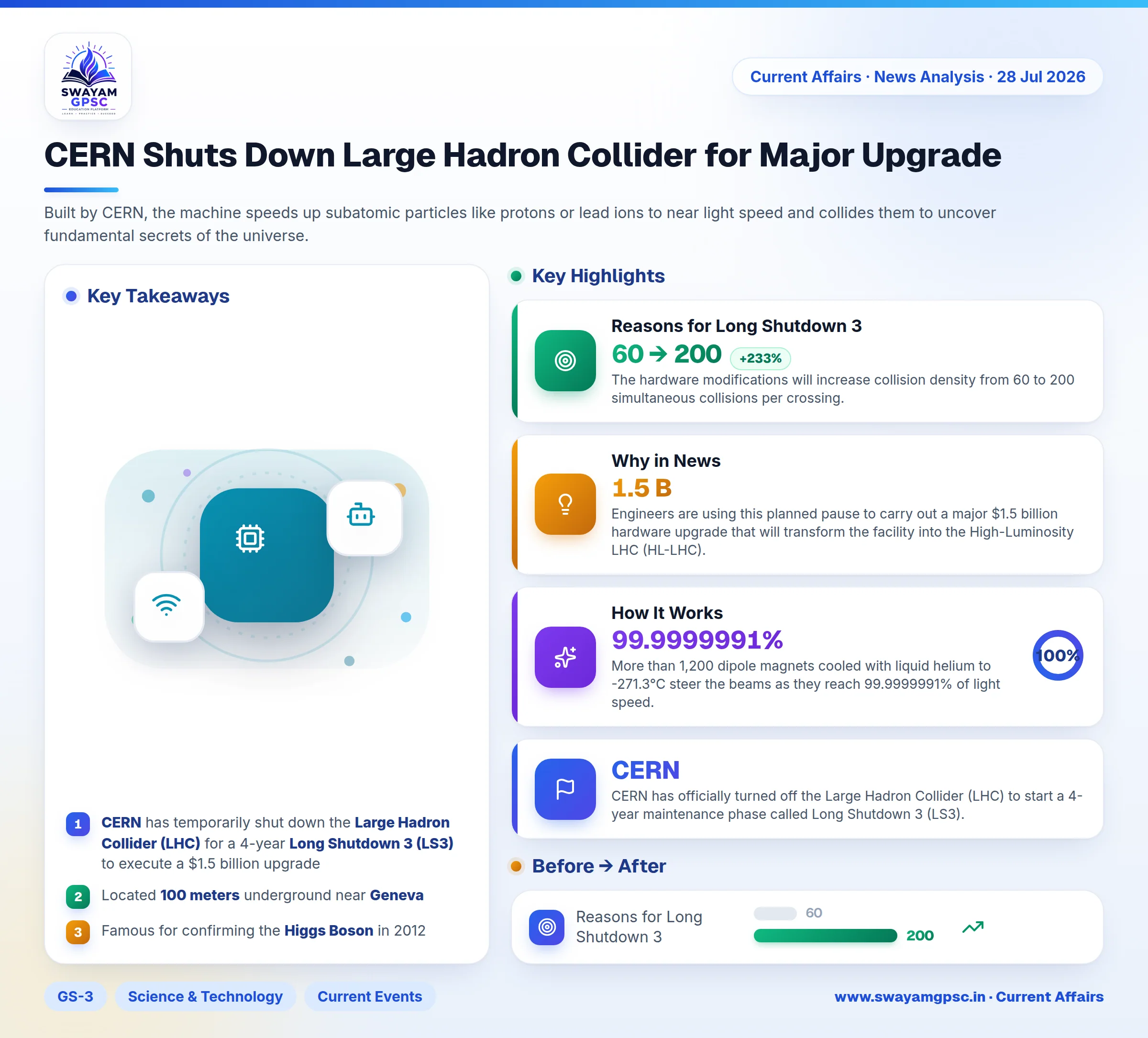
CERN Shuts Down Large Hadron Collider for Major Upgrade
#GS-3 #Science & Technology #Current Events #International #Physics #CERN #Large Hadron Collider
Why in News
- **CERN** has officially turned off the **Large Hadron Collider (LHC)** to start a **4-year** maintenance phase called **Long Shutdown 3 (LS3)**.
- Engineers are using this planned pause to carry out a major **$1.5 billion** hardware upgrade that will transform the facility into the **High-Luminosity LHC (HL-LHC)**.
What It Is
- The **Large Hadron Collider (LHC)** is the world's largest, most energetic, and most powerful particle accelerator ever constructed.
- Built by **CERN**, the machine speeds up subatomic particles like protons or lead ions to near light speed and collides them to uncover fundamental secrets of the universe.
Location of the LHC
- The facility rests inside a circular tunnel located about **100 meters** underground beneath the border between **France** and **Switzerland** near **Geneva**.
- The entire research complex is managed and operated by **CERN**.
How It Works
- Engineers extract protons from hydrogen gas, accelerate them through pre-accelerators, and inject them into two vacuum pipes moving in opposite directions.
- More than **1,200** dipole magnets cooled with liquid helium to **-271.3°C** steer the beams as they reach **99.9999991%** of light speed.
- Quadrupole magnets focus the particle beams to collide at four points where specialized detectors including **ATLAS**, **CMS**, **ALICE**, and **LHCb** capture millions of reactions each second.
Key Features
- The facility uses a **26.7 kilometer** underground circular tunnel containing over **9,000** superconducting magnets kept at **-271.3°C**.
- The collider operates at record energy levels of **13.6 TeV**, reproducing extreme thermal conditions that existed right after the Big Bang.
- The machine famously proved the existence of the **Higgs Boson** in **2012**, completing the Standard Model of particle physics.
- Four main underground detectors study specialized topics such as **dark matter**, antimatter asymmetry, and quark-gluon plasma.
- The scientific network involves more than **10,000** scientists and engineers collaborating across more than **100** nations.
Reasons for Long Shutdown 3
- Over the **4-year** shutdown, technicians will renovate **1.2 kilometers** of the tunnel to install niobium-tin magnets, crab cavities, and upgraded subdetectors.
- The hardware modifications will increase collision density from **60** to **200** simultaneous collisions per crossing.
- Generating **10 times** more collision data will allow scientists to study rare physics phenomena and search for **dark matter** when operations restart in **2030**.