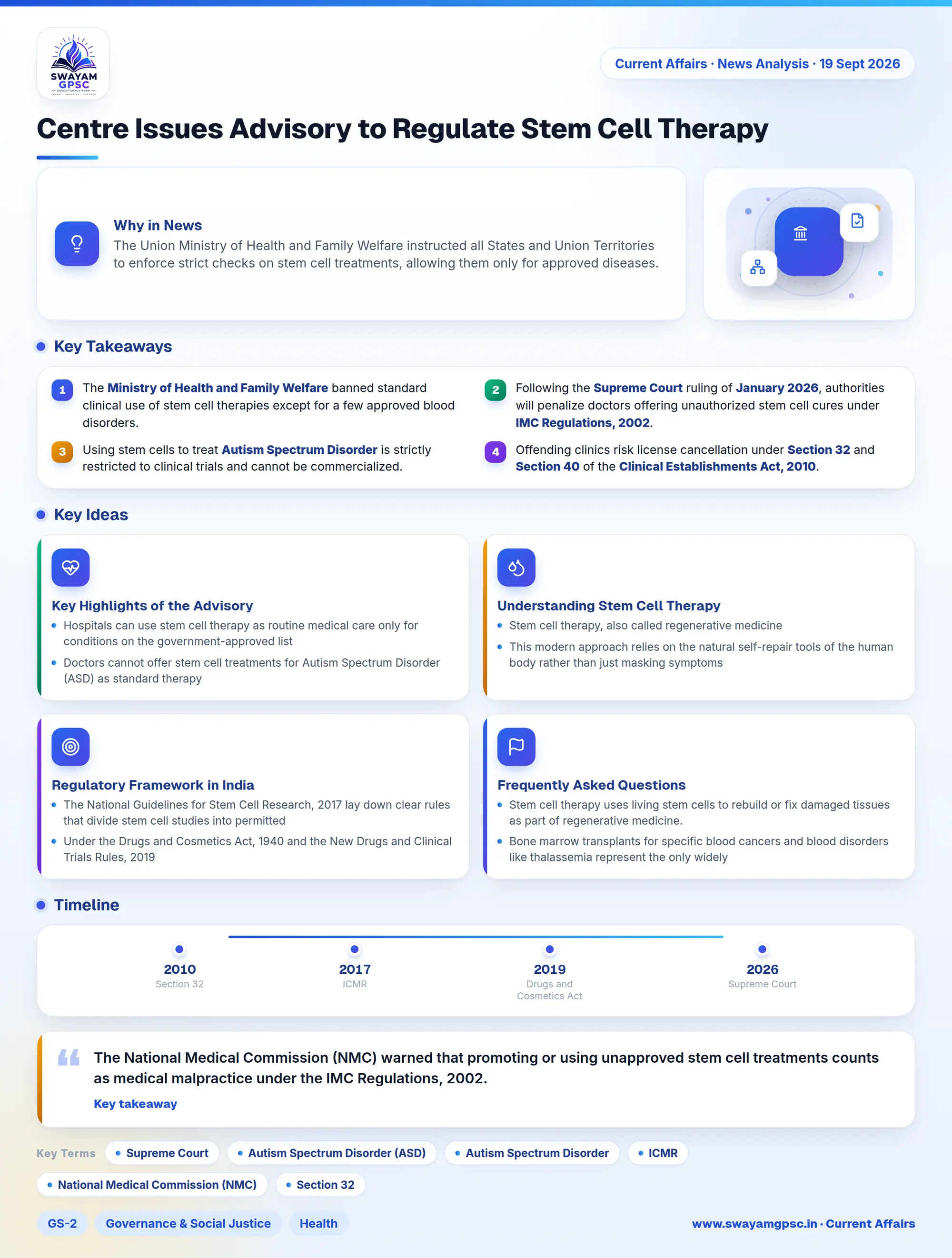
Centre Issues Advisory to Regulate Stem Cell Therapy
#GS-2 #Governance & Social Justice #Health #Indian Polity & Constitution #Judiciary #GS-3 #Science & Technology #Biotechnology #Current Events #National #Stem Cell Therapy #Medical Regulations
Key takeaways
- The Ministry of Health and Family Welfare banned standard clinical use of stem cell therapies except for a few approved blood disorders.
- Following the Supreme Court ruling of January 2026, authorities will penalize doctors offering unauthorized stem cell cures under IMC Regulations, 2002.
- Using stem cells to treat Autism Spectrum Disorder is strictly restricted to clinical trials and cannot be commercialized.
- Offending clinics risk license cancellation under Section 32 and Section 40 of the Clinical Establishments Act, 2010.
Why in News
- The Union Ministry of Health and Family Welfare instructed all States and Union Territories to enforce strict checks on stem cell treatments, allowing them only for approved diseases.
- This official advisory follows the Supreme Court decision of January 2026 in the Yash Charitable Trust & Ors. v. Union of India case, which called for punishing clinics that offer unproven therapies.
Key Highlights of the Advisory
- Hospitals can use stem cell therapy as routine medical care only for conditions on the government-approved list, such as certain blood cancers.
- Doctors cannot offer stem cell treatments for Autism Spectrum Disorder (ASD) as standard therapy; they can only study it within approved clinical trials.
- Private clinics must not sell or advertise unverified stem cell procedures for Autism Spectrum Disorder to the general public.
- Every clinical study must follow the National Guidelines for Stem Cell Research, 2017, which the ICMR and the DBT created together.
- The National Medical Commission (NMC) warned that promoting or using unapproved stem cell treatments counts as medical malpractice under the IMC Regulations, 2002.
- State Medical Councils will take direct disciplinary steps against any doctors who break these treatment rules.
- State authorities can shut down clinics and cancel their licenses under Section 32 and Section 40 of the Clinical Establishments Act, 2010.
Understanding Stem Cell Therapy
- Stem cell therapy, also called regenerative medicine, repairs or replaces damaged human body tissues using live stem cells.
- This modern approach relies on the natural self-repair tools of the human body rather than just masking symptoms with standard medicines.
- Unlike specialized muscle or nerve cells, stem cells work as basic building blocks that can transform into other cell types.
- These cells possess self-renewal ability, meaning they can copy themselves repeatedly to keep a healthy backup reserve inside the body.
- They also show differentiation, allowing them to turn into specific tissues when the body sends chemical distress signals.
- Embryonic stem cells come from early embryos and possess pluripotent power to form nearly any tissue in the human body.
- Adult stem cells exist in small amounts inside mature tissues like bone marrow or body fat.
- Most adult stem cells are multipotent, so they can only turn into a few limited cell varieties.
- Scientists create induced pluripotent stem cells (iPSCs) by reprogramming ordinary adult cells to act like embryonic cells.
- Doctors collect perinatal stem cells from birth-related materials like the placenta, umbilical cord blood, and amniotic fluid.
- The medical process takes cells from the patient or a matching donor, prepares them in a lab, and injects them back into the body.
- After entering the body, the cells travel to damaged organs, change into needed cells, and release chemicals that calm inflammation.
- Bone marrow transplants using blood-forming stem cells are already an approved, standard medical cure for Leukemia and Thalassemia.
- Using stem cell procedures for brain disorders like Alzheimer's, Parkinson's, or Autism remains unproven and experimental.
- Improper stem cell treatments carry major health dangers, including uncontrolled tumor growth, unwanted cell changes, and immune attacks.
- Research on embryos creates ethical debates, while fake commercial clinics expose patients to deadly infections, blood clots, and nerve injury.
Regulatory Framework in India
- The National Guidelines for Stem Cell Research, 2017 lay down clear rules that divide stem cell studies into permitted, restricted, and banned types.
- Under the Drugs and Cosmetics Act, 1940 and the New Drugs and Clinical Trials Rules, 2019, the government treats stem cell products as new drugs that need CDSCO clearance before sale.
- The Clinical Establishments Act, 2010 sets quality and infrastructure rules that all medical centers and hospitals must follow.
- The Health Ministry is using this central hospital law to cancel the official registrations of clinics running illegal stem cell centers.
Frequently Asked Questions
- Stem cell therapy uses living stem cells to rebuild or fix damaged tissues as part of regenerative medicine.
- Bone marrow transplants for specific blood cancers and blood disorders like thalassemia represent the only widely approved stem cell treatments today.
- No doctor can sell stem cell therapy for Autism Spectrum Disorder as regular treatment because the law allows it only within research trials.
- The National Guidelines for Stem Cell Research, 2017, framed by ICMR and DBT, provide safety and ethics guidance for Indian researchers.
- India regulates stem cell products as new drugs, requiring safety reviews and formal approval from the central drug authority before any commercial release.