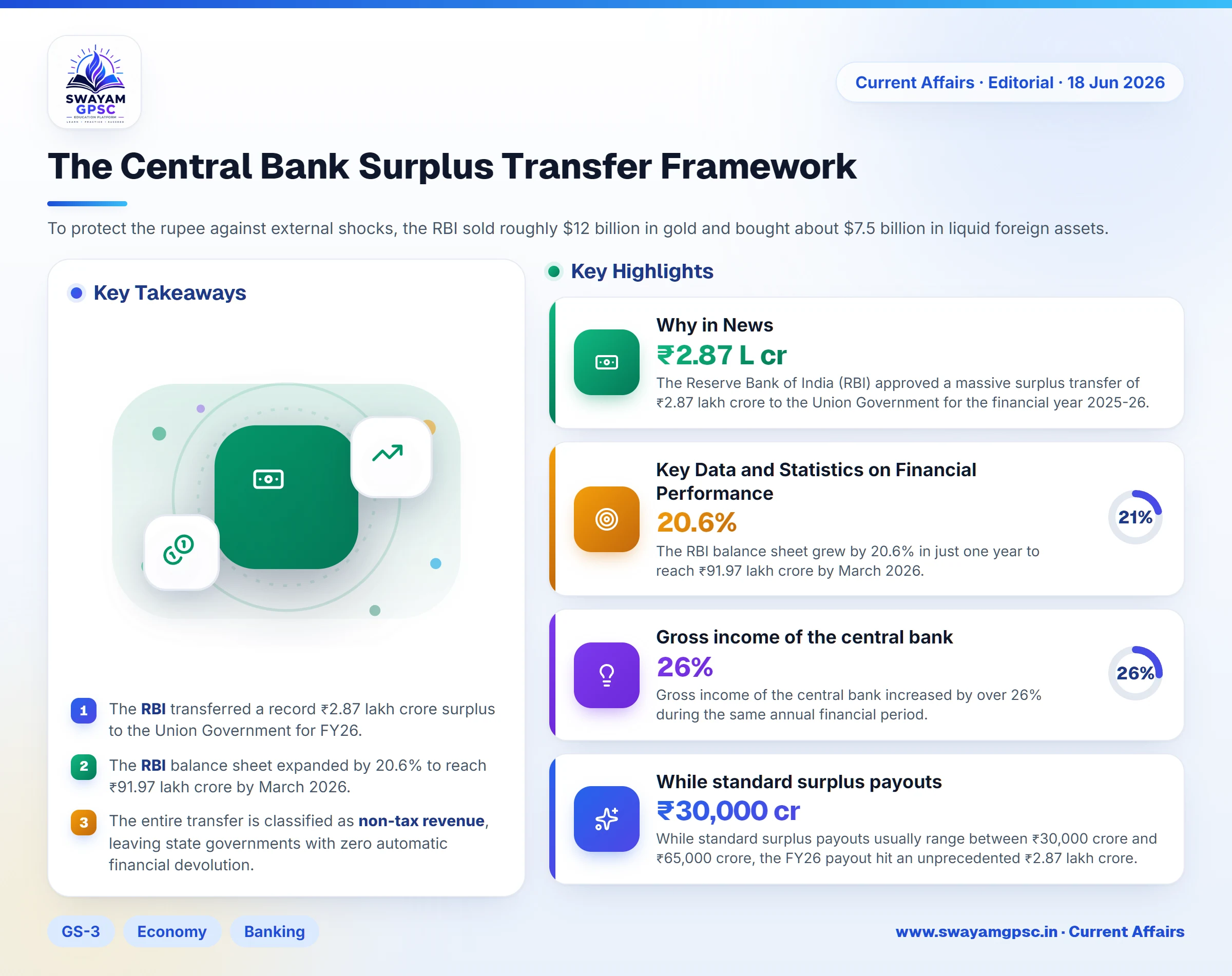
The Central Bank Surplus Transfer Framework
#GS-3 #Economy #Banking #Growth #Infrastructure #Indian Polity & Constitution #Federalism #Constitutional Bodies
Key takeaways
- The RBI transferred a record ₹2.87 lakh crore surplus to the Union Government for FY26.
- The RBI balance sheet expanded by 20.6% to reach ₹91.97 lakh crore by March 2026.
- The entire transfer is classified as non-tax revenue, leaving state governments with zero automatic financial devolution.
- States remain bound by strict borrowing limits under Article 293 despite bearing heavy local development duties.
Why in News
- The Reserve Bank of India (RBI) approved a massive surplus transfer of ₹2.87 lakh crore to the Union Government for the financial year 2025-26.
- This record payout follows the Economic Capital Framework (2019) guidelines but has triggered discussions regarding central bank autonomy and federal financial balance.
About The Central Bank Surplus Transfer Framework
- Central banks do not focus on making profits, but managing foreign exchange and monetary operations generates steady income.
- Under the Economic Capital Framework (2019), earnings above required safety buffers go to the government as non-tax revenue to create fiscal space without extra taxes or debt.
Key Data and Statistics on Financial Performance
- The RBI balance sheet grew by 20.6% in just one year to reach ₹91.97 lakh crore by March 2026.
- Gross income of the central bank increased by over 26% during the same annual financial period.
- While standard surplus payouts usually range between ₹30,000 crore and ₹65,000 crore, the FY26 payout hit an unprecedented ₹2.87 lakh crore.
- To protect the rupee against external shocks, the RBI sold roughly $12 billion in gold and bought about $7.5 billion in liquid foreign assets.
Analyzing Central Bank Fiscalisation
- A central bank needs institutional independence to keep a safe gap from short-term government spending demands.
- India's central bank earnings come from foreign asset returns and interest on securities rather than aggressive domestic bond buying seen in Western economies.
- The entire ₹2.87 lakh crore transfer is treated as non-tax revenue, meaning it goes solely to the Union Government with zero sharing with states.
- While the Center gains financial freedom, states remain stuck with strict borrowing limits under Article 293 of the Constitution.
Challenges
- Critics argue that massive non-shareable dividend transfers push the country toward asymmetric fiscal centralization.
- Relying on giant central bank payouts could expose monetary institutions to subtle pressure from the executive branch.
- Converting long-term gold reserves into liquid foreign papers changes the risk profile of the national balance sheet.
- This multi-billion dollar public fund transfer happens entirely without inter-state consultation or federal balance reviews.
Way Forward
- The RBI must keep conservative risk buffers under the Economic Capital Framework (2019) to protect its ₹92 lakh crore balance sheet.
- The Central Government should voluntarily share parts of massive non-tax windfalls with states facing tight borrowing limits under Article 293.
- Clear and timely reporting on gold liquidations must be enforced to prove that reserve management prioritizes stability over state revenue.
- Independent reviews should monitor the growing link between central bank earnings and state budgets to protect institutional autonomy.