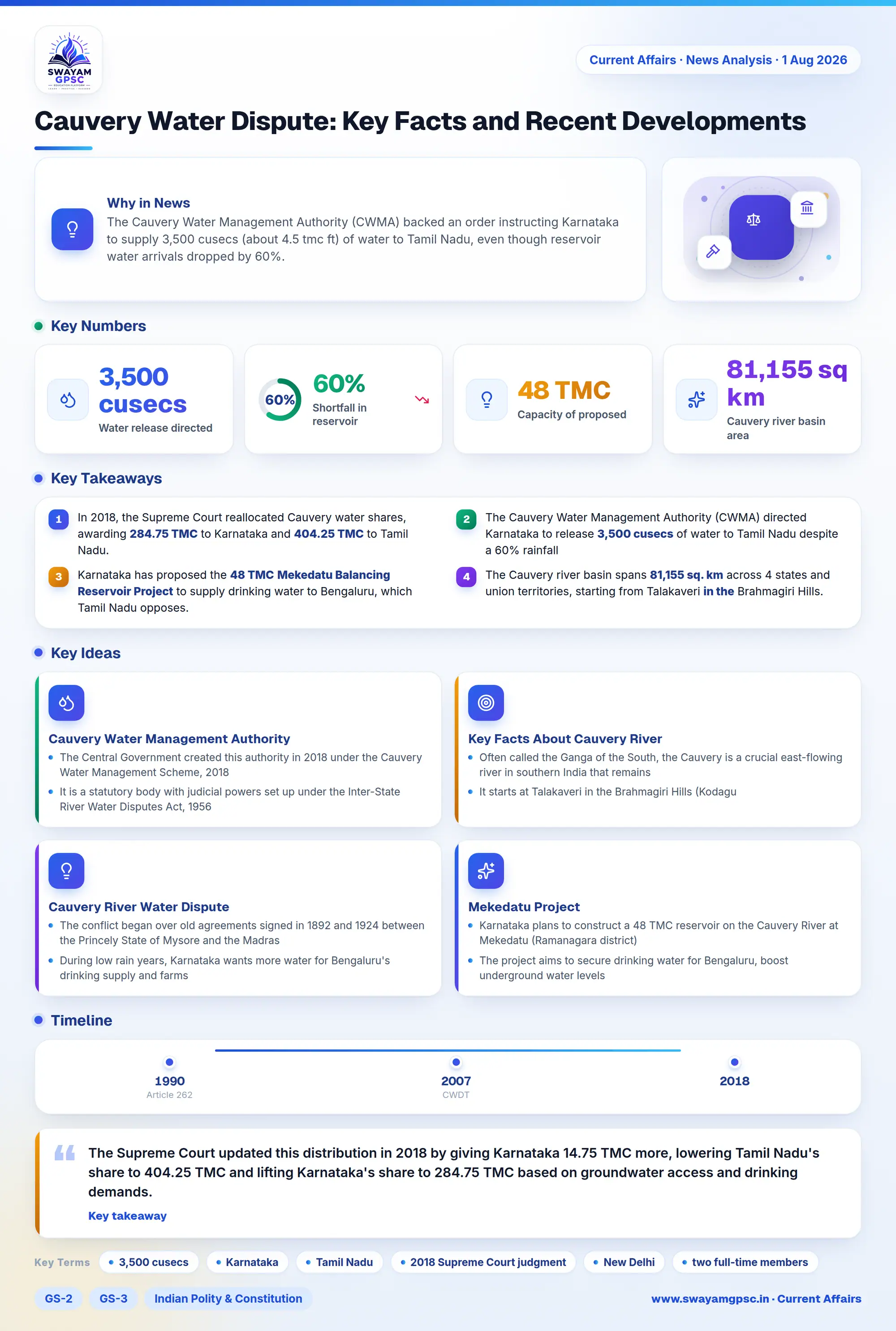
Cauvery Water Dispute: Key Facts and Recent Developments
#GS-2 #GS-3 #Indian Polity & Constitution #Federalism #Water Resources #National #Current Events
Key takeaways
- In 2018, the Supreme Court reallocated Cauvery water shares, awarding 284.75 TMC to Karnataka and 404.25 TMC to Tamil Nadu.
- The Cauvery Water Management Authority (CWMA) directed Karnataka to release 3,500 cusecs of water to Tamil Nadu despite a 60% rainfall inflow deficit.
- Karnataka has proposed the 48 TMC Mekedatu Balancing Reservoir Project to supply drinking water to Bengaluru, which Tamil Nadu opposes.
- The Cauvery river basin spans 81,155 sq. km across 4 states and union territories, starting from Talakaveri in the Brahmagiri Hills.
Why in News
- The Cauvery Water Management Authority (CWMA) backed an order instructing Karnataka to supply 3,500 cusecs (about 4.5 tmc ft) of water to Tamil Nadu, even though reservoir water arrivals dropped by 60%.
- Karnataka resisted this decision due to inadequate rain and delayed farming activities, whereas Tamil Nadu requested 9.8 tmc ft of water, causing fresh tensions over the river during a dry monsoon.
- At the same time, Tamil Nadu raised objections against Karnataka's proposed Mekedatu Balancing Reservoir Project and asked the Prime Minister to stop all official approvals for it.
Cauvery Water Management Authority
- The Central Government created this authority in 2018 under the Cauvery Water Management Scheme, 2018, alongside the Cauvery Water Regulation Committee (CWRC).
- It is a statutory body with judicial powers set up under the Inter-State River Water Disputes Act, 1956, to enforce the Cauvery Water Disputes Tribunal (CWDT) decisions modified by the 2018 Supreme Court judgment.
- Based in New Delhi under the Ministry of Jal Shakti, a senior IAS officer or a top civil engineer leads this team for a five-year term.
- The board features two full-time members for water and agriculture, two part-time members from the central government, four part-time members from basin states (Karnataka, Tamil Nadu, Kerala, and Puducherry), and a secretary from the Central Water Engineering Services (CWES).
- It handles river releases between states, sets fair water sharing rules during droughts, checks storage levels with the help of CWRC, and promotes better crop watering techniques.
Key Facts About Cauvery River
- Often called the Ganga of the South, the Cauvery is a crucial east-flowing river in southern India that remains central to a historic inter-state water dispute.
- It starts at Talakaveri in the Brahmagiri Hills (Kodagu, Karnataka) and travels across Karnataka and Tamil Nadu to meet the Bay of Bengal near Poompuhar.
- The river covers a catchment area of nearly 81,155 sq. km across Karnataka, Tamil Nadu, Kerala, and Puducherry.
- It stays filled with water throughout the year because its upper area gets rain during the Southwest Monsoon while the lower part receives water from the Northeast Monsoon.
- Its left bank is fed by the Harangi, Hemavati, Shimsha, and Arkavati rivers, while its right bank gets water from the Lakshmana Tirtha, Kabini, Suvarnavathi, Bhavani, Noyyal, and Amaravati rivers.
- The major water storage structures built across this river are the Krishna Raja Sagara dam in Karnataka and the Mettur Dam in Tamil Nadu.
- Key wildlife sanctuaries located within its basin include Nagarhole National Park (Karnataka), Wayanad Wildlife Sanctuary (Kerala), and Sathyamangalam Tiger Reserve (Tamil Nadu).
Cauvery River Water Dispute
- The conflict began over old agreements signed in 1892 and 1924 between the Princely State of Mysore and the Madras Presidency.
- During low rain years, Karnataka wants more water for Bengaluru's drinking supply and farms, while Tamil Nadu demands fixed releases to protect its Cauvery delta farming, especially the Kuruvai crop.
- Post-independence, the central authorities handled the legal issue under Article 262 and the Inter-State River Water Disputes Act, 1956, leading to the creation of the Cauvery Water Disputes Tribunal (CWDT) in 1990.
- In its 2007 award, the CWDT shared 740 TMC of water by assigning 419 TMC to Tamil Nadu, 270 TMC to Karnataka, 30 TMC to Kerala, 7 TMC to Puducherry, and keeping 14 TMC for nature.
- The Supreme Court updated this distribution in 2018 by giving Karnataka 14.75 TMC more, lowering Tamil Nadu's share to 404.25 TMC and lifting Karnataka's share to 284.75 TMC based on groundwater access and drinking demands.
- The court affirmed that river waters belong to the entire country, directing the operationalization of the CWMA and CWRC to handle water disputes smoothly.
Mekedatu Project
- Karnataka plans to construct a 48 TMC reservoir on the Cauvery River at Mekedatu (Ramanagara district), located around 100 km from Bengaluru.
- The project aims to secure drinking water for Bengaluru, boost underground water levels, and generate electricity without altering the river sharing limits set in 2007 and 2018.
- Tamil Nadu fears that this dam will allow Karnataka to hold back water during dry periods, violating the CWDT Award which bans new upper river dams without mutual consensus.