Cauvery River Water Sharing Dispute and Mekedatu Reservoir Project
#GS-1 #Geography #Physical Geography #Resources #GS-2 #Indian Polity & Constitution #Federalism #Current Events #National #Cauvery River Dispute #Mekedatu Project
Key takeaways
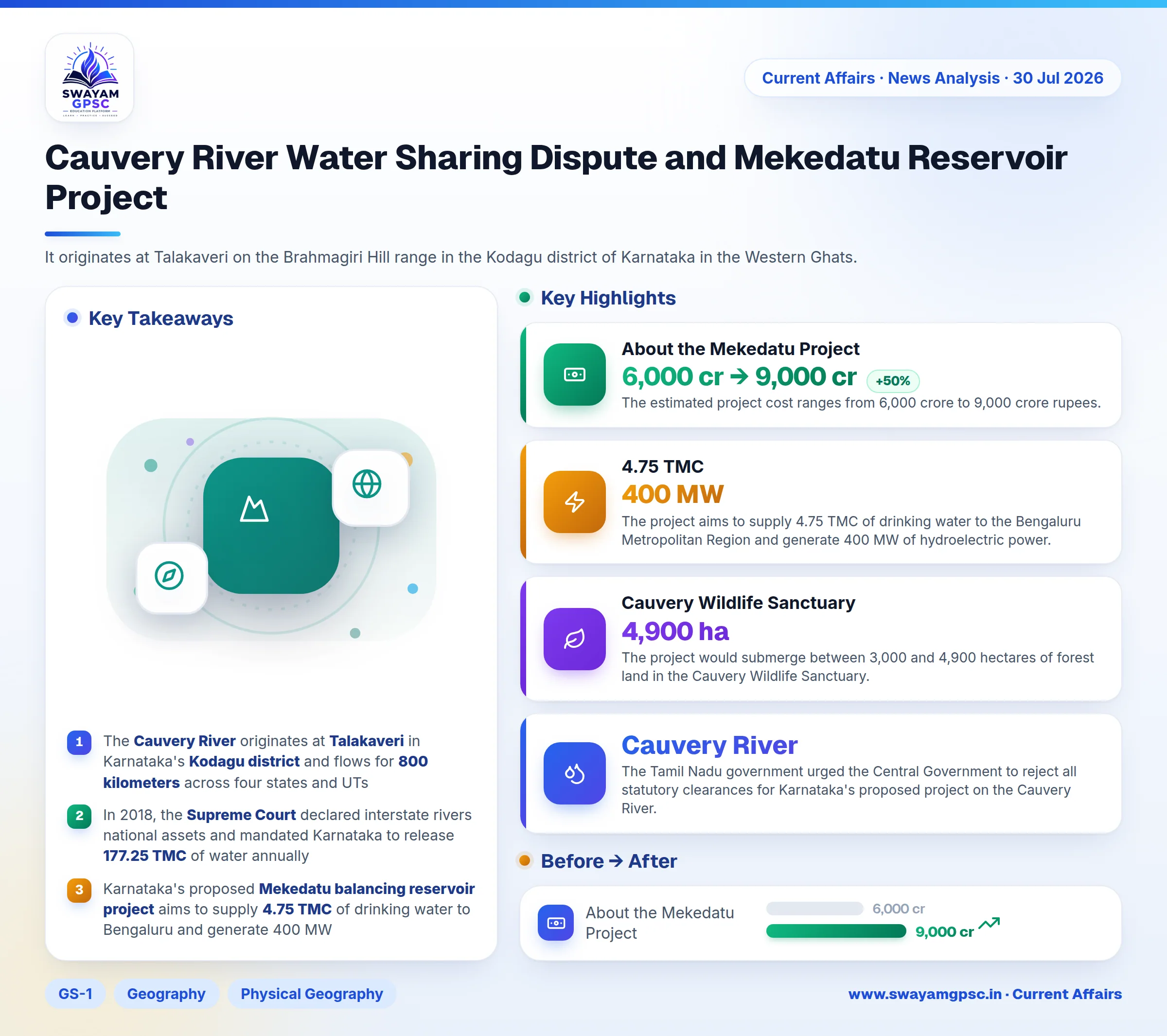
- The Cauvery River originates at Talakaveri in Karnataka's Kodagu district and flows for 800 kilometers across four states and UTs before draining into the Bay of Bengal.
- In 2018, the Supreme Court declared interstate rivers national assets and mandated Karnataka to release 177.25 TMC of water annually to Tamil Nadu at Biligundlu.
- Karnataka's proposed Mekedatu balancing reservoir project aims to supply 4.75 TMC of drinking water to Bengaluru and generate 400 MW of power at an estimated cost of 6,000 crore to 9,000 crore rupees.
- The Mekedatu project faces strong opposition from Tamil Nadu and raises ecological concerns due to the submergence of up to 4,900 hectares of forest in the Cauvery Wildlife Sanctuary.
Why in News
- The Chief Minister of Tamil Nadu wrote a letter to the Prime Minister of India regarding the Mekedatu balancing reservoir project.
- The Tamil Nadu government urged the Central Government to reject all statutory clearances for Karnataka's proposed project on the Cauvery River.
Overview of the Cauvery River
- The Cauvery River is one of the primary east-flowing peninsular rivers in Southern India.
- Historically known as the Ganga of the South or Ponni, it serves as a critical water source for farming, drinking, and wildlife.
- It originates at Talakaveri on the Brahmagiri Hill range in the Kodagu district of Karnataka in the Western Ghats.
- The river flows for about 800 kilometers across Southern India before reaching the Bay of Bengal at Poompuhar in Tamil Nadu.
- The Cauvery basin covers an area of 87,900 square kilometers across four states and Union Territories: Karnataka, Tamil Nadu, Kerala, and Puducherry.
Major Tributaries of the Cauvery
- The main left-bank tributaries of the river are the Harangi, Hemavati, Shimsha, and Arkavati.
- The main right-bank tributaries of the river are the Lakshmantirtha, Kabini, Suvarnavati, Bhavani, Noyil, and Amaravati.
Judicial Framework on Cauvery Water Sharing
- Water allocation was first set under the Cauvery Water Disputes Tribunal (CWDT) Award (2007) based on a total yield of 740 TMC.
- Under the 2007 CWDT Award, Tamil Nadu received 419 TMC, Karnataka received 270 TMC, Kerala received 30 TMC, Puducherry received 7 TMC, and 14 TMC was reserved for the environment.
- In 2018, the Supreme Court modified the award and ruled that an interstate river is a shared national asset.
- Under the 2018 Supreme Court Judgment, Karnataka's share increased to 284.75 TMC to meet Bengaluru's drinking water needs.
- The Supreme Court set Tamil Nadu's share at 404.25 TMC after considering 10 TMC of available groundwater.
- The allocations of 30 TMC for Kerala and 7 TMC for Puducherry remained unchanged.
- The Supreme Court directed Karnataka to release 177.25 TMC of water every year to Tamil Nadu at the Biligundlu gauging station.
About the Mekedatu Project
- Mekedatu means Goat's Leap in Kannada and is a proposed multipurpose balancing reservoir by Karnataka.
- The project is situated in the Ramanagara district of Karnataka, about 100 kilometers south of Bengaluru.
- It is located at the confluence of the Arkavati River and Cauvery River, just 4 to 5 kilometers upstream from the Tamil Nadu border.
- The proposed reservoir will have a storage capacity between 48 TMC and 67 TMC.
- The estimated project cost ranges from 6,000 crore to 9,000 crore rupees.
- The project aims to supply 4.75 TMC of drinking water to the Bengaluru Metropolitan Region and generate 400 MW of hydroelectric power.
- The project would submerge between 3,000 and 4,900 hectares of forest land in the Cauvery Wildlife Sanctuary.