Catch the Rain Campaign: Decentralized Water Conservation
#GS-2 #GS-3 #Government Policies & Interventions #Conservation #Climate Change #Governance & Social Justice #Environment #Water Conservation
Key takeaways
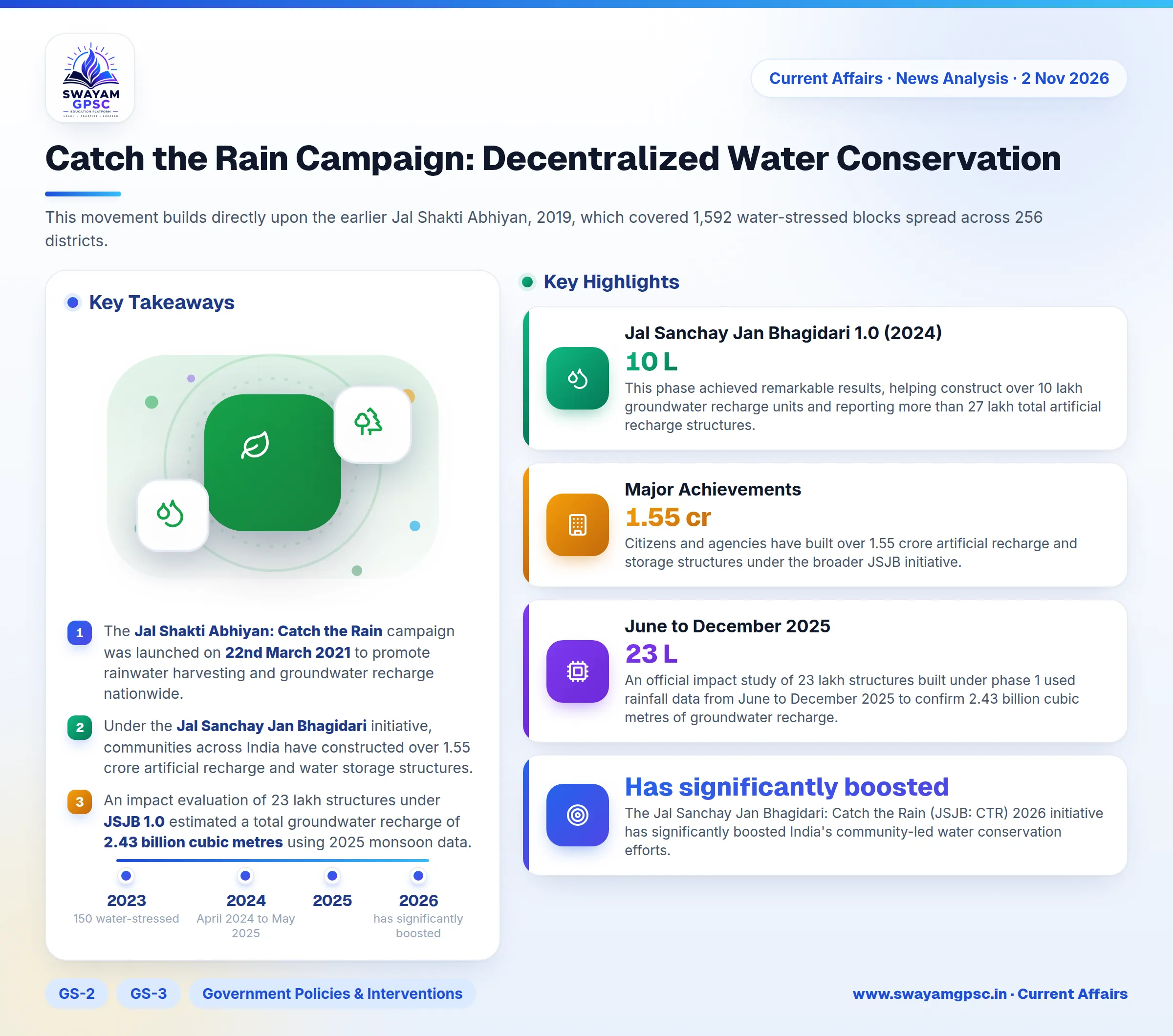
- The Jal Shakti Abhiyan: Catch the Rain campaign was launched on 22nd March 2021 to promote rainwater harvesting and groundwater recharge nationwide.
- Under the Jal Sanchay Jan Bhagidari initiative, communities across India have constructed over 1.55 crore artificial recharge and water storage structures.
- An impact evaluation of 23 lakh structures under JSJB 1.0 estimated a total groundwater recharge of 2.43 billion cubic metres using 2025 monsoon data.
- The campaign uses the 3Cs Approach standing for Community, Corporate Social Responsibility (CSR), and Cost to build low-cost, decentralized water infrastructure.
Why in News
- The Jal Sanchay Jan Bhagidari: Catch the Rain (JSJB: CTR) 2026 initiative has significantly boosted India's community-led water conservation efforts.
- It focuses on combining rainwater harvesting, groundwater recharge, and the revival of local water bodies into a single unified effort.
Key Facts About the Catch the Rain Campaign
- The Jal Shakti Abhiyan: Catch the Rain (JSA: CTR) campaign was officially launched on 22nd March 2021 to mark World Water Day.
- It uses the core central theme “Catch the Rain, Where It Falls, When It Falls.”
- This movement builds directly upon the earlier Jal Shakti Abhiyan, 2019, which covered 1,592 water-stressed blocks spread across 256 districts.
- Its major objectives include promoting rainwater harvesting, recharging underground aquifers, rejuvenating traditional water bodies, developing watersheds, and expanding tree cover through public participation.
- Key physical interventions involve setting up rainwater harvesting systems, recharge pits, and recharge shafts across private residences, institutional complexes, and public spaces.
- It prioritizes restoring traditional wells, stepwells (baolis), local ponds, and dried-up borewells to strengthen subterranean water tables.
- Desilting activities in local ponds and reservoirs help clear out accumulated mud, directly boosting monsoon water storage capacity.
- Afforestation drives and ecological protection of catchment zones build long-term climate resilience and improve natural water retention.
- The campaign converts water conservation into a widespread Jan Andolan (people's movement) by actively involving ordinary citizens, local bodies, schools, and non-profit groups.
- District-level Jal Shakti Kendras (JSKs) act as local knowledge hubs, offering technical support and helping communities plan their water management projects.
Jal Sanchay Jan Bhagidari 1.0 (2024)
- Implemented from April 2024 to May 2025, this first phase encouraged communities to build low-cost water recharge structures suited to their local geography.
- It relies on the Three Cs Approach, which stands for Community, Corporate Social Responsibility (CSR), and Cost.
- The model pulls resources from multiple existing schemes by following a combined Whole-of-Government and Whole-of-Society strategy.
- This phase achieved remarkable results, helping construct over 10 lakh groundwater recharge units and reporting more than 27 lakh total artificial recharge structures.
Jal Sanchay Jan Bhagidari 2.0 (2025)
- Launched on 1st June 2025, this second phase expanded grassroots conservation work, placing extra focus on critical and over-exploited groundwater areas.
- It concentrates on hyper-local, affordable recharge solutions, reviving natural water sources, and promoting strong local community ownership.
- The top-performing teams and communities from phase 1 received official recognition during the 6th National Water Awards in November 2025.
Jal Sanchay Jan Bhagidari: Catch the Rain (2026)
- Rolled out on 1st June 2026, this phase combines the JSJB model directly with the Catch the Rain campaign to strengthen long-term water security.
- It combines funds and support from key schemes like VB-G RAM G, PM Krishi Sinchayee Yojana (PMKSY), CAMPA, and Finance Commission Grants.
- Gram Panchayats, urban local bodies, self-help groups, youth teams, schools, and non-profits drive the project planning and ground execution.
- A dedicated digital portal and mobile application ensure real-time project tracking, complete operational transparency, and public feedback.
Jal Shakti Abhiyan: Catch the Rain (JSA: CTR)
- This overall national effort builds on lessons from JSA 2019, which covered 1,592 water-stressed blocks across 256 districts.
- It drives water conservation, watershed management, afforestation, and water body revival through nationwide public participation.
- The government runs this nationwide drive every year, updating the central theme and key priorities to meet emerging water challenges.
Major Achievements
- Citizens and agencies have built over 1.55 crore artificial recharge and storage structures under the broader JSJB initiative.
- An official impact study of 23 lakh structures built under phase 1 used rainfall data from June to December 2025 to confirm 2.43 billion cubic metres of groundwater recharge.
Annual Themes and Focus Areas
- The 2021 campaign focused on 'Catch the Rain, Where It Falls, When It Falls', emphasizing scientific planning, mapping water bodies, and creating Jal Shakti Kendras.
- The 2022 drive expanded interventions to revive traditional water bodies, protect spring-sheds, rejuvenate wetlands, and restore degraded rivers.
- The 2023 initiative targeted 150 water-stressed districts under the theme 'Source Sustainability for Drinking Water' to protect local drinking water sources.
- The 2024 phase adopted the theme 'Nari Shakti se Jal Shakti', empowering women's groups to lead pond desilting, borewell revival, and local tree planting drives.
- The 2025 theme, 'Jal Sanchay Jan Bhagidari: Jan Jagrukta ki Ore', prioritized 148 districts using the 3Cs model to combine public awareness with multi-scheme funding.
Conclusion
- The campaign shifts India away from central planning toward local, scientifically guided water management.
- Combining community leadership, modern digital tracking, and traditional wisdom builds long-term groundwater security and climate resilience across rural India.