Carbon Capture, Utilisation and Storage (CCUS) in India
#GS-3 #Environment #Climate Change #Science & Technology #Infrastructure #Conservation #Achievements of Indians in Science & Technology
Key takeaways
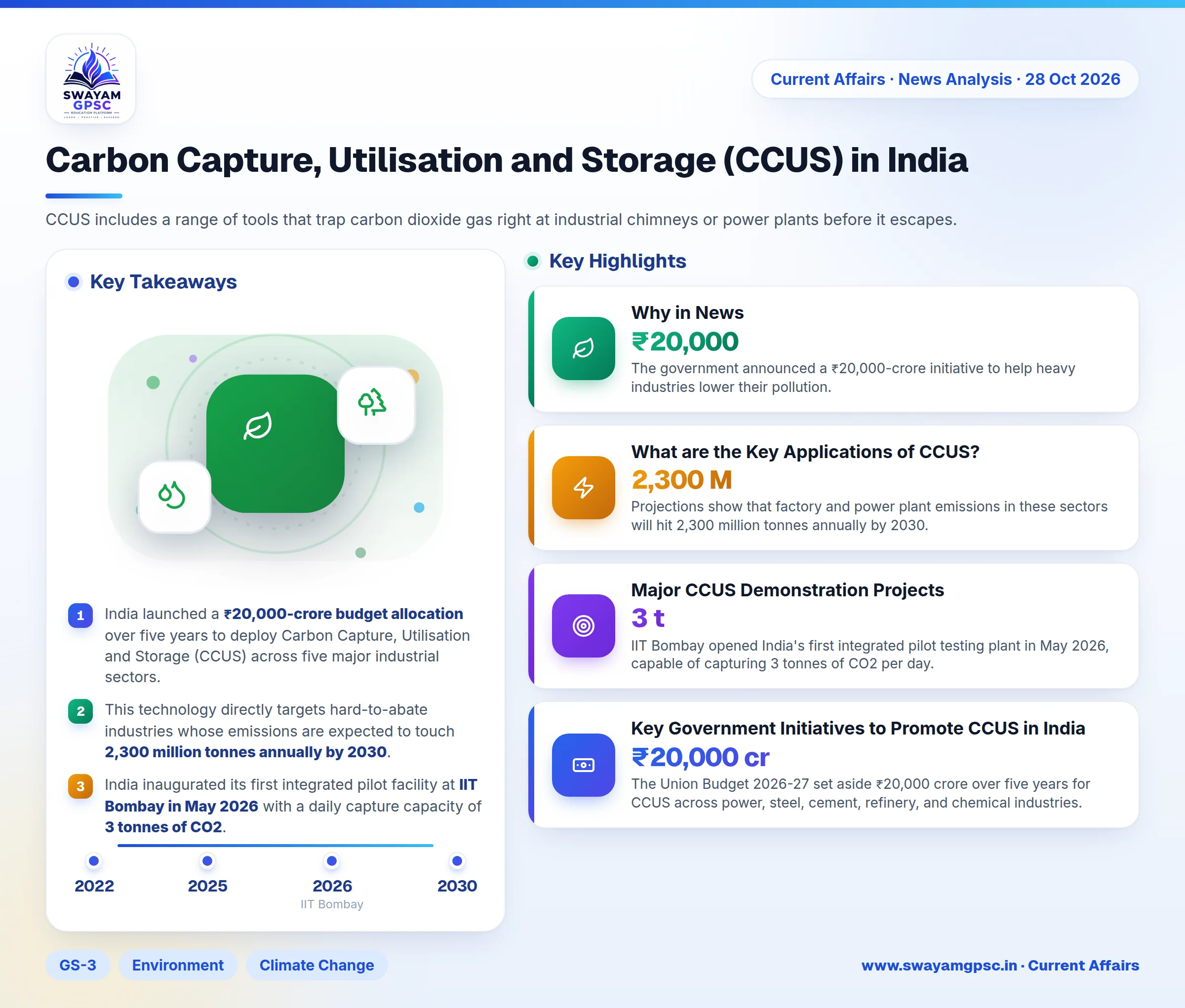
- India launched a ₹20,000-crore budget allocation over five years to deploy Carbon Capture, Utilisation and Storage (CCUS) across five major industrial sectors.
- This technology directly targets hard-to-abate industries whose emissions are expected to touch 2,300 million tonnes annually by 2030.
- India inaugurated its first integrated pilot facility at IIT Bombay in May 2026 with a daily capture capacity of 3 tonnes of CO2.
- By April 2026, India's national CCU pipeline expanded to include 3 active, 6 under-construction, and 16 proposed projects.
- CCUS is essential for meeting India's broader climate commitments, including its Panchamrit targets and Net Zero emissions by 2070.
Why in News
- India is taking big steps to build its Carbon Capture, Utilisation and Storage (CCUS) framework.
- The country is expanding research efforts, launching industrial pilot projects, and committing money.
- The government announced a ₹20,000-crore initiative to help heavy industries lower their pollution.
- This effort plays a central role in helping India achieve its Net Zero emissions target by 2070.
What is Carbon Capture, Utilisation and Storage (CCUS)?
- CCUS includes a range of tools that trap carbon dioxide gas right at industrial chimneys or power plants before it escapes.
- After trapping the carbon dioxide, facilities either use it to manufacture products or lock it deep underground permanently.
- This technology focuses on heavy industries where switching to solar or battery power alone cannot wipe out emissions.
- The capture process works by separating carbon dioxide from factory smoke, followed by cleaning and compressing the gas for easy transport.
- Transport systems move the compressed gas through pipelines, ocean ships, or trucks to usage hubs or underground storage wells.
- Utilisation turns the trapped gas into useful industrial raw materials like building blocks or chemical feedstocks.
- Geological storage pumps the gas deep underground into natural rock layers to isolate it from the air forever.
- Storage locations include depleted oil and gas fields, deep saline aquifers, and underground basalt formations.
- The NITI Aayog framework promotes shared regional hubs that connect nearby factories to common pipelines, lowering overall costs for everyone.
What are the Key Applications of CCUS?
- It helps clean up hard-to-abate sectors like steel, cement, oil refining, chemical plants, and fertiliser manufacturing.
- Projections show that factory and power plant emissions in these sectors will hit 2,300 million tonnes annually by 2030.
- It supports blue hydrogen production by trapping carbon emissions created during fossil fuel processing.
- While green hydrogen uses renewable power to split water, blue hydrogen captures carbon created from natural gas or coal.
- Factories can convert captured gas into building materials, synthetic fuels, methanol, plastics, and chemicals to create a circular carbon economy.
- Oil companies can pump carbon dioxide into old wells through Enhanced Oil Recovery (EOR) to pull out remaining petroleum while trapping some gas.
- Companies can add capture equipment directly onto running power plants and older factories without tearing them down.
- Carbon mineralisation binds the gas with rocks to produce hard mineral carbonates for eco-friendly construction materials.
- Biological systems can feed the captured gas to algae farms, producing biofuels and biomass products.
Major CCUS Demonstration Projects
- IIT Bombay opened India's first integrated pilot testing plant in May 2026, capable of capturing 3 tonnes of CO2 per day.
- Researchers at IIT Bombay will also drill test wells into the Deccan Traps basalt rock formations to verify safe permanent storage.
- The Department of Science and Technology (DST) created five CCU testbeds for cement plants in May 2025 through public-private partnerships.
- The DST is funding two pilot plants with IIT Delhi-Thermax and CSIR-IICT Hyderabad-BHEL to turn coal gas into methanol and Dimethyl Ether (DME).
- India joined international initiatives like Accelerating CCUS Technologies (ACT) and the Clean Energy Transition Partnership (CETP) across four research groups.
- By April 2026, India recorded 3 active, 6 under-construction, and 16 planned CCU projects across various states.
- The 3 active projects operate in Madhya Pradesh, Tamil Nadu, and Maharashtra.
- The 6 projects under construction are located in Andhra Pradesh (3), Telangana (2), and Maharashtra (1).
- The 16 planned projects cover Assam (4), Odisha (4), Gujarat (2), Rajasthan (2), along with individual projects in Andhra Pradesh, Madhya Pradesh, Haryana, and Tamil Nadu.
Key Government Initiatives to Promote CCUS in India
- The Union Budget 2026-27 set aside ₹20,000 crore over five years for CCUS across power, steel, cement, refinery, and chemical industries.
- The DST CCUS Research Roadmap (2025) guides research funding, domestic machine building, and large-scale industrial adoption.
- The roadmap highlights major industrial zones like the Gujarat coast, the Odisha-Jharkhand industrial belt, and Northeast India for joint CCUS networks.
- The NITI Aayog Policy Framework (2022) outlines detailed sector guides and shared infrastructure strategies to support industrial decarbonisation.
- The government established National CCUS Centres at IIT Bombay and JNCASR Bengaluru in 2022 to lead technology development.
- The DST and the Department of Biotechnology (DBT) team up with global partners under the Mission Innovation program.
- The CSIR hosted the ESTIC Conclave 2026 in New Delhi from 27-29 October 2026 under the theme “Creative Minds, Catalyzing Science, Empowering Technologies”.
Conclusion
- CCUS technology serves as a major pillar for reaching India's Panchamrit targets and Net Zero goal by 2070.
- Building better research facilities, investment channels, and factory installations will protect the environment while supporting economic growth.