CAG Performance Audit of Green India Mission
#GS-2 #GS-3 #Governance & Social Justice #Environment #Good Governance #Climate Change #Sustainable Development #National
Key takeaways
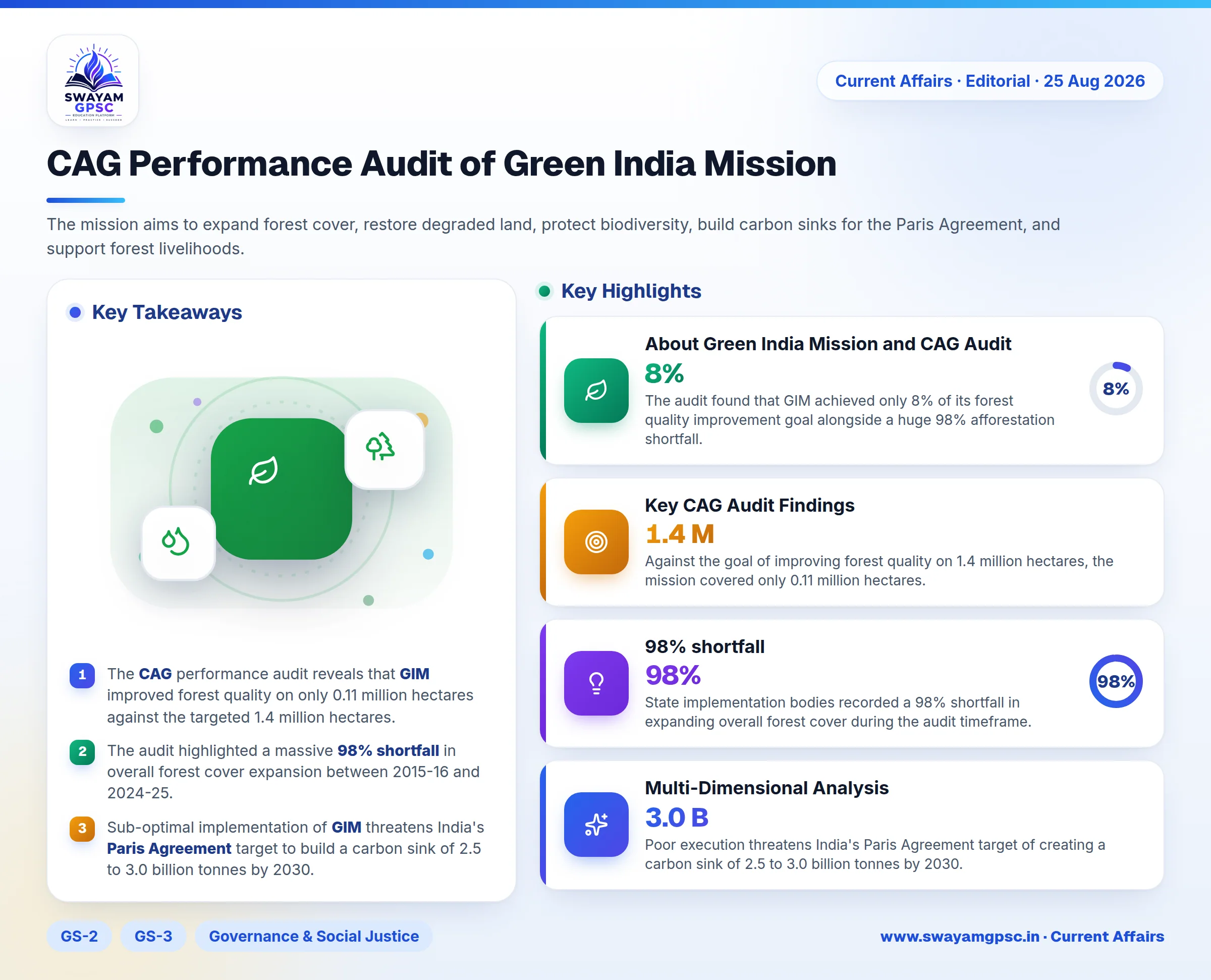
- The CAG performance audit reveals that GIM improved forest quality on only 0.11 million hectares against the targeted 1.4 million hectares.
- The audit highlighted a massive 98% shortfall in overall forest cover expansion between 2015-16 and 2024-25.
- Sub-optimal implementation of GIM threatens India's Paris Agreement target to build a carbon sink of 2.5 to 3.0 billion tonnes by 2030.
- Experts recommend allocating 70% of mission funds to eco-sensitive zones using ISRO vulnerability maps and tracking 3 to 5 year sapling survival rates.
Why in News
- The Comptroller and Auditor General of India (CAG) presented a performance audit of the National Mission for a Green India (GIM) in Parliament.
- This performance audit evaluated the mission's progress from 2015-16 to 2024-25 across 16 States and Union Territories.
- The government started GIM in 2014 as one of the eight core missions under the National Action Plan on Climate Change (NAPCC).
- The mission aims to expand forest cover, restore degraded land, protect biodiversity, build carbon sinks for the Paris Agreement, and support forest livelihoods.
About Green India Mission and CAG Audit
- The audit found that GIM achieved only 8% of its forest quality improvement goal alongside a huge 98% afforestation shortfall.
- The CAG pointed out serious shortcomings in funding delivery, inter-agency coordination, and ground-level monitoring.
Key CAG Audit Findings
- Against the goal of improving forest quality on 1.4 million hectares, the mission covered only 0.11 million hectares.
- State implementation bodies recorded a 98% shortfall in expanding overall forest cover during the audit timeframe.
- State officials bypassed vulnerable climate zones and chose low-risk regions without scientific justification.
- The mission worked in isolation without linking to other forestry programs like CAMPA or MGNREGS.
- Several state agencies failed to maintain yearly financial records, leading to unverified accounting entries.
- The program lacked unified annual planting targets, live seedling tracking systems, and field verification procedures.
Multi-Dimensional Analysis
- Programs like Nagar Van Yojana and School Nursery Yojana operated independently instead of following a broad landscape strategy.
- State Forest Departments faced administrative delays, shortages of field staff, and slow approval of Annual Plans of Operation.
- The program suffered from persistent gaps between estimated financial requirements and actual budget allocations.
- Delays in sending funds from state treasuries to field units disrupted essential pre-plantation nursery preparations.
- Historic planting drives focused mainly on total sapling counts rather than native biodiversity and multi-layer forest canopies.
- High mortality rates occurred because agencies failed to maintain saplings over the required 3 to 5 year lifecycle.
- Limited involvement of Gram Sabhas and Joint Forest Management Committees (JFMCs) reduced local ownership of plantations.
- Agencies neglected forest-based livelihood goals, which decreased local community motivation to protect plantation sites.
- Poor execution threatens India's Paris Agreement target of creating a carbon sink of 2.5 to 3.0 billion tonnes by 2030.
Challenges
- High population density and competing agricultural land use make acquiring large parcels of land for planting very difficult.
- Heatwaves, unpredictable rainfall, and human-wildlife conflicts lower sapling survival rates across field locations.
- State capacities vary significantly regarding frontline staffing, nursery automation, and digital monitoring systems.
Way Forward
- State governments should establish single-window coordination bodies to pool funds from GIM, CAMPA, and MGNREGS.
- Authorities should direct at least 70% of available funds to eco-sensitive areas using ISRO climate vulnerability maps.
- Forest divisions should measure success by tree canopy growth after 3 to 5 years rather than initial saplings planted.
- States must mandate high-resolution satellite tracking, geotagged tree monitoring, and public transparency dashboards.
- Governments should transfer planning authority and survival-linked Direct Benefit Transfer (DBT) payments to JFMCs and FRA bodies.
Conclusion
- The CAG report offers a clear framework to reform forest governance and improve environmental outcomes.
- India can fulfill its international climate commitments by moving from symbolic planting numbers to transparent, community-led forest restoration.