Cabinet Approves BHAVYA Rasayan Scheme for Chemical Parks
#GS-3 #Economy #Infrastructure #Current Events #National #BHAVYA Rasayan Scheme
Key takeaways
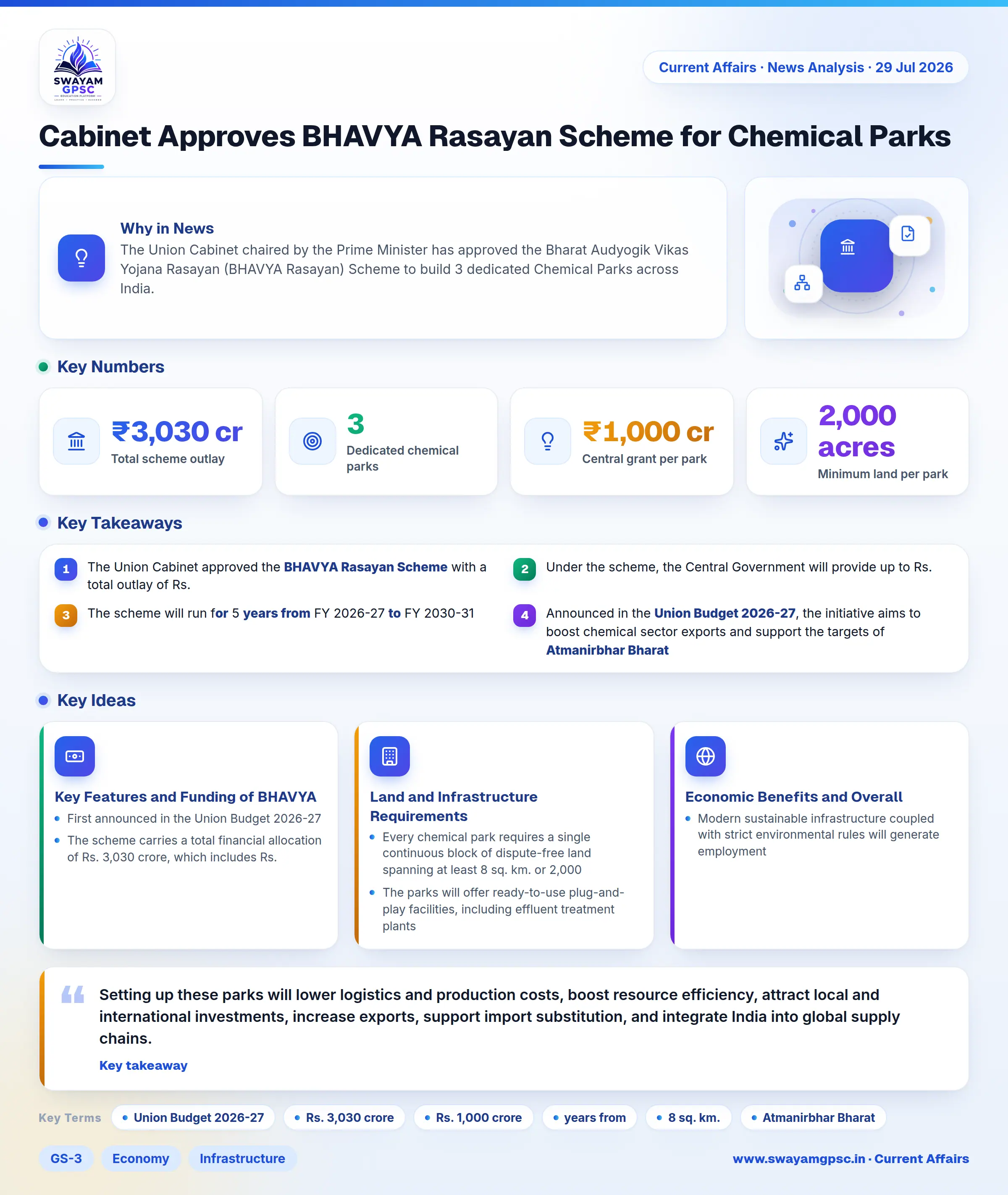
- The Union Cabinet approved the BHAVYA Rasayan Scheme with a total outlay of Rs. 3,030 crore to establish 3 dedicated Chemical Parks across India.
- Under the scheme, the Central Government will provide up to Rs. 1,000 crore per park, while State Governments must contribute a minimum of Rs. 500 crore.
- The scheme will run for 5 years from FY 2026-27 to FY 2030-31, requiring each park to possess at least 8 sq. km. or 2,000 acres of contiguous land.
- Announced in the Union Budget 2026-27, the initiative aims to boost chemical sector exports and support the targets of Atmanirbhar Bharat and Viksit Bharat @ 2047.
Why in News
- The Union Cabinet chaired by the Prime Minister has approved the Bharat Audyogik Vikas Yojana Rasayan (BHAVYA Rasayan) Scheme to build 3 dedicated Chemical Parks across India.
Key Features and Funding of BHAVYA Rasayan Scheme
- First announced in the Union Budget 2026-27, the BHAVYA Rasayan scheme sets up chemical parks with shared infrastructure for chemical, petrochemical, downstream, and ancillary industries.
- The scheme carries a total financial allocation of Rs. 3,030 crore, which includes Rs. 3,000 crore for common infrastructure and utilities along with Rs. 30 crore for administrative costs.
- The Central Government will offer up to Rs. 1,000 crore for each park, while the respective State Government must contribute at least Rs. 500 crore.
- Implementation will span 5 years from FY 2026-27 to FY 2030-31, with State Governments competing to develop these parks through the Challenge Route.
Land and Infrastructure Requirements
- Every chemical park requires a single continuous block of dispute-free land spanning at least 8 sq. km. or 2,000 acres.
- The parks will offer ready-to-use plug-and-play facilities, including effluent treatment plants, hazardous waste management systems, water supply, solvent recovery units, steam networks, pipelines, logistics, and warehousing.
Economic Benefits and Overall Significance
- Setting up these parks will lower logistics and production costs, boost resource efficiency, attract local and international investments, increase exports, support import substitution, and integrate India into global supply chains.
- Modern sustainable infrastructure coupled with strict environmental rules will generate employment, strengthen downstream businesses, and help fulfill the vision of Atmanirbhar Bharat and Viksit Bharat @ 2047.