Building Universal Social Security for India's Informal Workers
#GS-3 #Economy #Employment #GS-2 #Governance & Social Justice #Vulnerable Sections #Poverty #e-Shram Portal #Social Security
Key takeaways
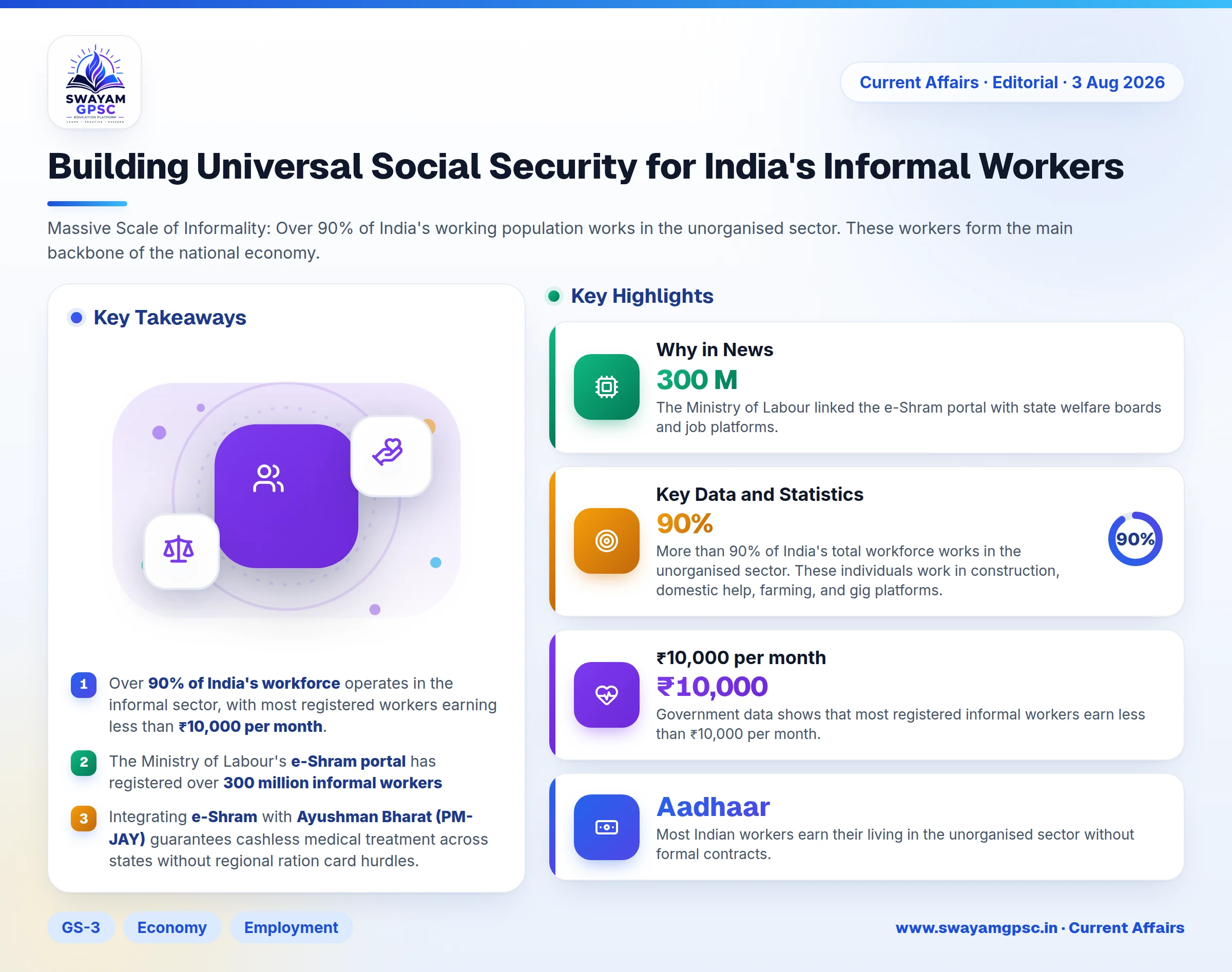
- Over 90% of India's workforce operates in the informal sector, with most registered workers earning less than ₹10,000 per month.
- The Ministry of Labour's e-Shram portal has registered over 300 million informal workers, creating a national database for welfare targeting.
- Integrating e-Shram with Ayushman Bharat (PM-JAY) guarantees cashless medical treatment across states without regional ration card hurdles.
- A portable safety net requires pooled financing through automated welfare cesses on digital platforms, logistics operators, and construction projects.
Why in News
- The Ministry of Labour linked the e-Shram portal with state welfare boards and job platforms. This step created a single digital record of more than 300 million unorganised workers.
- This progress shows that India must move beyond registration. The country now needs to offer portable social security to every informal worker.
About Universal Social Security for India's Informal Workforce
- A universal social safety net offers lifelong protection to informal workers. This protection includes healthcare, accident coverage, and pensions that move with workers when they switch jobs or locations.
- Most Indian workers earn their living in the unorganised sector without formal contracts. Creating a single social security account linked to Aadhaar helps shield poor families from sudden financial trouble.
Key Data and Statistics
- More than 90% of India's total workforce works in the unorganised sector. These individuals work in construction, domestic help, farming, and gig platforms.
- Government data shows that most registered informal workers earn less than ₹10,000 per month. This small income leaves families with no savings for health emergencies or job losses.
- The e-Shram portal has registered over 300 million informal workers. This system creates a national database to target welfare benefits effectively.
Need for Social Security Coverage for Informal Workers
- Massive Scale of Informality: Over 90% of India's working population works in the unorganised sector. These workers form the main backbone of the national economy.
- Low Earning Baseline and Vulnerability: A large majority of registered informal workers earn below ₹10,000 per month. They lack any financial shield against sudden cash crises.
- Health Crisis Impoverishment: Unexpected hospital expenses are the main cause of sudden debt for poor families. High medical costs force households to sell assets or pull children out of school.
- Economic Insecurity from Unstable Work: Informal jobs offer no written contracts, paid sick leave, injury protection, or pensions. A short illness can destroy a family's daily survival.
- Dignity of Labour and Inclusive Growth: Turning digital registration into lifelong social protection stops predatory debt. It also helps fulfill the economic promise of Viksit Bharat.
Key Pillars of a Portable Universal Safety Net
- Aadhaar-Linked Universal Account: India needs a single social security account linked to Aadhaar. This account will follow workers smoothly across state borders and job changes.
- Cashless Healthcare Access: Connecting e-Shram directly with Ayushman Bharat (PM-JAY) guarantees free medical treatment at empanelled hospitals nationwide without needing local ration cards.
- Immediate Accident Cover and Old-Age Pension: The government must provide basic insurance for workplace injuries. It must also set up a minimum monthly pension for elderly informal workers.
- Pooled and Innovative Financing Architecture: Funding should combine central government money with automatic welfare cesses. These cesses can come from digital platforms, logistics firms, and construction projects.
- Flexible Micro-Contributions: Workers should have options to make small payments through digital wallets. These optional savings will help workers build higher pensions over time.
Challenges
- Geographic and Administrative Fragmentation: Traditional welfare programs link benefits strictly to home addresses. Migrant workers lose access to welfare benefits as soon as they move to another state.
- Spatial Friction for Inter-State Migrants: Migrant workers build city infrastructure and handle supply chains. However, strict local document rules keep them out of state welfare boards.
- Occupational Rigidity: Welfare rules tie benefits to specific job types. This system penalizes workers who switch between seasonal farming, site construction, and gig work.
- Absence of Unified Portability Mechanisms: Even with digital records, health benefits, pensions, and welfare support cannot transfer easily across state lines or job shifts.
- Piecemeal Funding Models: Separate state welfare boards often mismanage or underuse their funds. They lack a shared funding system supported by digital platform cesses.
Way Forward
- Single-Window Portable Account: Policy makers must launch a universal social security account linked to digital identity that remains active across all states and jobs.
- Universal Healthcare Integration: Linking e-Shram profiles directly to Ayushman Bharat (PM-JAY) will ensure free, cashless treatment in any hospital across India.
- Pooled and Innovative Financing: Government should collect welfare cesses from app-based platforms, transport companies, and large infrastructure projects to fund worker safety.
- Flexible Micro-Contributions: Simple digital wallet tools should let informal workers save small amounts voluntarily for their retirement years.
- Core Triad Guarantees: The welfare system must deliver three basic rights on the ground: workplace injury cover, nationwide healthcare, and a minimum monthly pension.
Conclusion
- Digital systems like e-Shram have helped identify India's informal workforce. However, real economic growth requires converting these digital lists into permanent, portable safety benefits.
- Replacing broken local schemes with one national safety net will protect working families from sudden poverty. Providing universal social security gives basic dignity and safety to the workers who build India.