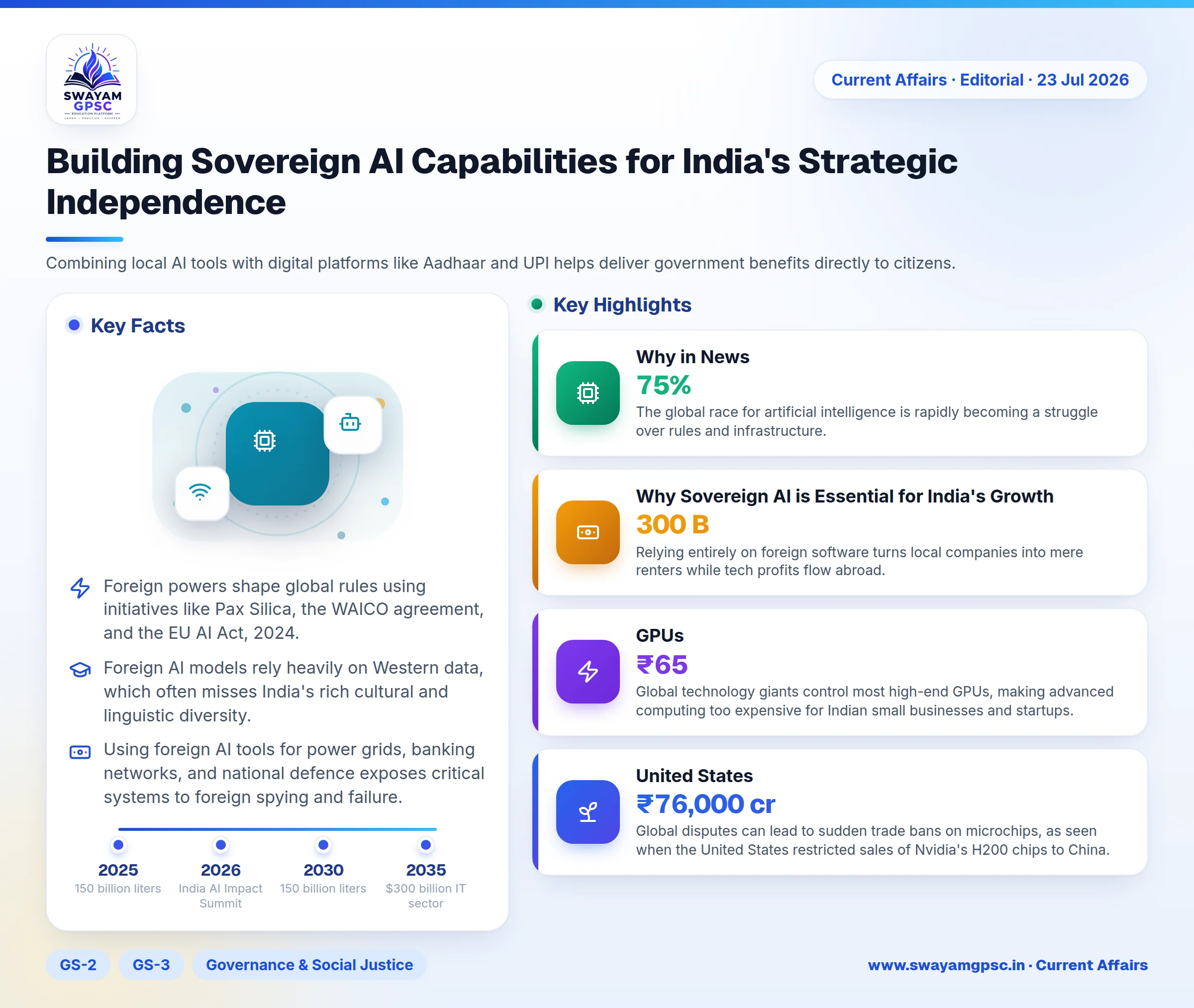
Building Sovereign AI Capabilities for India's Strategic Independence
#GS-2 #GS-3 #Governance & Social Justice #Good Governance #E-Governance #Economy #Infrastructure #Science & Technology #Artificial Intelligence #ICT #Current Events #National
Why in News
- The global race for artificial intelligence is rapidly becoming a struggle over rules and infrastructure. Right now, the United States controls 75% and China holds 15% of the world's top 500 supercomputers.
- Foreign powers shape global rules using initiatives like Pax Silica, the WAICO agreement, and the EU AI Act, 2024. To protect its national interests, India needs AI sovereignty by keeping its citizen data, critical systems, and digital networks strictly under domestic laws.
Why Sovereign AI is Essential for India's Growth
- Foreign AI models rely heavily on Western data, which often misses India's rich cultural and linguistic diversity. Building domestic AI ensures full compliance with local laws like the DPDP Act, 2023. For example, the IndiaAI Mission currently funds 20 indigenous sovereign model proposals, including 12 LLMs and 8 Small Language Models, to understand regional Indian languages correctly.
- Relying entirely on foreign software turns local companies into mere renters while tech profits flow abroad. Developing homegrown AI can transform India's $300 billion IT sector into a high-value product industry. Studies by PwC and NITI Aayog project that AI could add $550 billion to $607 billion to India's economy by 2035, with long-term gains topping $1.7 trillion.
- Global technology giants control most high-end GPUs, making advanced computing too expensive for Indian small businesses and startups. The government treats computing power as a public service to solve this problem. Under the IndiaAI Mission, the government has added over 38,000 high-end GPUs to a central system and offers them to researchers at subsidized rates of roughly ₹65 per hour.
- Using foreign AI tools for power grids, banking networks, and national defence exposes critical systems to foreign spying and failure. Building dedicated national processing clusters keeps administrative, medical, and defence data safe within Indian borders.
- Combining local AI tools with digital platforms like Aadhaar and UPI helps deliver government benefits directly to citizens. For instance, Bhashini uses over 350 AI models to translate languages and convert speech in real time, helping non-literate citizens access online banking and public services easily.
- Global disputes can lead to sudden trade bans on microchips, as seen when the United States restricted sales of Nvidia's H200 chips to China. To protect itself from such shocks, India supports local chip manufacturing through the ₹76,000 crore India Semiconductor Mission alongside native microprocessors like SHAKTI and VEGA.
- Custom AI tools built on local medical and farming data can quickly detect regional diseases and forecast unusual weather. State-backed AI tools have already shown high accuracy in diagnosing conditions like tuberculosis and diabetic eye diseases while giving accurate crop advice to farmers.
- A clear national policy on AI builds confidence among global investors and draws capital into the country. Supported by events like the India AI Impact Summit 2026, total AI-related investments in India are expected to pass $200 billion over the next two years, funding clean energy grids and software development.
Primary Obstacles in Achieving Sovereign AI
- Even though 38,000 GPUs exist on the government portal, small companies struggle to use them due to heavy paperwork. Strict limits like 7-day rental rules and confusing renewal procedures make it hard for businesses to rely on this government-subsidized hardware for long-term projects.
- India remains heavily dependent on foreign chipmakers, importing over $20 billion worth of semiconductors in FY 2024. While local chip packaging is growing, manufacturing advanced microchips smaller than 7nm domestically will still take several years to become commercially ready.
- Unlike investors in China or the United States, Indian venture capitalists rarely fund high-risk technology research that takes years to turn a profit. Most private funding in India goes toward basic cloud infrastructure or foreign data centers rather than developing native AI research.
- Modern AI servers generate extreme heat that standard air conditioners cannot cool, requiring costly liquid cooling systems. Furthermore, data center water use will rise from 150 billion liters in 2025 to 358 billion liters by 2030, straining power grids and local water supplies.
- Most Indian digital systems run on cloud servers owned by foreign firms. Foreign laws like the US CLOUD Act, 2018 allow foreign governments to demand access to data stored on those servers, creating political risks and threatening national privacy.
- While India creates almost 20% of all digital data worldwide, most of it is unorganized or locked in outdated computer systems. Government spending prioritizes buying expensive hardware over cleaning and organizing this raw information for AI training.
- India produces many software engineers, but lacks specialists in chip design, quantum physics, and complex hardware systems. Top Indian researchers often move abroad to work for major tech firms like OpenAI, Google DeepMind, or Meta due to better pay and equipment.
Strategic Steps to Secure India's AI Sovereignty
- India should establish a dedicated national bureau to create high-quality artificial datasets for training AI. This agency would use advanced simulations to supply local developers with rich, culturally accurate data without violating personal privacy laws.
- Instead of running everything in giant city data centers, India should fund research into tiny AI models that run directly on small devices. Embedding lightweight AI into farm sensors and rural payment terminals allows quick offline processing in remote areas.
- The government should create a central testing system to check all homegrown AI models before approving them for public use. Automated security tests and bias checks would ensure that domestic AI tools remain safe, reliable, and fair.
- India can create a shared national supercomputing network by linking unused processing power from universities, corporate servers, and banks during off-peak hours. Encrypted connections would safely pool this extra computing power for public use.
- Government AI programs should adopt Zero-Knowledge Proofs (ZKP) technology to protect public privacy. This security tool lets AI systems verify official records or eligibility without ever revealing or reading the citizen's underlying personal details.
- India should build specialized AI coding assistants trained on older government computer systems. These tools would help software developers maintain and update public digital platforms using simple regional language commands.
- To help high-tech startups succeed, the state should set up a national reinsurance fund to absorb early financial losses. This financial safety net would encourage domestic pension funds and mutual funds to invest safely in AI technology.
- India should invest in brain-inspired neuromorphic chips that mimic human brain functions. These next-generation microprocessors use a tiny fraction of the electricity required by standard silicon chips, making future AI systems far more energy-efficient.
Conclusion
- Achieving true Sovereign AI requires India to combine hardware investments with local data management and strict public oversight. By balancing state-supported computing power, native chip design, and accountable regulations, India can protect its strategic independence while guiding other nations across the Global South.