Building a Resilient Care Economy in India
#GS-1 #Indian Society #Women #Vulnerable Sections #GS-2 #Governance & Social Justice #Good Governance #Poverty #GS-3 #Economy #Growth #Employment #Infrastructure #Current Events #National
Key takeaways
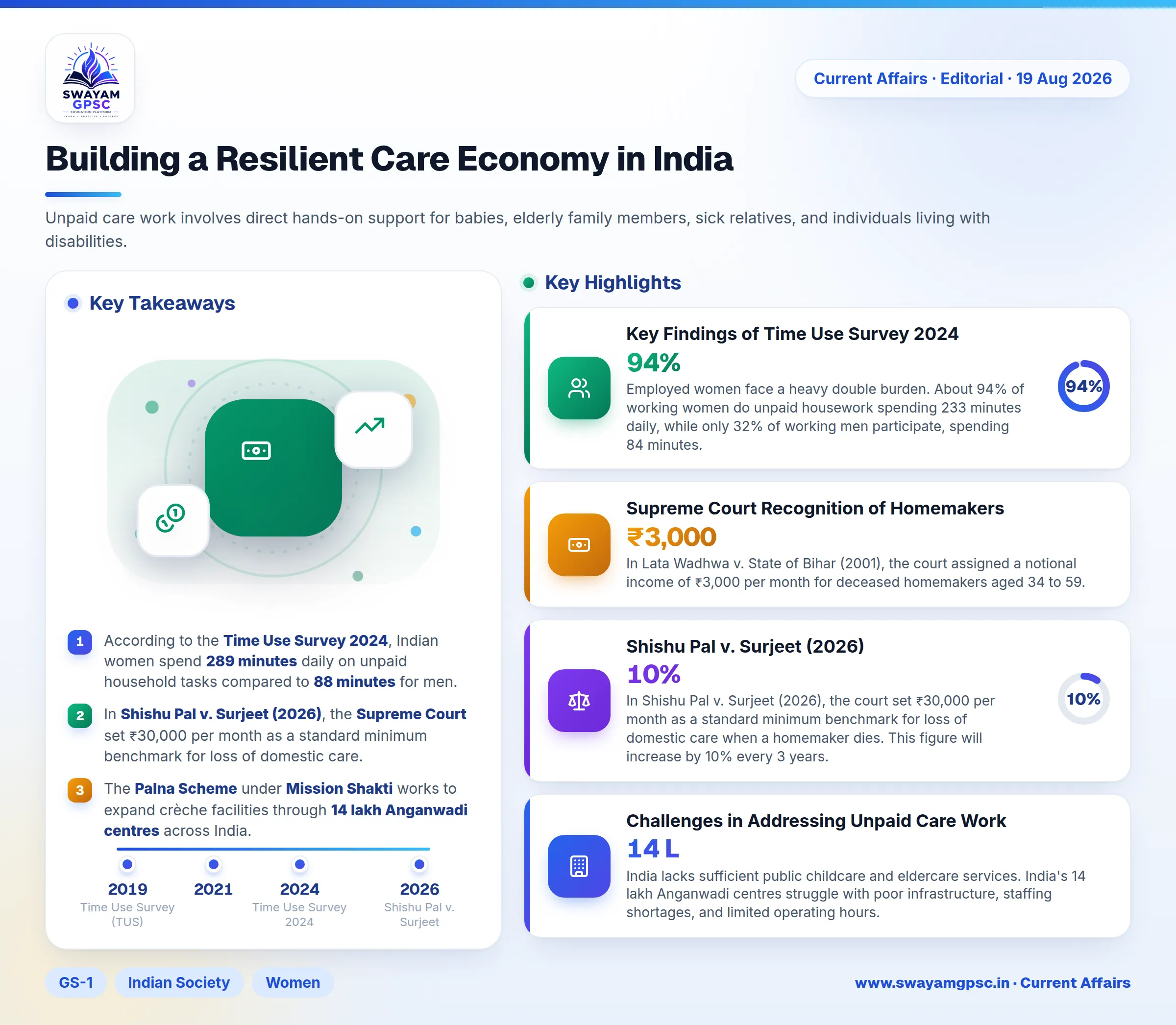
- According to the Time Use Survey 2024, Indian women spend 289 minutes daily on unpaid household tasks compared to 88 minutes for men.
- In Shishu Pal v. Surjeet (2026), the Supreme Court set ₹30,000 per month as a standard minimum benchmark for loss of domestic care.
- The Palna Scheme under Mission Shakti works to expand crèche facilities through 14 lakh Anganwadi centres across India.
- The government aims to train 1.5 lakh caregiving professionals during 2026-27 to formalize the national paid care workforce.
Why in News
- Recent Supreme Court rulings recognized homemakers as nation builders. The court assigned a minimum monetary value to their work in accident cases and ruled that expecting women to perform all domestic tasks is unfair.
- Data from the Time Use Survey 2024 shows an urgent need to recognize, reduce, and share unpaid household labor. Strengthening India's formal care sector is essential to achieve gender balance.
Unpaid Domestic and Care Work
- Unpaid domestic work includes routine household tasks like cooking, washing, fetching water, buying groceries, managing budgets, and organizing family healthcare.
- Unpaid care work involves direct hands-on support for babies, elderly family members, sick relatives, and individuals living with disabilities.
- Subsistence production covers rural farm tasks like caring for livestock, gathering firewood, and helping in family businesses. Standard national accounts include some of these tasks, but ignore household care.
- Paid care work includes formal roles such as Anganwadi workers, ASHA helpers, domestic staff, nurses, teachers, and specialized eldercare workers.
Key Findings of Time Use Survey 2024
- The Time Use Survey (TUS) tracks how people spend their daily hours across employment, housework, leisure, and caregiving. India conducted national surveys in 2019 and 2024.
- For adults aged 15 to 59, women spend 305 minutes daily on domestic tasks while men spend 86 minutes. Women also spend 140 minutes on caregiving compared to 74 minutes by men.
- Among all citizens aged six and above, women spend 289 minutes a day on unpaid chores compared to 88 minutes for men. Women also spend 137 minutes on caregiving versus 75 minutes for men.
- Employed women face a heavy double burden. About 94% of working women do unpaid housework spending 233 minutes daily, while only 32% of working men participate, spending 84 minutes.
- Heavy domestic work keeps women out of paid jobs. This creates a harmful cycle where lack of employment keeps them tied to unpaid household labor.
Supreme Court Recognition of Homemakers
- In Lata Wadhwa v. State of Bihar (2001), the court assigned a notional income of ₹3,000 per month for deceased homemakers aged 34 to 59. It ruled that financial contribution exists even without formal market wages.
- In Arun Kumar Agrawal v. National Insurance Co. Ltd. (2010), the court declared that a homemaker's multi-faceted role cannot be equated to a fixed-hour domestic helper.
- In Kirti v. Oriental Insurance Co. Ltd. (2021), the court ruled that calculating homemaker income based on family situations is legally necessary. It added that future prospects must also increase this value over time.
- In Shishu Pal v. Surjeet (2026), the court set ₹30,000 per month as a standard minimum benchmark for loss of domestic care when a homemaker dies. This figure will increase by 10% every 3 years.
Exclusion of Unpaid Work from GDP
- Gross Domestic Product follows international standard rules called the System of National Accounts. It tracks goods and services bought and sold in regular markets.
- Unpaid domestic services stay outside GDP because they lack market prices, involve no cash payments, and are hard to calculate accurately using hypothetical formulas.
- Excluding unpaid care from official calculations does not mean it lacks value. It simply shows that standard GDP is an incomplete indicator of human welfare.
Debate on Adding Unpaid Work to GDP
- Supporters argue that counting unpaid care gives an accurate picture of total economic production and highlights women's hidden economic contributions.
- Proponents note that calculating unpaid labor encourages state investment in public care infrastructure and provides a better measure of overall citizen wellbeing.
- Supporters also point out that valuing home production reflects the true reality of developing economies where subsistence farming and informal work dominate.
- Critics warn that placing a monetary value on parenting or cooking is subjective because no global formula exists for non-market family tasks.
- Opponents argue that including non-market activities could artificially boost national figures and distort comparison between countries with different social setups.
- Experts warn that tracking millions of individual household tasks requires huge administrative costs and carries a high risk of statistical error.
Care Economy versus Monetised Economy
- The care economy focuses on human development, health, and family maintenance, while the monetised economy focuses on commercial production and financial trade.
- Care work is largely unpaid and hidden from national accounts, whereas monetised activity is fully recorded in official GDP statistics.
- Family affection and social duty drive care work, while market demand and profit margins drive commercial businesses.
- The care sector relies heavily on informal female workers with low pay, while the formal economy operates under statutory minimum wages and labor contracts.
- Care services depend heavily on public facilities like Anganwadis, while regular businesses rely on commercial banks and corporate investments.
- Governments track care work using Time Use Surveys, whereas they measure market economic activity through cash flow and financial volume.
Challenges in Addressing Unpaid Care Work
- India lacks sufficient public childcare and eldercare services. India's 14 lakh Anganwadi centres struggle with poor infrastructure, staffing shortages, and limited operating hours.
- Paid care work remains highly informal. Frontline workers like ASHAs and Anganwadi helpers face low compensation, weak legal protection, and poor working conditions.
- Rural infrastructure deficits force women to spend hours fetching drinking water and firewood, increasing their daily work burden.
- Standard statistical tools struggle to record simultaneous care activities, such as supervising a child while cooking meals or running a home business.
- Simply paying homemakers a salary might backfire. It risks freezing women in traditional domestic roles and discouraging them from joining the formal job market.
Government Initiatives for the Care Economy
- The Ministry of Statistics conducts national Time Use Surveys to collect precise data on unpaid labor across rural and urban households.
- The government runs Anganwadi centres to offer early childhood education and basic nutrition to young children.
- The Palna Scheme under Mission Shakti provides day-care crèche facilities for young children of working mothers.
- The Maternity Benefit Act, 1961 was updated in 2017 to offer 26 weeks of paid leave, mandate workplace crèches, and allow remote work options.
- The Pradhan Mantri Matru Vandana Yojana (PMMVY) provides cash benefits to pregnant women to partially offset lost wages during childbirth.
- Public welfare programs like Jal Jeevan Mission, Ujjwala Yojana, and Swachh Bharat Mission reduce the time women spend fetching water and fuel.
- The central government set a goal to train 1.5 lakh caregiving professionals during 2026-27 to build a skilled care workforce.
Way Forward
- India should adopt the 5R Framework: Recognise care work, Reduce hard labor, Redistribute duties, Reward caregivers fairly, and Represent them in policy decisions.
- The Ministry of Statistics should create Care Satellite Accounts to track unpaid household production alongside standard GDP numbers without distorting official series.
- Policy makers must establish clear national laws that guarantee minimum wages, health coverage, and pension benefits for ASHA and Anganwadi workers.
- The state should turn caregiving into a recognized profession by setting up standard national certification programs and structured career growth steps.
- Expanding basic civic utilities like piped drinking water and clean cooking gas will instantly eliminate rural time poverty for women.
- Family laws should support equal partnership principles, giving women fair rights to family assets and financial support after divorce.
- The government must set up affordable, high-quality crèches near major job hubs, industrial zones, and rural farming areas.
- India needs a strong public long-term care strategy for senior citizens and persons with disabilities, combining home nursing, day care, and specialized medical support.
Conclusion
- Unpaid care work forms the foundation of India's economy, yet it keeps millions of women trapped in time poverty. Court decisions like Shishu Pal (2026) mark progress, but real reform demands shared household duties, strong public infrastructure, and quality job creation.