Building a Nutritionally Secure India
#GS-2 #Health #GS-1 #Food Security #Economy #Agriculture #Governance & Social Justice #Poverty #Environment #Climate Change
Key takeaways
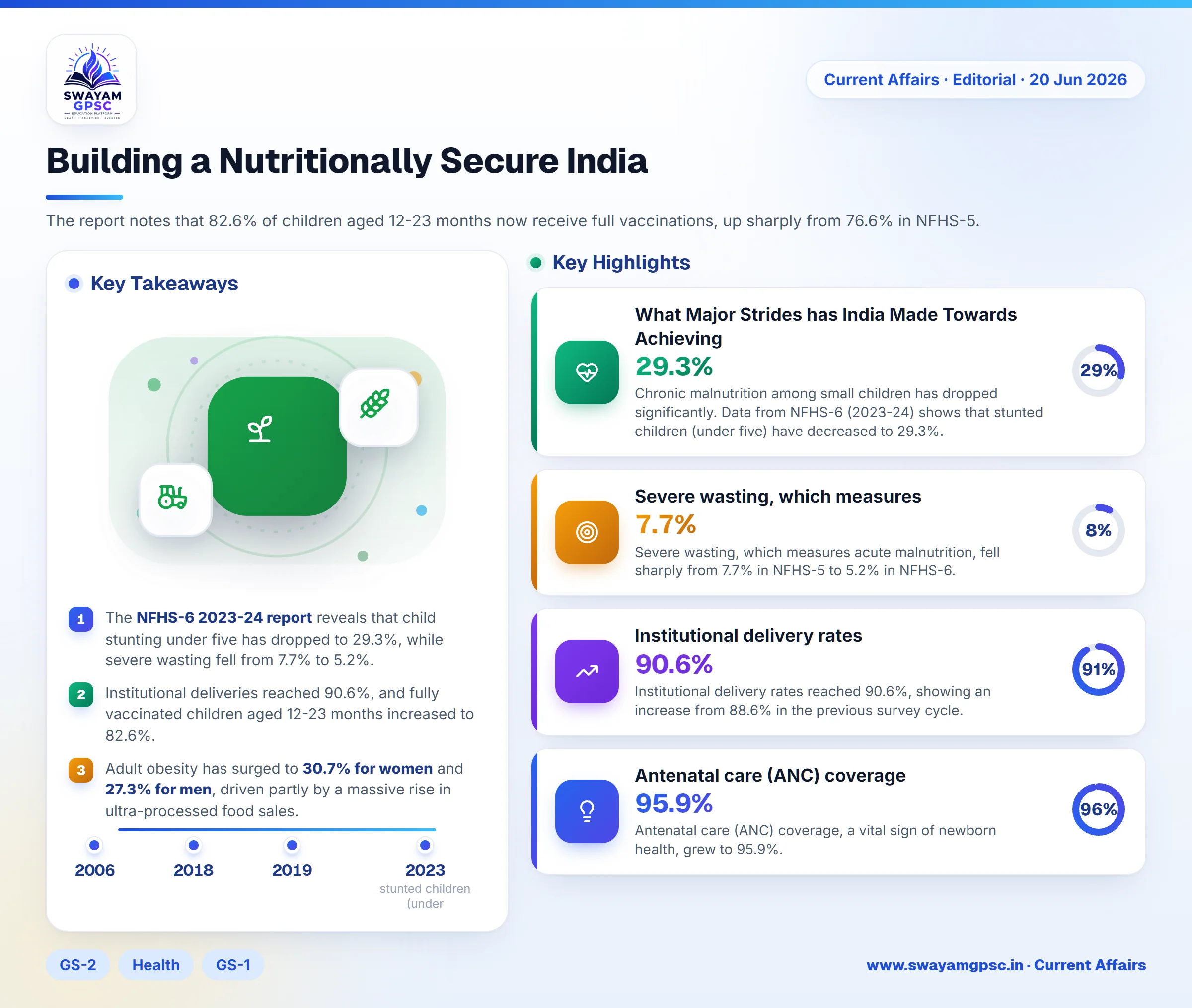
- The NFHS-6 2023-24 report reveals that child stunting under five has dropped to 29.3%, while severe wasting fell from 7.7% to 5.2%.
- Institutional deliveries reached 90.6%, and fully vaccinated children aged 12-23 months increased to 82.6%.
- Adult obesity has surged to 30.7% for women and 27.3% for men, driven partly by a massive rise in ultra-processed food sales.
- A Centre for Science and Environment report highlights that 71% of Indians cannot afford a healthy diet, contributing to widespread hidden hunger.
Introduction
- The National Family Health Survey (NFHS)-6 2023-24 report highlights a dual reality in public health. Strong institutional delivery and better immunization have lowered child stunting. However, these gains are limited by a cereal-heavy food system, rising adult obesity, and costly nutrient-rich foods. Fixing this requires moving beyond basic calories to precise strategies that target maternal time and gut health.
What Major Strides has India Made Towards Achieving Nutritional Security?
- Chronic malnutrition among small children has dropped significantly. Data from NFHS-6 (2023-24) shows that stunted children (under five) have decreased to 29.3%.
- Severe wasting, which measures acute malnutrition, fell sharply from 7.7% in NFHS-5 to 5.2% in NFHS-6.
- This progress stems from better early childhood care and the wider reach of local Anganwadi networks.
- Institutional delivery rates reached 90.6%, showing an increase from 88.6% in the previous survey cycle.
- Antenatal care (ANC) coverage, a vital sign of newborn health, grew to 95.9%.
- Professional support during childbirth successfully lowers risks tied to maternal and infant mortality.
- The report notes that 82.6% of children aged 12-23 months now receive full vaccinations, up sharply from 76.6% in NFHS-5.
- The government uses the Poshan Tracker, a digital tool that tracks over 14 lakh Anganwadi Centres and nearly 10 crore beneficiaries in real time.
- The application gathers daily attendance and growth data. This lets workers spot stunting and wasting quickly to deliver focused hotspot help.
- Grassroots outreach includes over 9.8 crore Community-Based Events (CBEs) and 150 crore Jan Andolan activities since 2018.
- These local campaigns teach communities about proper breastfeeding, food mixing, and nutrient-dense local diets.
- Poshan Vatikas or agri-nutrition gardens use backyards and Anganwadi spaces to grow diverse, climate-resilient, and bio-fortified crops.
- This local effort shifts the focus from simple calorie intake to sustainable micronutrient security.
- The government promotes millets as an ecological tool to fight systemic hunger, securing farm livelihoods while offering essential vitamins.
- Global advocacy led to the International Year of Millets 2023, supported by financial incentives through Minimum Support Price (MSP) changes.
- Public research institutions use advanced breeding techniques to embed essential vitamins directly into seeds during plant growth.
- A major success in this field is Dhanashakti, the world's first bio-fortified pearl millet variety rich in iron and zinc.
Challenges
- India's farming policy and MSP systems have long favored rice and wheat production.
- This focus discourages farmers from growing pulses, millets, fruits, and vegetables.
- Even with plenty of food, a lack of dietary variety causes hidden hunger where calorie intake is fine but micronutrient levels are very low.
- Vitamin deficiencies remain common, such as night blindness in pregnant women due to low Vitamin A intake.
- India faces a double burden of undernutrition and overnutrition at the same time.
- Adult obesity rates reached 30.7% for women and 27.3% for men according to NFHS-6 data.
- Eating more ultra-processed foods trades childhood stunting for lifestyle diseases like diabetes and high blood pressure.
- Sales of ultra-processed foods in India jumped from USD 0.9 billion in 2006 to nearly USD 38 billion in 2019, marking a massive rise.
- Only about 15% of children aged 6 to 23 months get an adequate diet, and exclusive breastfeeding for infants under six months dropped to 55.8%.
- Many children miss out on proper feeding during their crucial first thousand days, leading to permanent growth and brain deficits.
- About 30% of women engage in paid work, but unpaid family labor adds a heavy hidden workload.
- Without local crèches, working mothers leave babies with older relatives or young sisters, which hurts the girls' schooling.
- This daily strain heavily disrupts breastfeeding and proper feeding routines for young toddlers.
- A healthy diet is too expensive for many families. A Centre for Science and Environment report notes that 71% of Indians cannot afford a healthy diet.
- Rising heat, erratic rain, and poor soil health damage crop output and lower the nutritional quality of harvested food.
- High temperatures speed up plant respiration and reduce the time available for grains to store proteins and minerals.
- Heat stress blocks transporter proteins, lowering the levels of essential minerals like iron, zinc, and magnesium in crops.
- Antimicrobial resistance creates a damaging loop where infections block nutrient absorption.
- India is the fourth-largest user of antibiotics in livestock, letting resistant bacteria enter the food supply.
- Eating these bacteria alters the gut microbiome and causes chronic gut inflammation, which stops the body from absorbing nutrients properly.
Way Forward
- Introduce a Nutri-Credit system for small farmers, similar to carbon credits.
- Farmers who switch from staple monocultures to climate-resilient, bio-fortified crops should receive direct financial subsidies.
- Upgrade the public distribution system with AI to link ration accounts directly to individual health needs.
- Families with high anemia rates could receive extra pulses, while households with obesity could get fresh produce vouchers.
- Build community kitchens in urban slums run by women's Self-Help Groups to provide cheap, protein-rich meals.
- These kitchens can double as health check and vaccination centers to help solve maternal time poverty.
- Launch a national pilot project to map the gut health of children living in high stunting districts.
- Use this data for precision nutrition, offering targeted probiotic supplements so children can actually absorb their food.
- Create a mobile application where mothers and health workers earn points for child weight gains and regular health checks.
- Redeem these points for subsidized cooking gas cylinders or educational tablets.
- Give tax breaks to small food processors who adopt nutrient-density certifications and clear star ratings.
- Adopt municipal policies for edible landscapes, integrating vertical gardens and vegetable plots into Anganwadi and school grounds.
Conclusion
- The NFHS-6 report proves that healthcare delivery works, but it also exposes deep gaps in diet, gender equity, and policy.
- Solving these issues requires tackling maternal time poverty, changing farm subsidies, and using AI alongside gut health science.