BRICS Opposes EU's Carbon Border Adjustment Mechanism
#GS-2 #GS-3 #International Relations #Environment #Climate Change #Economy #Trade Policy #BRICS
Key takeaways
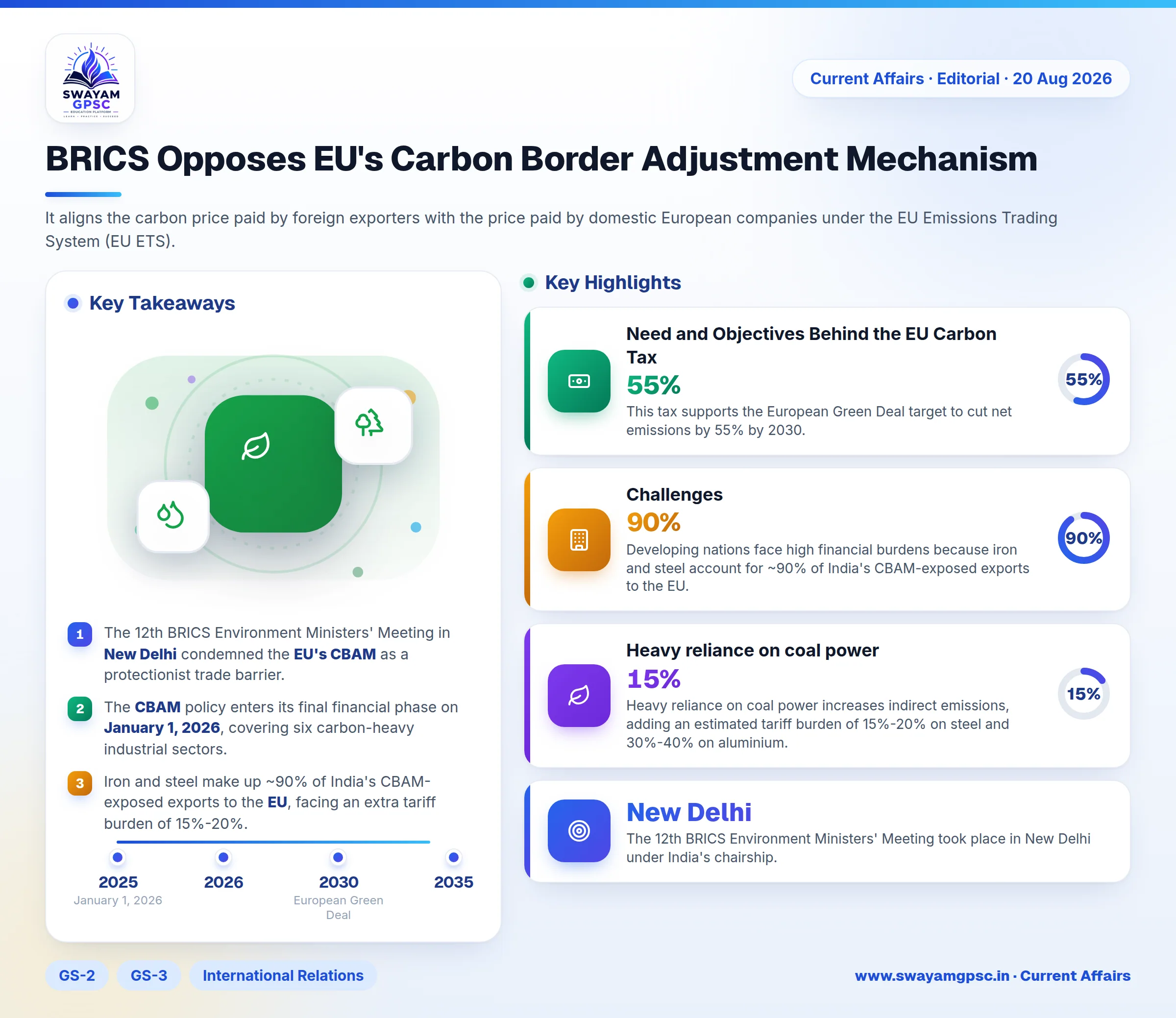
- The 12th BRICS Environment Ministers' Meeting in New Delhi condemned the EU's CBAM as a protectionist trade barrier.
- The CBAM policy enters its final financial phase on January 1, 2026, covering six carbon-heavy industrial sectors.
- Iron and steel make up ~90% of India's CBAM-exposed exports to the EU, facing an extra tariff burden of 15%-20%.
- BRICS members argue that the unilateral carbon tax violates CBDR principles established under the UNFCCC.
- India can reduce tariff impacts by building its Carbon Credit Trading Scheme and expanding green steel production.
Why in News
- The 12th BRICS Environment Ministers' Meeting took place in New Delhi under India's chairship.
- Ministers adopted a joint statement criticizing the European Union's Carbon Border Adjustment Mechanism (CBAM) as a unilateral and discriminatory trade barrier.
Understanding the Carbon Border Adjustment Mechanism
- The CBAM is a major climate trade policy created by the European Union to price carbon on imported goods.
- The policy enters its full financial phase on January 1, 2026, following a transitional reporting period from 2023 to 2025.
- It aligns the carbon price paid by foreign exporters with the price paid by domestic European companies under the EU Emissions Trading System (EU ETS).
How EU Carbon Taxation Operates
- The system targets six heavy industrial sectors: iron and steel, aluminium, cement, fertilisers, hydrogen, and electricity.
- Importers must calculate and submit verified direct manufacturing emissions under Scope 1 and indirect power emissions under Scope 2.
- Importers must purchase CBAM certificates tied directly to weekly price averages from the EU ETS.
- If an exporter pays an official carbon price in its home country, the EU deducts that exact amount from the final tax bill.
Need and Objectives Behind the EU Carbon Tax
- The policy stops carbon leakage by preventing EU firms from shifting production to countries with weaker green laws.
- It protects domestic European factories from being undercut by cheaper imports while official free carbon allowances phase out.
- The EU uses market access to encourage trading partners to switch to cleaner technologies like green hydrogen.
- This tax supports the European Green Deal target to cut net emissions by 55% by 2030.
- Sales from carbon certificates will raise funds for European clean technology investments.
Challenges
- Developing nations face high financial burdens because iron and steel account for ~90% of India's CBAM-exposed exports to the EU.
- Indian steel generates 2.5 tons of carbon per ton compared to the EU benchmark of 1.8 tons.
- Heavy reliance on coal power increases indirect emissions, adding an estimated tariff burden of 15%-20% on steel and 30%-40% on aluminium.
- BRICS nations state that CBAM violates the principle of Common But Differentiated Responsibilities (CBDR) under the UNFCCC and the Paris Agreement.
- High compliance and audit costs create severe trade barriers for small and medium businesses.
- The tax forces companies to split production lines by sending green goods to Europe and high-carbon goods elsewhere.
Way Forward
- Developing countries should challenge CBAM at the World Trade Organization (WTO) under GATT Articles I, III, and XX.
- Nations must establish local carbon markets like India's Carbon Credit Trading Scheme to keep tax revenues at home.
- Governments and industries should invest in green steel using green hydrogen and electric arc furnaces.
- Developing nations must demand that wealthy countries fulfill pledges ahead of COP31 to triple adaptation funding by 2035.
Conclusion
- The CBAM policy blends climate goals with international trade rules in a unprecedented way.
- While the EU views the measure as essential for climate protection, developing nations view it as protectionist.
- Balancing trade fairness requires domestic carbon pricing, cleaner industrial practices, and reliable climate finance from developed nations.