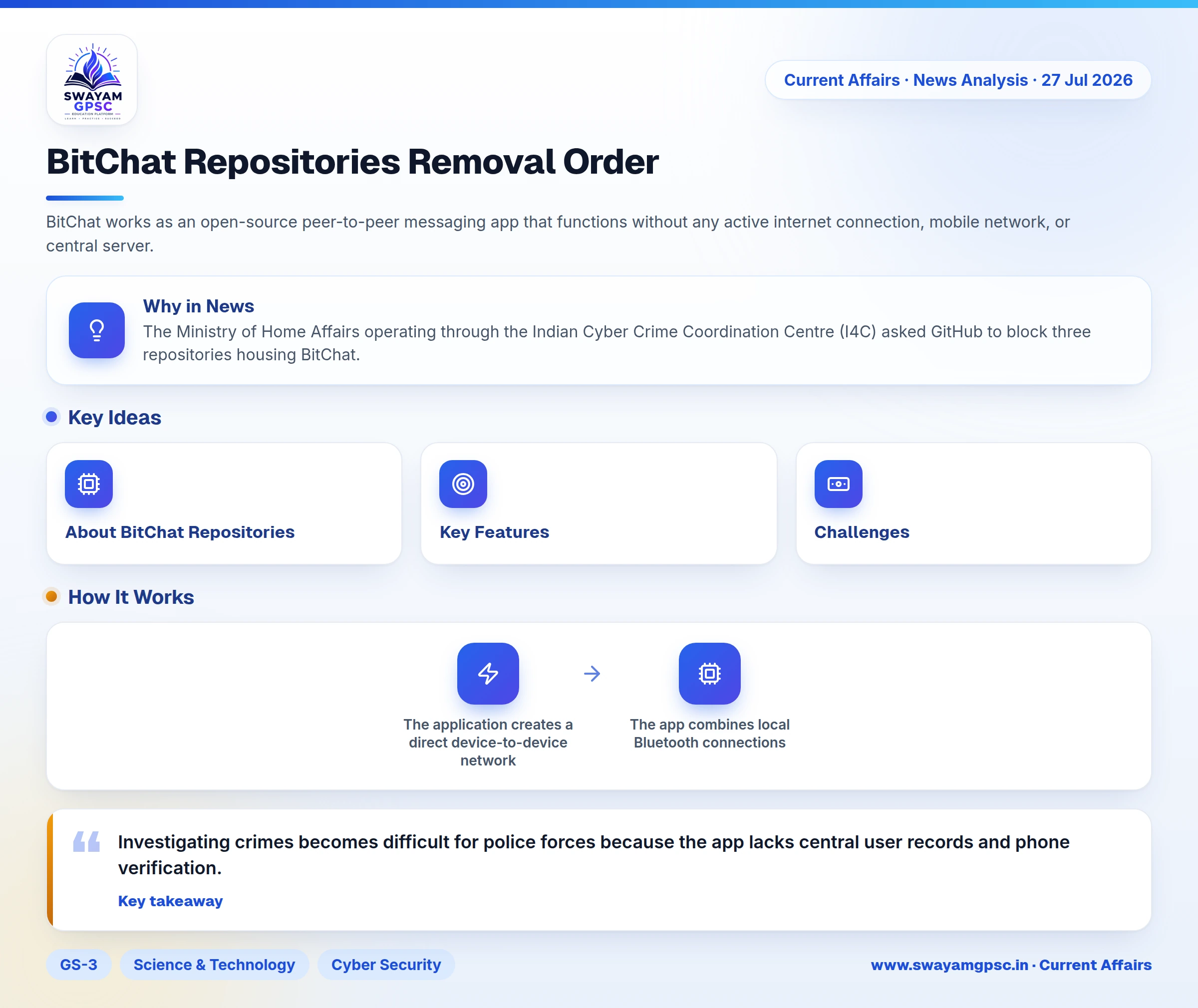
BitChat Repositories Removal Order
#GS-3 #Science & Technology #Cyber Security #ICT #Current Events #National #GS-2 #Governance & Social Justice #Regulatory Bodies #Information Technology #IT Act
Why in News
- The **Ministry of Home Affairs** operating through the **Indian Cyber Crime Coordination Centre (I4C)** asked **GitHub** to block three repositories housing **BitChat**.
About BitChat Repositories
- **BitChat** works as an open-source peer-to-peer messaging app that functions without any active internet connection, mobile network, or central server. The software code and Android app installation files reside on **GitHub**.
- **Doris Lima** originally created the concept for **BitChat**, while **Jack Dorsey**, the co-founder of **Twitter/X** and chief executive of **Block**, developed the application.
How It Works
- The application creates a direct device-to-device network through **Bluetooth Low Energy (BLE)** to detect nearby phones within **~30 to 100 meters**. Every smartphone transmits encrypted messages to neighboring devices until reaching the destination.
- The app combines local Bluetooth connections with the decentralized **Nostr protocol** whenever an internet connection becomes available to users.
Key Features
- The system operates smoothly during complete internet blackouts, sudden network shutdowns, or severe natural disasters.
- Users can access the app with complete anonymity without sharing phone numbers, email IDs, or personal accounts.
- The platform secures communication with the **Noise Protocol Framework** so intermediate devices cannot read or modify message content.
- The lack of central servers means law enforcement agencies cannot request stored user databases or central messaging history.
- The software includes self-deleting messages and quick data wiping features to prevent physical data recovery from seized devices.
Challenges
- Investigating crimes becomes difficult for police forces because the app lacks central user records and phone verification.
- The offline mesh network allows people to communicate during government internet suspensions, making public order maintenance harder.
- Legal experts argue that using **Section 79(3)(b)** rather than **Section 69A** of the **IT Act** bypasses legal safeguards set by the Supreme Court in **Shreya Singhal** and **Anuradha Bhasin** cases.