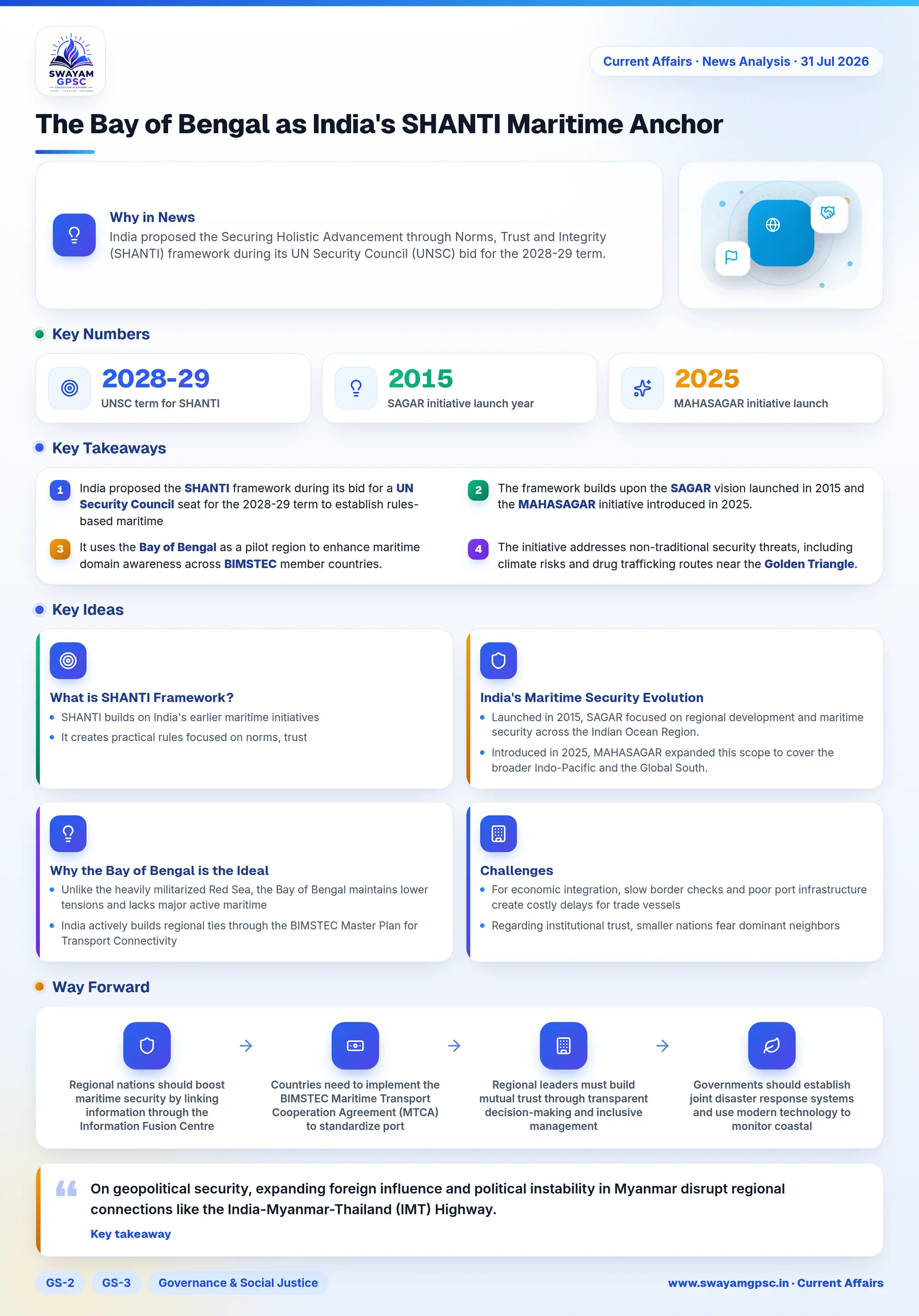
The Bay of Bengal as India's SHANTI Maritime Anchor
#GS-2 #GS-3 #Governance & Social Justice #Current Events #International #India and its Neighbourhood #Government Policies & Interventions #Maritime Security
Key takeaways
- India proposed the SHANTI framework during its bid for a UN Security Council seat for the 2028-29 term to establish rules-based maritime governance.
- The framework builds upon the SAGAR vision launched in 2015 and the MAHASAGAR initiative introduced in 2025.
- It uses the Bay of Bengal as a pilot region to enhance maritime domain awareness across BIMSTEC member countries.
- The initiative addresses non-traditional security threats, including climate risks and drug trafficking routes near the Golden Triangle.
Why in News
- India proposed the Securing Holistic Advancement through Norms, Trust and Integrity (SHANTI) framework during its UN Security Council (UNSC) bid for the 2028-29 term.
- The SHANTI framework establishes rules for shared sea spaces, starting in the Bay of Bengal before expanding to the wider Indo-Pacific.
What is SHANTI Framework?
- SHANTI builds on India's earlier maritime initiatives, including SAGAR launched in 2015 and MAHASAGAR announced in 2025.
- It creates practical rules focused on norms, trust, and integrity to guide daily maritime cooperation among neighboring nations.
- The initiative marks a strategic shift from regional rivalry to cooperation, focusing on building long-term maritime resilience.
- It aims to establish India as a reliable security partner and first responder while strengthening BIMSTEC and promoting the Blue Economy.
India's Maritime Security Evolution
- Launched in 2015, SAGAR focused on regional development and maritime security across the Indian Ocean Region.
- Introduced in 2025, MAHASAGAR expanded this scope to cover the broader Indo-Pacific and the Global South.
- The new SHANTI framework adds operational rules to govern shared maritime spaces through mutual trust and ethical standards.
Why the Bay of Bengal is the Ideal Testing Ground
- Unlike the heavily militarized Red Sea, the Bay of Bengal maintains lower tensions and lacks major active maritime border disputes.
- India actively builds regional ties through the BIMSTEC Master Plan for Transport Connectivity, the Colombo Security Conclave, and credit lines for projects in Bangladesh, Sri Lanka, Myanmar, and Thailand.
- The bay connects South Asia to Southeast Asia and guards the western entry to the Strait of Malacca, helping counter strategic projects like China's Kyaukphyu port.
- The region faces non-traditional threats like severe cyclones, rising sea levels, illegal fishing, and drug trafficking linked to the Golden Triangle.
- SHANTI serves as a unifying force for BIMSTEC by improving maritime governance and Maritime Domain Awareness (MDA) without creating extra bureaucracies.
- This approach lets India demonstrate leadership as a helpful partner without appearing dominant or coercive to smaller neighboring nations.
Challenges
- On geopolitical security, expanding foreign influence and political instability in Myanmar disrupt regional connections like the India-Myanmar-Thailand (IMT) Highway.
- For economic integration, slow border checks and poor port infrastructure create costly delays for trade vessels across regional ports.
- Regarding institutional trust, smaller nations fear dominant neighbors, while existing regional groups like BIMSTEC remain fragmented.
- On environmental fronts, severe climate events, marine pollution, and illegal fishing threaten coastal communities and marine ecosystems.
Way Forward
- Regional nations should boost maritime security by linking information through the Information Fusion Centre - Indian Ocean Region (IFC-IOR) and holding regular security dialogues.
- Countries need to implement the BIMSTEC Maritime Transport Cooperation Agreement (MTCA) to standardize port rules and speed up trade.
- Regional leaders must build mutual trust through transparent decision-making and inclusive management of shared trade corridors.
- Governments should establish joint disaster response systems and use modern technology to monitor coastal waters against environmental damage.
Conclusion
- By anchoring the SHANTI framework in the Bay of Bengal, India links its Act East Policy directly to the broader Indo-Pacific.
- Successfully managing these shared waters will secure India's position as an indispensable provider of regional security.