Balancing Growth with Governance
#GS-2 #Governance & Social Justice #Good Governance #Economy #Infrastructure #Consumer Rights #E-Governance
Key takeaways
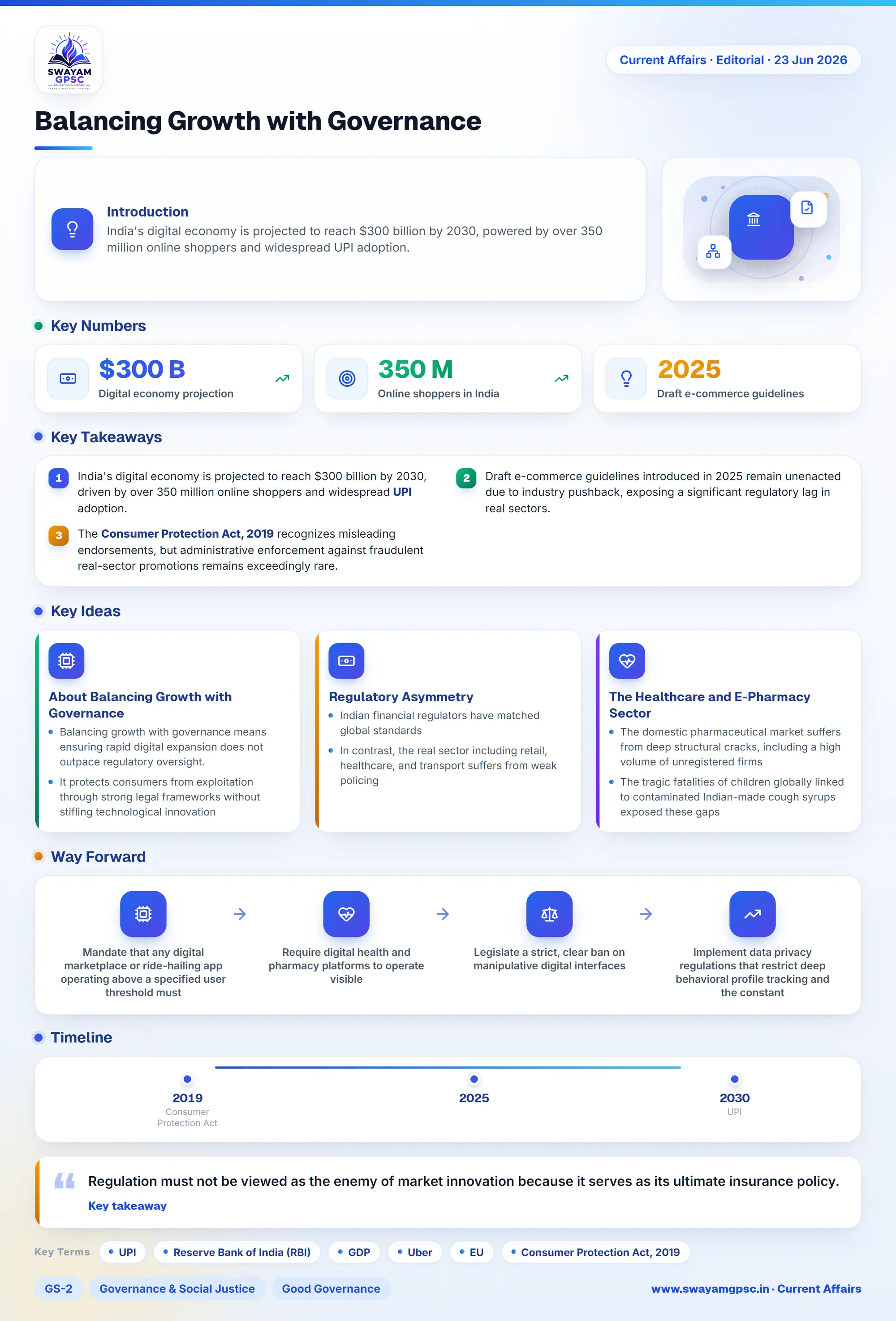
- India's digital economy is projected to reach $300 billion by 2030, driven by over 350 million online shoppers and widespread UPI adoption.
- Draft e-commerce guidelines introduced in 2025 remain unenacted due to industry pushback, exposing a significant regulatory lag in real sectors.
- The Consumer Protection Act, 2019 recognizes misleading endorsements, but administrative enforcement against fraudulent real-sector promotions remains exceedingly rare.
Introduction
- India's digital economy is projected to reach $300 billion by 2030, powered by over 350 million online shoppers and widespread UPI adoption.
- A critical regulatory lag in real sectors like healthcare and transport exposes consumers to exploitation, underscoring the urgent need for a robust framework balancing innovation with structural accountability.
About Balancing Growth with Governance
- Balancing growth with governance means ensuring rapid digital expansion does not outpace regulatory oversight.
- It protects consumers from exploitation through strong legal frameworks without stifling technological innovation and economic momentum.
Regulatory Asymmetry
- Indian financial regulators have matched global standards, with the Reserve Bank of India (RBI) deploying AI-driven fraud detection systems and the Securities and Exchange Board of India (SEBI) clamping down on misleading financial advice from influencers.
- In contrast, the real sector including retail, healthcare, and transport suffers from weak policing, and draft e-commerce guidelines introduced in 2025 remain unenacted due to industry pushback.
- Postponing regulations due to corporate pressure sacrifices long-term consumer safety for short-term corporate profiteering.
The Healthcare and E-Pharmacy Sector
- The domestic pharmaceutical market suffers from deep structural cracks, including a high volume of unregistered firms, authorized units operating outside designated manufacturing zones, and a stagnant number of drug inspectors relative to GDP growth.
- The tragic fatalities of children globally linked to contaminated Indian-made cough syrups exposed these gaps, forcing emergency bans on over-the-counter cough syrup sales.
- While physical monitoring falters, pure-play e-pharmacists are expanding rapidly using high-profile celebrity endorsements to gain trust despite lacking visible quality assurance teams or physical corporate offices.
The Ride-Hailing Sector
- Tech aggregators like Uber, Ola, and Rapido have largely replaced traditional auto unions and taxi stands, removing physical, on-ground points of contact for commuters.
- If a modern commuter faces overcharging, reckless driving, or physical harassment, there is no physical office to walk into for grievance redressal.
- Redressal is instead routed through automated, distant call centers or rigid, opaque in-app chat windows.
Consumer Psychology and Retail Sector
- Digital retail environments use behavioral tracking to weaponize consumer weaknesses through flash sales, scarcity cues, and synthetic urgency prompts.
- These manipulative user interfaces, known as dark patterns, actively trick consumers into making purchases or entering subscription traps.
- While the EU bans manipulative designs outright and the US aggressively fines subscription traps, Indian shoppers are left vulnerable.
The Human Element: Endorsee and Platform Liability
- Human faces like cricketers, film stars, and mega-influencers vouch for digital platforms, lending them instant legitimacy beyond mere algorithmic tricks.
- Although the Consumer Protection Act, 2019 recognizes misleading endorsements, administrative enforcement remains exceedingly rare.
- A sharper regulatory standard must hold endorsers personally and financially liable if they endorse substandard medicines or fraudulent financial schemes, while hosting platforms must share strict co-liability.
Strategic Dimension: National Resilience
- We live in an era of active global discord where state and non-state actors weaponize the internet, execute cyberattacks, and disrupt supply lines.
- Complete systemic reliance on pure-play digital marketplaces with zero physical assets leaves India's internal trade network highly vulnerable to foreign cyber shocks.
- Mandating that digital platforms maintain a clear physical footprint and localized grievance cells is a pillar of national security to make the marketplace harder for an adversary to destabilize.
Way Forward
- Mandate that any digital marketplace or ride-hailing app operating above a specified user threshold must maintain fully staffed physical local offices in every major city they serve.
- Require digital health and pharmacy platforms to operate visible, accredited quality-checking teams to trace supply lines before medications hit consumers.
- Legislate a strict, clear ban on manipulative digital interfaces, mirroring the European Union's Digital Services Act.
- Implement data privacy regulations that restrict deep behavioral profile tracking and the constant monetization of consumer surveillance data.
- Implement punitive financial penalties on high-profile figures who fail to exercise due diligence before promoting high-risk real-sector products.
- Enforce annual independent audits on dominant platforms to verify that search results are fair and not manipulated to favor internal platform-owned brands.
Conclusion
- Regulation must not be viewed as the enemy of market innovation because it serves as its ultimate insurance policy.
- Unchecked digital marketing risks destroying the very trust required for a digital economy to thrive, and clear rules today will secure tomorrow's market.