Atal Vayo Abhyuday Yojana (AVYAY) for Elderly Welfare in India
#GS-2 #Governance & Social Justice #Social Justice #Vulnerable Sections #Welfare Schemes #Government Policies & Interventions #GS-3 #Economy #Inclusive Growth #Health
Key takeaways
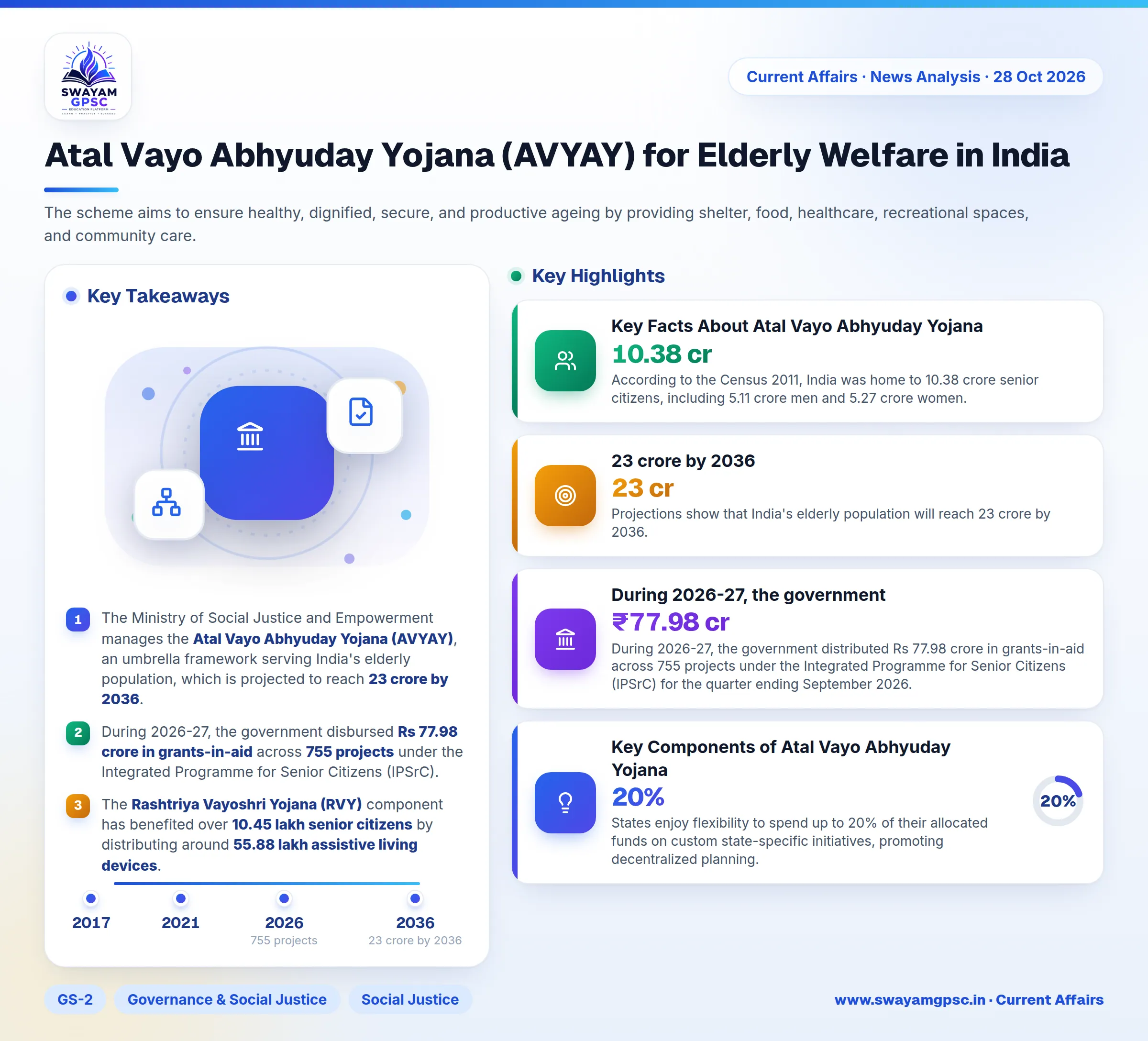
- The Ministry of Social Justice and Empowerment manages the Atal Vayo Abhyuday Yojana (AVYAY), an umbrella framework serving India's elderly population, which is projected to reach 23 crore by 2036.
- During 2026-27, the government disbursed Rs 77.98 crore in grants-in-aid across 755 projects under the Integrated Programme for Senior Citizens (IPSrC).
- The Rashtriya Vayoshri Yojana (RVY) component has benefited over 10.45 lakh senior citizens by distributing around 55.88 lakh assistive living devices.
- The national helpline Elderline (14567) has successfully addressed over 8.66 lakh actionable calls from senior citizens seeking guidance or emergency intervention.
- Under the SAGE initiative, senior-focused startups can receive up to Rs 1 crore in equity support to foster growth in India's Silver Economy.
Why in News
- The Atal Vayo Abhyuday Yojana (AVYAY) is becoming increasingly vital because India's elderly population is growing rapidly.
- The demand for dedicated geriatric care is rising sharply while traditional family support systems are weakening.
Key Facts About Atal Vayo Abhyuday Yojana
- The Ministry of Social Justice and Empowerment launched AVYAY in 2021 as an umbrella scheme that absorbed the previous National Action Plan for Senior Citizens (NAPSrC).
- The scheme aims to ensure healthy, dignified, secure, and productive ageing by providing shelter, food, healthcare, recreational spaces, and community care.
- According to the Census 2011, India was home to 10.38 crore senior citizens, including 5.11 crore men and 5.27 crore women.
- Projections show that India's elderly population will reach 23 crore by 2036.
- Rapid city growth, outward migration, and the rise of nuclear families are eroding traditional support, creating a greater demand for institutional and community care.
- The core principle of Ageing with Dignity focuses on delivering respectful, empowering care that protects the independence and well-being of older adults.
- The core principle of Ageing in Place helps elderly citizens stay safely in their own homes through accessible infrastructure, assistive devices, and local support networks.
- The Ministry of Social Justice and Empowerment acts as the main central authority through its Department of Social Justice and Empowerment.
- State and Union Territory governments design and execute tailored local welfare plans under the State Action Plan for Senior Citizens (SAPSrC).
- Local District-Level Committees headed by the District Collector or District Magistrate select beneficiaries and monitor implementation.
- During 2026-27, the government distributed Rs 77.98 crore in grants-in-aid across 755 projects under the Integrated Programme for Senior Citizens (IPSrC) for the quarter ending September 2026.
Monitoring and Accountability
- A dedicated Project Monitoring Unit (PMU) performs regular field visits to inspect IPSrC projects on the ground.
- Partner NGOs maintain financial discipline by submitting detailed progress reports, Utilisation Certificates (UCs), and audited balance sheets.
- The government uses the e-Anudaan portal, contactless cloud biometric attendance, and live CCTV feeds to maintain strong digital oversight.
Key Components of Atal Vayo Abhyuday Yojana
- The Integrated Programme for Senior Citizens (IPSrC) offers financial grants to NGOs, Panchayati Raj Institutions, and local bodies to run care facilities.
- Key services supported under IPSrC include Senior Citizen Homes, Continuous Care Homes, Mobile Medicare Units, Physiotherapy Clinics, and Regional Resource and Training Centres.
- The programme currently funds 764 Senior Citizen Homes, 13 Continuous Care Homes, 17 Mobile Medicare Units, and 3 Physiotherapy Clinics.
- Institutional care under IPSrC prioritizes shelter, food, medicine, and recreation for destitute seniors who lack family backing.
- The State Action Plan for Senior Citizens (SAPSrC) grants funds to State and UT governments to design local senior welfare initiatives.
- Major interventions under SAPSrC involve training geriatric caregivers, organizing cataract surgery drives, and upgrading physical care facilities.
- States enjoy flexibility to spend up to 20% of their allocated funds on custom state-specific initiatives, promoting decentralized planning.
- Launched in 2017 and later merged into AVYAY, the Rashtriya Vayoshri Yojana (RVY) provides free assistive living devices to seniors with age-related physical disabilities.
- Distribution of devices occurs through specialized physical camps and Pradhan Mantri Divyasha Vayoshri Kendras (PMD-VKs) managed by ALIMCO.
- The RVY scheme has assisted over 10.45 lakh senior citizens by distributing roughly 55.88 lakh assistive devices.
- Regional Resource and Training Centres (RRTCs) act as regional hubs for training, academic research, advocacy, and scheme monitoring.
- These training centers operate as supportive regional arms under the IPSrC framework rather than as a standalone component.
- RRTCs build regional databases, conduct project checks, offer geriatric training, and coordinate between government bodies and field units.
- Every designated RRTC receives an annual grant of approximately Rs 19.58 lakh under established scheme guidelines.
Major Digital and Support Initiatives for Senior Citizens
- Launched in October 2021, the national helpline Elderline (14567) offers free information, emotional counseling, field intervention, and grievance redressal.
- The helpline has handled over 8.66 lakh actionable calls, connecting needy citizens with local district officers and non-profit groups.
- Rolled out in May 2026, the JEEVAN mobile application gives seniors instant access to information on government schemes, care facilities, and emergency helplines with one-tap dialing.
- Introduced in May 2026, the SHATAYU dashboard functions as an online portal connecting senior citizens directly with qualified geriatric caregivers.
- The SHATAYU platform manages a national database of 30,151 registered caregivers, which includes 23,334 women and 6,817 men.
- The Anubhav Bolta Hai portal allows senior citizens to share life experiences and insights while providing details on healthy living, legal rights, and schemes.
- Digital tools like the e-Anudaan Portal, biometric attendance trackers, regular inspections, and financial audits maintain operational transparency.
- The Seniorcare Ageing Growth Engine (SAGE) encourages startups to invent goods and services for seniors by providing equity grants up to Rs 1 crore, mentorship, and market connections.
- The Senior Citizen Opportunities for Productive Engagement (SCOPE) portal connects skilled elderly individuals with organizations seeking experienced talent.
- The PM-SPECIAL initiative offers free structured vocational training through accredited centers to train professional caregivers and plug human resource gaps.
- On 1st September 2026, the government signed an agreement with Ramakrishna Math and Ramakrishna Mission to foster intergenerational ties across 200 pilot schools through shared games, bilingual materials, and teacher training.
Conclusion
- The Atal Vayo Abhyuday Yojana (AVYAY) serves as an integrated national platform that ensures safe, healthy, and active ageing through care centers and community programs.
- By aligning government departments, non-profit partners, and expert centers, the scheme strengthens social safety nets for India's growing elderly population.