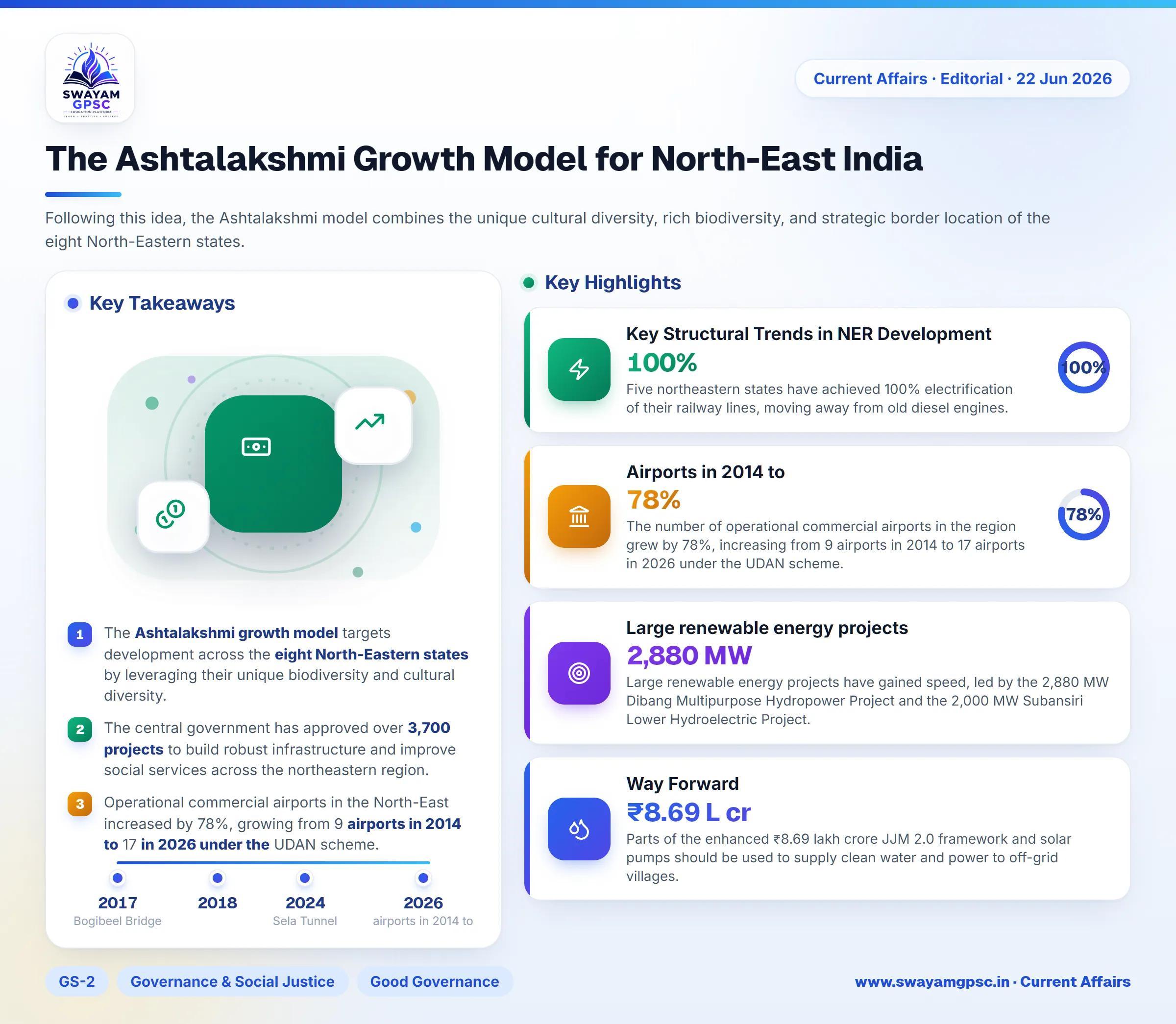
The Ashtalakshmi Growth Model for North-East India
#GS-2 #Governance & Social Justice #Good Governance #GS-3 #Infrastructure #Economy #Current Events #National
Key takeaways
- The Ashtalakshmi growth model targets development across the eight North-Eastern states by leveraging their unique biodiversity and cultural diversity.
- The central government has approved over 3,700 projects to build robust infrastructure and improve social services across the northeastern region.
- Operational commercial airports in the North-East increased by 78%, growing from 9 airports in 2014 to 17 in 2026 under the UDAN scheme.
- The region has advanced connectivity through major engineering marvels, including the 9.15 km Dhola-Sadiya Bridge and the high-altitude Sela Tunnel.
- Manipur is currently constructing the 141-metre-tall Noney Bridge, which is set to become the world's tallest railway pier bridge.
Why in News
- The Press Information Bureau released a detailed backgrounder titled Ashtalakshmi - The North-East at the Heart of India’s Growth Story to highlight the rapid progress of the region.
- This report reviews the major transformation and development milestones achieved across the north-eastern states over the past twelve years.
About The Ashtalakshmi Growth Model
- In Indian culture, Goddess Lakshmi represents eight different forms of happiness, health, and financial success.
- Following this idea, the Ashtalakshmi model combines the unique cultural diversity, rich biodiversity, and strategic border location of the eight North-Eastern states.
- The eight states included in this growth model are Assam, Arunachal Pradesh, Manipur, Meghalaya, Mizoram, Nagaland, Tripura, and Sikkim.
Target Sector Allocations and Infrastructure
- The central government has approved over 3,700 projects to ensure regular financial support for building infrastructure and improving social services.
- The PM-DevINE scheme provides money for high-impact projects in connectivity and livelihood sectors to fill existing regional development gaps.
- Higher allocations in successive railway budgets have speeded up network expansion, modernization, and connection in remote northeastern areas.
- The rapid laying of broad-gauge railway tracks has successfully connected previously isolated states to the main national railway network.
- Dedicated funding for renewable energy training has produced skilled workers for solar and green energy sectors across the Northeast.
Rural Welfare, Housing and Digital Access
- States such as Arunachal Pradesh and Mizoram have achieved universal rural tap-water access to improve local health and living standards.
- Massive construction of rural toilets has helped the entire region achieve Open Defecation Free status and better public sanitation.
- The completion of PMAY housing projects has greatly improved housing security and living conditions for families in rural and urban areas.
- The expansion of Ayushman Bharat health insurance has widened medical access and reduced out-of-pocket medical expenses for residents.
- New mobile towers and BharatNet internet services have reduced digital isolation and improved access to banking and education.
Agrarian and Allied Growth Vectors
- Rising fish production has strengthened rural livelihoods, with Assam successfully emerging as the fisheries hub of the region.
- Large reserves of agarwood provide major export and income opportunities, especially for states like Tripura.
- Direct income support through PM-KISAN has financially assisted millions of farmers, including a large share of women beneficiaries.
- Organic farming programs under MOVCD-NER have promoted sustainable agriculture, strengthened farmer producer organizations, and boosted farmer incomes.
Key Structural Trends in NER Development
- The region has built permanent high-capacity engineering structures to overcome difficult mountain barriers and fast-flowing rivers.
- Key engineering achievements include the combined road-rail Bogibeel Bridge completed in 2018 and the Dhola-Sadiya Bridge built in 2017 for heavy military use.
- The high-altitude Sela Tunnel, built at 13,000 feet in 2024, provides all-weather connectivity across difficult mountain terrain.
- Five northeastern states have achieved 100% electrification of their railway lines, moving away from old diesel engines.
- The number of operational commercial airports in the region grew by 78%, increasing from 9 airports in 2014 to 17 airports in 2026 under the UDAN scheme.
- Active National Waterways in the region increased from just 1 in 2014 to 20 by 2024 by utilizing the Brahmaputra and Barak rivers.
- Large renewable energy projects have gained speed, led by the 2,880 MW Dibang Multipurpose Hydropower Project and the 2,000 MW Subansiri Lower Hydroelectric Project.
Challenges
- Laying heavy railway tracks and building tunnels across landslide-prone mountain zones requires complex geotechnical engineering.
- Bad weather and high-altitude transport routes often disrupt local supply chains and increase the retail prices of goods.
- Frontline state agencies sometimes show uneven operational efficiency when executing complex centrally funded projects.
- The region harvests many raw materials like bamboo and organic spices, but it lacks enough local processing units to maximize commercial profits.
Way Forward
- The government must quickly finish the 141-metre-tall Noney Bridge in Manipur along the Jiribam to Imphal line, which will be the world's tallest railway pier bridge.
- Authorities need to speed up cross-border land routes like the India-Myanmar-Thailand Trilateral Highway and the Kaladan Multi-Modal Transit Transport Project.
- Parts of the enhanced ₹8.69 lakh crore JJM 2.0 framework and solar pumps should be used to supply clean water and power to off-grid villages.
- The region must leverage its 89 GI-registered assets by building solar-powered cold storages and expanding exports through the Krishi UDAN scheme.