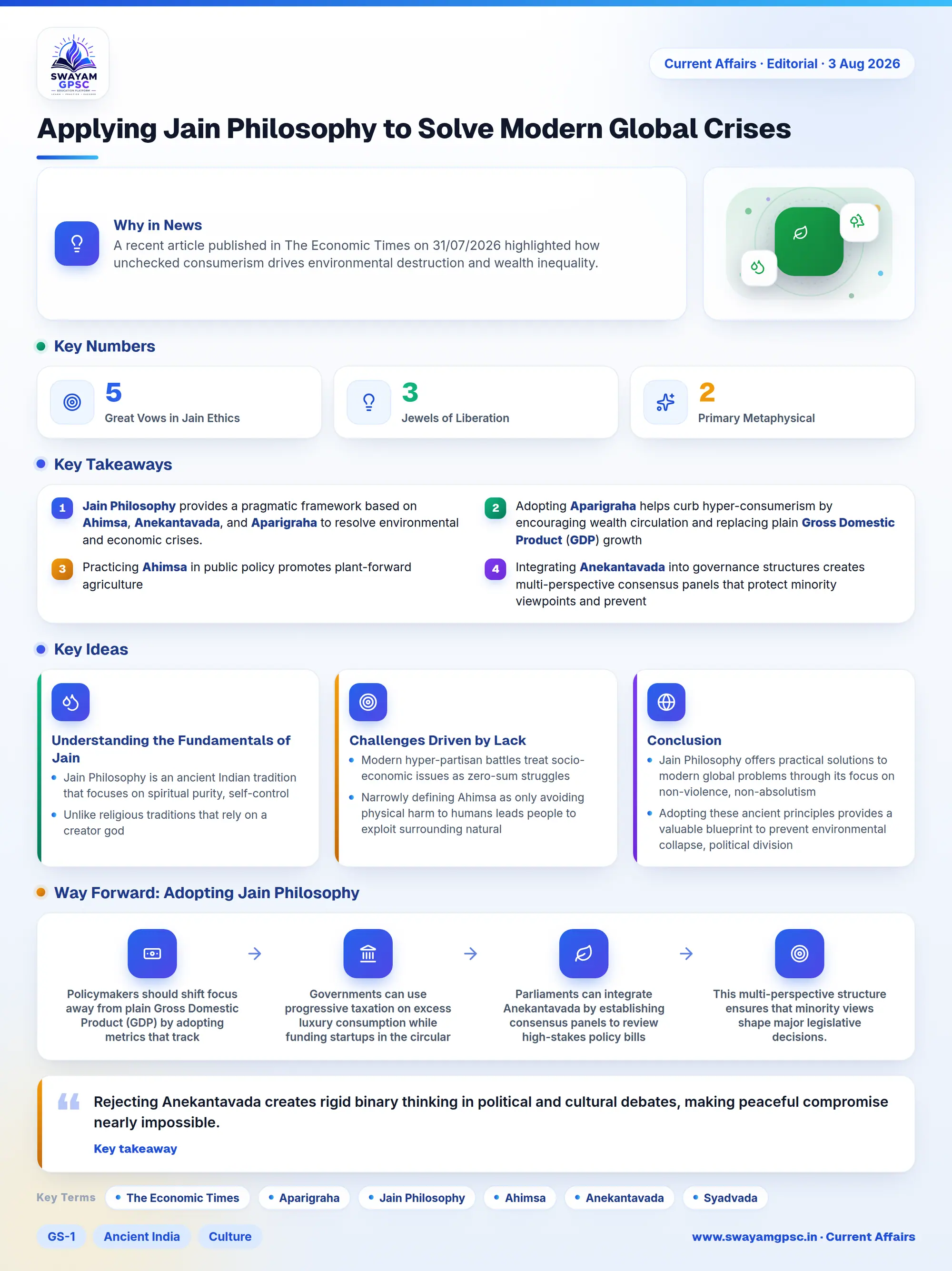
Applying Jain Philosophy to Solve Modern Global Crises
#GS-1 #Ancient India #Culture #GS-3 #Sustainable Development #Environment #GS-4 #Ethics #Socio-cultural Reform Movements
Key takeaways
- Jain Philosophy provides a pragmatic framework based on Ahimsa, Anekantavada, and Aparigraha to resolve environmental and economic crises.
- Adopting Aparigraha helps curb hyper-consumerism by encouraging wealth circulation and replacing plain Gross Domestic Product (GDP) growth with sustainable economic models.
- Practicing Ahimsa in public policy promotes plant-forward agriculture, which reduces greenhouse gas emissions and guards against zoonotic diseases.
- Integrating Anekantavada into governance structures creates multi-perspective consensus panels that protect minority viewpoints and prevent political polarization.
Why in News
- A recent article published in The Economic Times on 31/07/2026 highlighted how unchecked consumerism drives environmental destruction and wealth inequality.
- The publication emphasized that reviving the Jain concept of Aparigraha provides an essential moral framework to curb greed and promote sustainable development worldwide.
Understanding the Fundamentals of Jain Philosophy
- Jain Philosophy is an ancient Indian tradition that focuses on spiritual purity, self-control, and Ahimsa to free the soul (jiva) from rebirth (samsara).
- Unlike religious traditions that rely on a creator god, Jainism is a nontheistic philosophy that views the universe as uncreated, eternal, and governed by natural cosmic laws.
- The core principle of Ahimsa commands non-injury to all living beings through actions, words, and thoughts, making it the highest moral duty (param dharma).
- Jains follow strict vegetarianism and take care to protect even microscopic organisms from harm.
- The concept of Anekantavada states that reality is complex and perceived differently from various vantage points, so no single human perspective holds absolute truth.
- The parable of the blind men describing an elephant illustrates Anekantavada, showing how limited personal experience leads to incomplete understanding.
- The doctrine of Syadvada asserts that all logical statements are conditional, using qualifiers like Syat to prevent dogmatic thinking.
- The principle of Aparigraha requires individuals to minimize their attachment to material goods, personal wealth, and negative emotions like greed and anger.
- Monks of the Digambara tradition abandon all clothing to demonstrate total freedom from physical possessions.
- Jain metaphysics divides the universe into two main eternal categories, which are conscious living substance (Jiva) and unconscious non-living matter (Ajiva).
- The mechanism of Karma causes particles to flow into the soul through Asrava, which leads to karmic binding known as Bandha.
- Spiritual practice helps stop new karma through Samvara and shed existing karmic matter through Nirjara.
- The soul achieves total liberation (Moksha) at the top of the universe (Siddhashila) when it permanently frees itself from all karmic weight.
- Jains follow the Three Jewels (Ratnatraya) to reach liberation, which consist of Samyak Darshan, Samyak Jnana, and Samyak Charitra.
- Right conduct (Samyak Charitra) relies on the Five Great Vows (Mahavratas), which include Ahimsa, Satya, Asteya, Brahmacharya, and Aparigraha.
- Jain cosmology views time as a cyclical wheel that moves through downward decline (Avasarpini) and upward growth (Utsarpini).
Challenges Driven by Lack of Philosophical Understanding
- Rejecting Anekantavada creates rigid binary thinking in political and cultural debates, making peaceful compromise nearly impossible.
- Modern hyper-partisan battles treat socio-economic issues as zero-sum struggles, which silences moderate voices across society.
- Narrowly defining Ahimsa as only avoiding physical harm to humans leads people to exploit surrounding natural ecosystems.
- Destruction of the Amazon rainforest treats nature as an inert commodity, which accelerates ecological collapse and climate change.
- Ignoring Aparigraha drives hyper-consumerism, because economic growth models wrongly equate material accumulation with human happiness.
- Jain thought explains that excess consumption naturally leads to systemic exploitation and social tension.
- The fast fashion industry thrives on overconsumption while exploiting low-wage labor in developing nations.
- Abandoning Syadvada allows digital outrage and targeted hate speech to spread rapidly across online networks.
- Online mobs often take short clips out of context to spark real-world communal conflicts.
- Ignoring the principle of Parasparopagraho Jivanam reduces animals to mere industrial commodities.
- Intensive factory farming causes immense animal suffering while increasing the risk of zoonotic diseases and greenhouse gas emissions.
- Neglecting the virtue of Kshama encourages long-lasting grudges and endless cycles of vengeance.
- Geopolitical rivalries remain trapped in deadlocks because nations prioritize political ego over restorative dialogue.
- Abandoning Samyama removes internal ethical restraint from leaders holding high positions of authority.
- Corporate financial scandals occur when unchecked executive greed overrides public interest and economic stability.
Way Forward: Adopting Jain Philosophy for Modern Solutions
- Policymakers should shift focus away from plain Gross Domestic Product (GDP) by adopting metrics that track ecological footprint and material restraint.
- Governments can use progressive taxation on excess luxury consumption while funding startups in the circular economy.
- Parliaments can integrate Anekantavada by establishing consensus panels to review high-stakes policy bills on AI ethics and environmental protection.
- This multi-perspective structure ensures that minority views shape major legislative decisions.
- Public health systems can apply Ahimsa by redirecting agricultural subsidies away from factory farms toward plant-based farming.
- Serving plant-rich meals in public institutions reduces carbon emissions and lowers healthcare costs for chronic diseases.
- International organizations like the United Nations can adopt Kshama to build restorative justice frameworks.
- De-escalation tribunals can replace military arms races with shared resource agreements in disputed border regions.
- Regulations can require social media companies to use Syadvada principles by adding context metadata tags to viral posts.
- Contextual tags help curb the spread of unverified outrage and manipulative fake news.
- Promoting Samyama creates an internal moral compass for public officials and business leaders.
- Ethical self-restraint helps eliminate corporate fraud, insider trading, and abuse of power.
- Applying Aparigraha treats wealth as a public trust, encouraging capital circulation and voluntary philanthropy.
- Historically, Jain merchants maintained stable trade networks under the Solankis, Delhi Sultanate, and Mughals by prioritizing economic cooperation over political domination.
Conclusion
- Jain Philosophy offers practical solutions to modern global problems through its focus on non-violence, non-absolutism, and material restraint.
- Adopting these ancient principles provides a valuable blueprint to prevent environmental collapse, political division, and economic inequality.