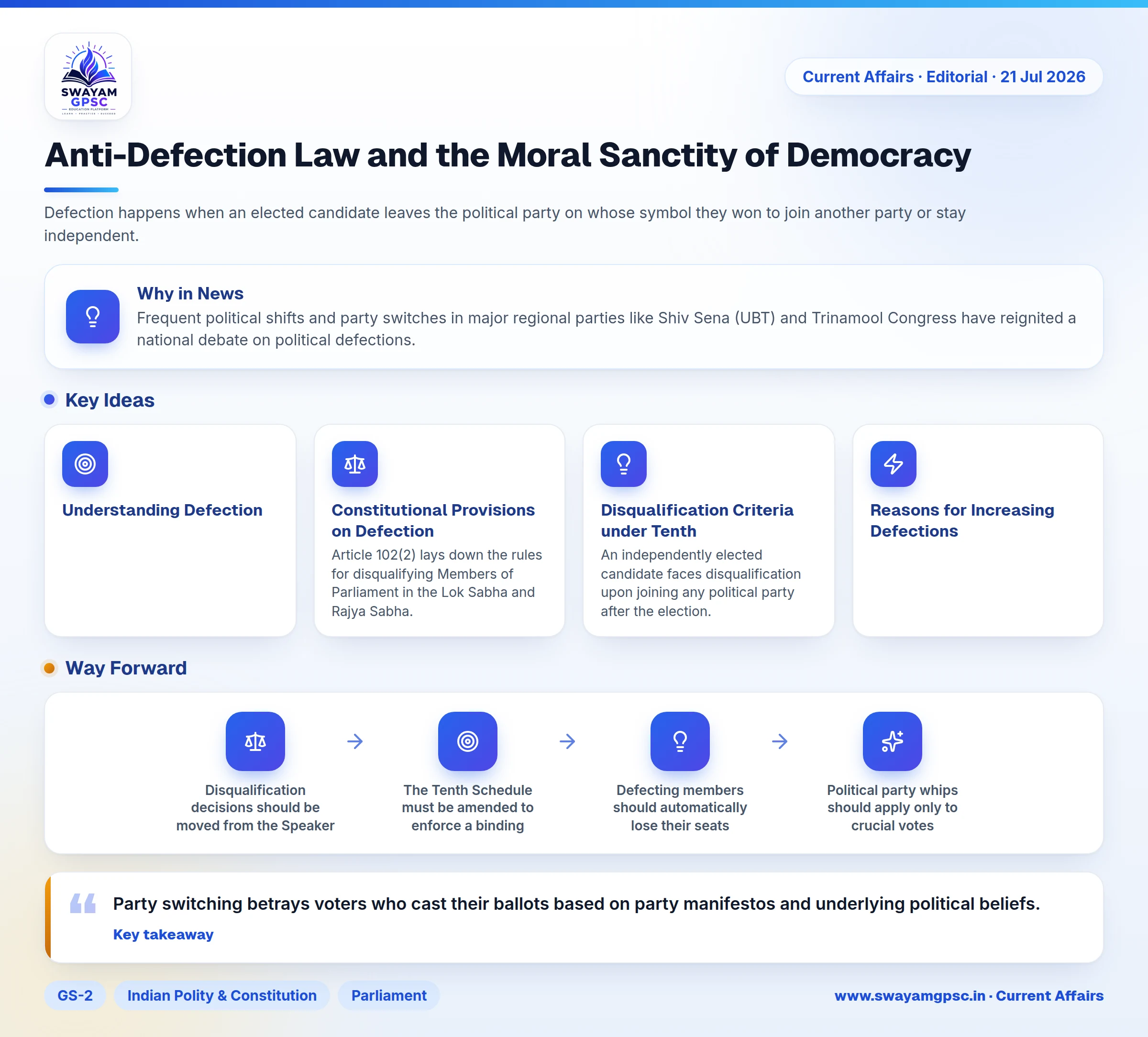
Anti-Defection Law and the Moral Sanctity of Democracy
#GS-2 #Indian Polity & Constitution #Parliament #Constitution #Judiciary #Anti-Defection Law #Electoral Reforms
Why in News
- Frequent political shifts and party switches in major regional parties like Shiv Sena (UBT) and Trinamool Congress have reignited a national debate on political defections.
Understanding Defection
- Defection happens when an elected candidate leaves the political party on whose symbol they won to join another party or stay independent.
- Popularly known as Aaya Ram Gaya Ram politics, this practice turns a public voting mandate into a personal bargaining tool for power and protection.
Constitutional Provisions on Defection
- The Tenth Schedule of the Indian Constitution governs anti-defection rules and was added by the 52nd Constitutional Amendment Act 1985.
- Article 102(2) lays down the rules for disqualifying Members of Parliament in the Lok Sabha and Rajya Sabha.
- Article 191(2) outlines the disqualification rules for Members of State Legislative Assemblies and Legislative Councils.
- The 91st Constitutional Amendment Act 2003 removed the old provision that allowed a one-third split in a party.
- Currently, legislators can only avoid disqualification if at least two-thirds of the members of a legislative party agree to a merger.
Disqualification Criteria under Tenth Schedule
- Legislators are disqualified if they voluntarily give up the membership of their political party through resignation or conduct.
- Disqualification occurs if members vote or abstain from voting against party direction without prior permission or condonation within 15 days.
- An independently elected candidate faces disqualification upon joining any political party after the election.
- Nominated members lose their seat if they join any political party after six months from taking office.
Reasons for Increasing Defections
- Politicians switch parties mainly to secure minister posts, political power, and administrative control rather than ideological alignment.
- Representatives facing legal troubles often join the ruling party to gain immunity and reduce scrutiny from investigative agencies.
- Assembly Speakers often act in a partisan manner by delaying disqualification decisions to protect ruling governments.
- Defecting groups exploit the merger loophole under Paragraph 4 of the Tenth Schedule by gathering two-thirds support.
- Strict central control inside political parties limits internal debate and forces unhappy leaders to leave the party.
Challenges to Democratic Sanctity
- Party switching betrays voters who cast their ballots based on party manifestos and underlying political beliefs.
- Continuous defections weaken opposition parties in parliament and reduce effective government oversight.
- Using defections to clear legal cases destroys public trust in the neutrality of law enforcement bodies.
- Governance turns into a market arrangement where political posts are bought and sold based on convenience.
- Voters lose genuine policy choices when elected officials frequently change sides for personal gains.
Key Supreme Court Judgments
- In Kihoto Hollohan v. Zachillhu (1992), the court upheld the Tenth Schedule and ruled that Speaker decisions are subject to judicial review.
- In Keisham Meghachandra Singh v. Speaker Manipur (2020), the court mandated that Speakers decide disqualification petitions within a limit of three months.
- In Subhash Desai v. Governor of Maharashtra (2023), the SC stated that internal party dissent alone does not justify calling a floor test.
- In Padi Kaushik Reddy Case (2025), the court reaffirmed time bound decisions and instructed the Telangana Speaker to decide pending cases within three months.
Way Forward
- Disqualification decisions should be moved from the Speaker to an independent tribunal headed by a retired judge or the Election Commission of India.
- The Tenth Schedule must be amended to enforce a binding resolution window of 60 to 90 days for all disqualification petitions.
- Defecting members should automatically lose their seats and be barred from holding public office for the remaining legislative term.
- Political party whips should apply only to crucial votes like No-Confidence Motions and Money Bills to allow freedom of thought on general bills.
- Civil society organizations must build voter awareness to penalize defecting representatives at the voting booth.
Conclusion
- Although the Tenth Schedule aimed to prevent opportunistic party switching, legal loopholes and delayed decisions have weakened its impact.
- Protecting public mandate requires setting strict timelines and moving adjudication powers to independent bodies.