Andromeda Galaxy Star Formation Decline Studied by Hubble Telescope
#GS-3 #Science & Technology #Space #Current Events #International #Astronomy
Key takeaways
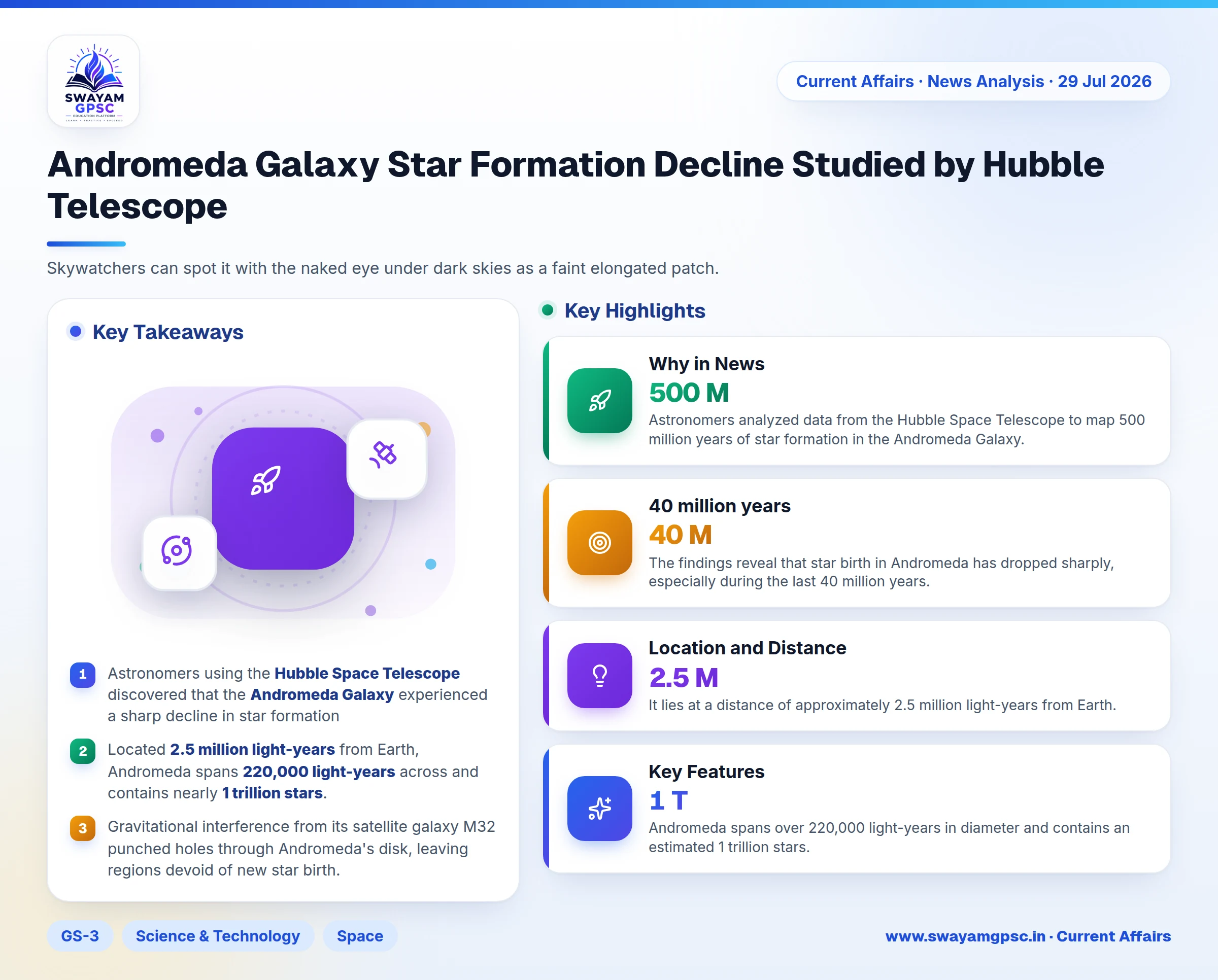
- Astronomers using the Hubble Space Telescope discovered that the Andromeda Galaxy experienced a sharp decline in star formation over the past 40 million years.
- Located 2.5 million light-years from Earth, Andromeda spans 220,000 light-years across and contains nearly 1 trillion stars.
- Gravitational interference from its satellite galaxy M32 punched holes through Andromeda's disk, leaving regions devoid of new star birth.
- Moving at 110 km/s, Andromeda is on a direct course to merge with our Milky Way in 4 to 10 billion years.
Why in News
- Astronomers analyzed data from the Hubble Space Telescope to map 500 million years of star formation in the Andromeda Galaxy.
- The findings reveal that star birth in Andromeda has dropped sharply, especially during the last 40 million years.
What is Andromeda Galaxy?
- The Andromeda Galaxy, also known as Messier 31 or M31, is a massive barred spiral galaxy.
- It is the closest major spiral neighbor to our Milky Way and the largest galaxy in the Local Group.
Location and Distance
- This galaxy is located within the Andromeda constellation.
- It lies at a distance of approximately 2.5 million light-years from Earth.
- Skywatchers can spot it with the naked eye under dark skies as a faint elongated patch.
Key Features
- Andromeda spans over 220,000 light-years in diameter and contains an estimated 1 trillion stars.
- The steady slowdown of star birth across its ring structures marks its transition into a quieter cosmic middle age.
- Gravitational passes by its satellite galaxy M32 punched through its stellar disk and created a dead zone with no new stars.
- Most of its remaining gas is concentrated in prominent ring structures located at radii of 26,000 light-years and 33,000 light-years.
- Moving toward the Milky Way at 110 km/s, Andromeda will likely collide and merge with our galaxy in 4 to 10 billion years.
Significance
- Studying Andromeda helps astronomers understand how large spiral galaxies form, mature, and stop producing stars over time.
- Data from its slowing star formation helps scientists refine models that measure the age and growth of distant galaxies.