AI Revolution in Indian Enterprises: Scope, Risks, and Safety Framework
#GS-3 #Science & Technology #Artificial Intelligence #Cyber Security #ICT #Economy #Infrastructure
Why in News
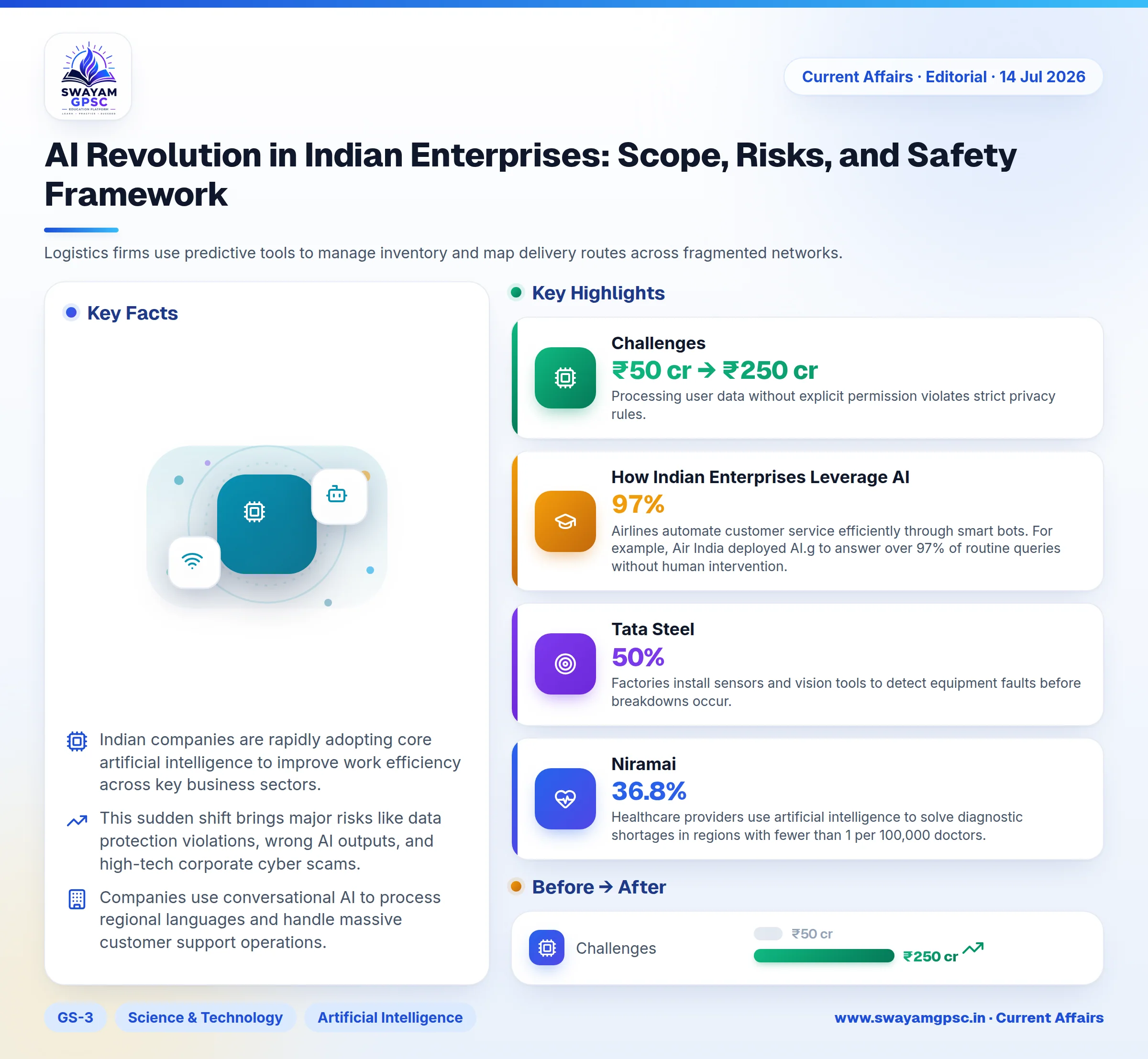
- Indian companies are rapidly adopting core artificial intelligence to improve work efficiency across key business sectors.
- This sudden shift brings major risks like data protection violations, wrong AI outputs, and high-tech corporate cyber scams.
How Indian Enterprises Leverage AI
- Companies use conversational AI to process regional languages and handle massive customer support operations. For instance, Reliance Jio and Bharti Airtel use systems like Yellow.ai and Haptik for daily queries.
- Airlines automate customer service efficiently through smart bots. For example, Air India deployed AI.g to answer over 97% of routine queries without human intervention.
- Factories install sensors and vision tools to detect equipment faults before breakdowns occur. At its Jamshedpur plant, Tata Steel uses thermal imaging tools to cut unplanned downtime by 30-50% and reduce maintenance costs by 15-35%.
- Logistics firms use predictive tools to manage inventory and map delivery routes across fragmented networks. Maruti Suzuki aligns parts supply with live store data, while Flipkart forecasts local demand to speed up delivery to Tier-2 and Tier-3 cities.
- Financial firms rely on machine learning to catch fraud and run fast credit checks. HDFC Bank and ICICI Bank track spending patterns, while startup Arya.ai automates insurance claim approvals.
- Healthcare providers use artificial intelligence to solve diagnostic shortages in regions with fewer than 1 per 100,000 doctors. This sector shows a 36.8% annual growth rate as companies like Niramai screen early breast cancer using non-invasive thermal tools.
- Tech firms use intelligent software agents to write code automatically. Tata Consultancy Services (TCS) trained 150,000 workers on generative platforms and launched WisdomNext, while mid-sized firm Chirpn uses AutoPATH to cut build times by 60%.
- Agribusinesses guide small farmers through satellite tracking and weather analytics. ITC Limited uses ITC e-Choupal 4.0 to give farmers soil advice while stabilizing its raw supply network.
Challenges
- AI models often state incorrect facts with confidence, which damages business reputations. A survey by Nasscom showed that 56% of Indian executives view these hallucinations as their top operational threat.
- Processing user data without explicit permission violates strict privacy rules. Under the Digital Personal Data Protection (DPDP) Act, 2023, fines range from ₹50 Crore to ₹250 Crore, while 36% of business leaders report privacy compliance struggles and 43% lack quality data.
- Cybercriminals deploy AI voices and videos to trick staff and steal company funds. The 2026 Thales Data Threat Report revealed that 65% of Indian firms faced deepfake attacks, 55% lost trust due to fake content, and 64% fear smart cyber threats.
- Complex decision models operate like opaque boxes that can unintentionally discriminate by gender or income. Around 35% of leaders fear this lack of clarity, 29% worry about bias, and 94% demand clear decision reasoning for business trust.
- Staff members paste internal software code or secret financial records into public AI tools. Only 35% of Indian firms know where all their data is stored, and just 36% classify their data properly to stop leaks.
- Companies fail to allocate funding specifically for artificial intelligence defenses. Only 30% of firms have dedicated AI security funds, leaving 53% reliant on basic firewalls that cannot block modern prompt attacks.
- Interconnected software agents can trigger uncontrollable feedback loops during operations. Automated trading or pricing tools can launch damaging price wars within seconds if left without proper safeguards.
Way Forward
- Business leaders should set up formal governance bodies following the 7 sutras outlined by MeitY. They must form an internal committee to grade applications by risk levels before deployment.
- Teams should apply quantitative risk scores using the framework created by Nasscom. Multiplying impact and likelihood on a standard scale helps flag high-risk models before release.
- Firms must build clean data channels that strip personal details before training systems. Automated consent tracking ensures full compliance with the DPDP Act, 2023.
- Engineers should run specialized monitoring tools like LangFuse, Deepchecks, or Evidently AI to watch for model drift. If factual accuracy drops below 95%, the system should roll back to a safe backup state automatically.
- Financial institutions must integrate tools like SHAP and LIME to explain algorithmic results clearly. This practice complies with RBI guidance and ensures every rejected application leaves an auditable paper trail.
- Security officers must block unsafe public AI portals with enterprise tools such as Microsoft Purview. Linking system endpoints to corporate security software stops secret code from leaking outward.
- Organizations need clear human review steps for high-stakes decisions like medical diagnoses. Lower-risk tools require immediate manual override switches to stop unexpected error chains.
Conclusion
- Expanding corporate AI adoption brings massive efficiency gains but requires strong regulatory and security safeguards.
- Adopting structured governance and risk tracking enables long-term growth while protecting consumer trust and meeting national privacy standards.