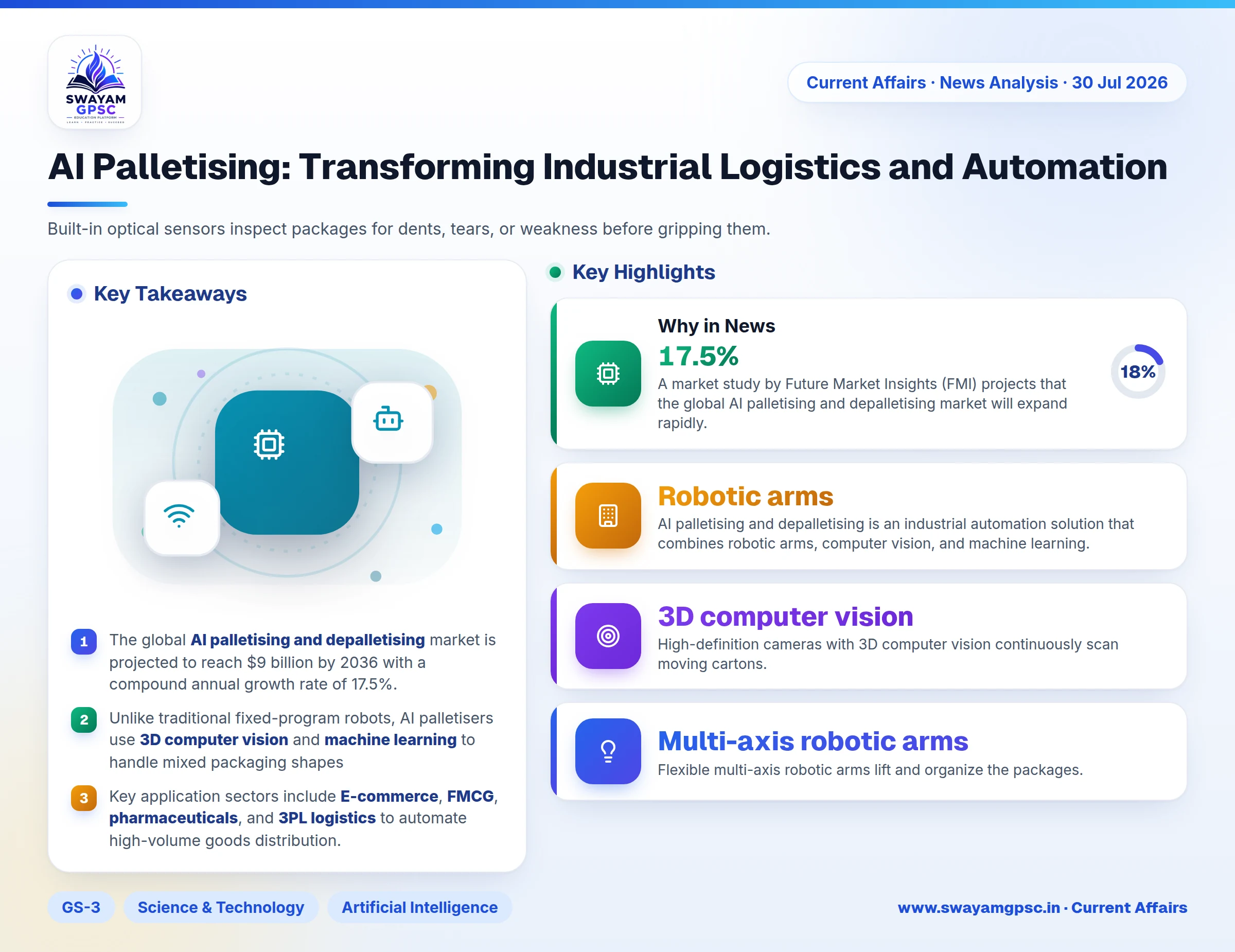
AI Palletising: Transforming Industrial Logistics and Automation
#GS-3 #Science & Technology #Artificial Intelligence #Robotics #Economy #Infrastructure
Key takeaways
- The global AI palletising and depalletising market is projected to reach $9 billion by 2036 with a compound annual growth rate of 17.5%.
- Unlike traditional fixed-program robots, AI palletisers use 3D computer vision and machine learning to handle mixed packaging shapes and sizes automatically without manual intervention.
- Key application sectors include E-commerce, FMCG, pharmaceuticals, and 3PL logistics to automate high-volume goods distribution.
- Primary adoption hurdles include high initial capital costs and complex integration with legacy Warehouse Management Systems (WMS).
Why in News
- A market study by Future Market Insights (FMI) projects that the global AI palletising and depalletising market will expand rapidly. The market value is expected to rise from $1.8 billion in 2026 to $9 billion by 2036, growing at a 17.5% compound annual growth rate.
What is AI Palletising?
- AI palletising and depalletising is an industrial automation solution that combines robotic arms, computer vision, and machine learning. It automatically loads cartons onto transport platforms called pallets and unloads them when required.
- Traditional industrial robots depend on fixed code and only process identical boxes. In contrast, modern AI systems adjust instantly to different package dimensions, uneven shapes, and minor carton damage without human assistance.
How It Works
- High-definition cameras with 3D computer vision continuously scan moving cartons. They instantly evaluate length, width, height, structural strength, and placement angle in real time.
- Intelligent algorithms determine the safest location for the robotic gripper. They also design optimized, stable stacking plans to fit maximum products securely without causing pallet collapse.
- Flexible multi-axis robotic arms lift and organize the packages. These arms continuously adjust their speed and gripping pressure based on instant feedback from visual sensors.
Key Features
- The automated system handles thousands of distinct product types on a single pallet. It effortlessly mixes packages of different shapes, sizes, and weights together.
- Built-in optical sensors inspect packages for dents, tears, or weakness before gripping them. This prevents damaged packages from getting stacked and avoids warehouse accidents.
- When production lines switch to new packaging designs, engineers do not need to reprogram the robot. The AI system learns new package dimensions automatically on its own.
- The system uses machine learning models to analyze everyday operations continuously. Over time, it increases stacking speed, improves gripping accuracy, and resolves minor operational errors.
Major Industry Applications
- Large E-Commerce hubs and 3PL logistics warehouses use this technology to process mixed-SKU shipments, unload containers, and speed up package dispatch.
- Food and beverage factories install AI robotic units at the end of assembly lines to move bottles, cans, and heavy crates safely at high production speeds.
- Companies manufacturing Fast-Moving Consumer Goods (FMCG) deploy these automated units to handle complex product lines across shared shipping pallets.
- Pharmaceutical and chemical facilities use soft-touch robotic arms to handle delicate medicine packages and dangerous materials safely.
Challenges
- Adding modern AI robotic cells into older facilities with traditional conveyor systems and outdated Warehouse Management Systems (WMS) is technically challenging and expensive.
- Purchasing high-resolution 3D vision systems, multi-axis robotic arms, and specialized software requires a large initial financial outlay.
- If a poorly integrated robot drops a box and fails to recover automatically, it can pause the entire factory assembly line.