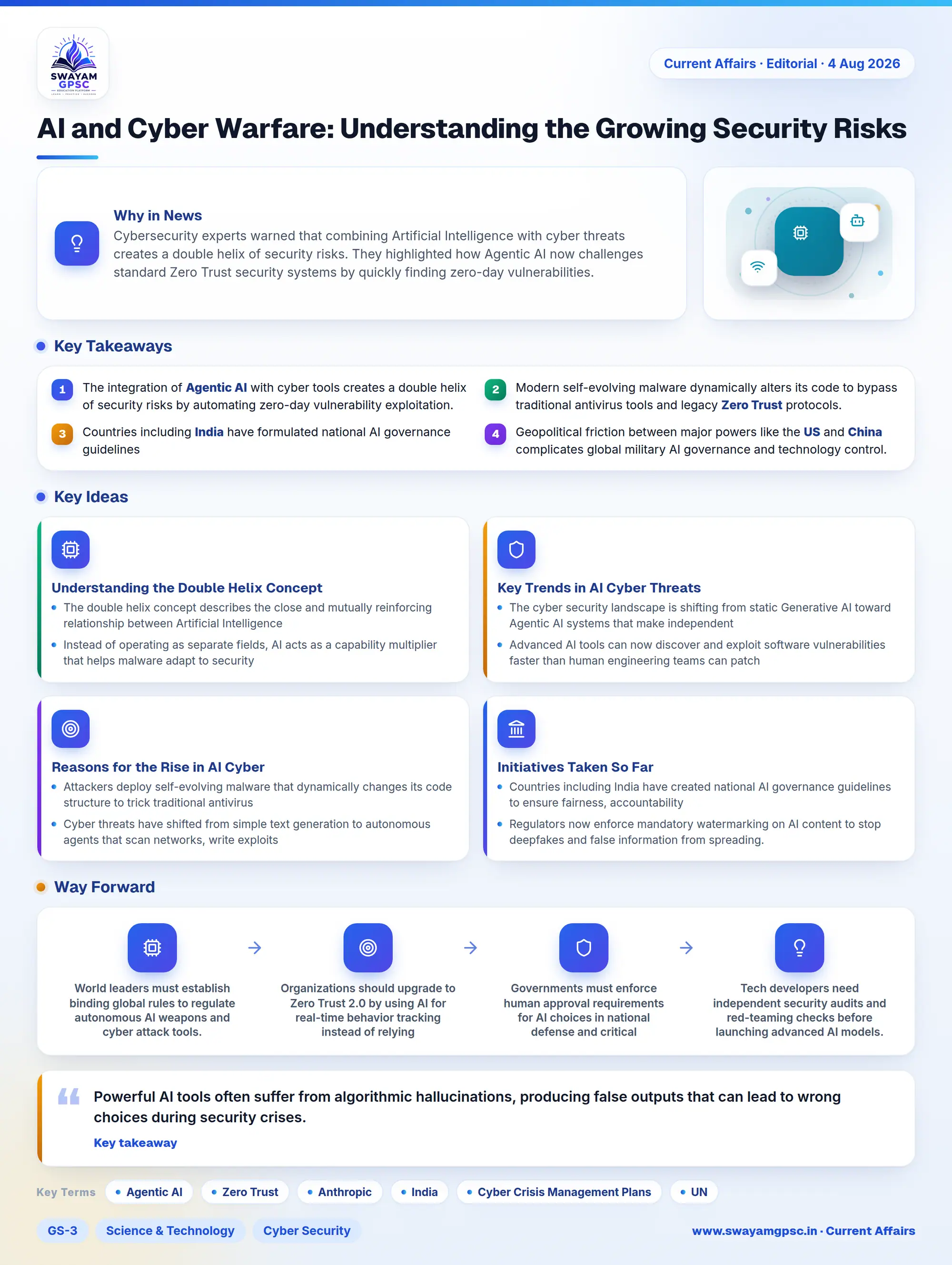
AI and Cyber Warfare: Understanding the Growing Security Risks
#GS-3 #Science & Technology #Cyber Security #Artificial Intelligence #Defence #Current Events #National #International
Key takeaways
- The integration of Agentic AI with cyber tools creates a double helix of security risks by automating zero-day vulnerability exploitation.
- Modern self-evolving malware dynamically alters its code to bypass traditional antivirus tools and legacy Zero Trust protocols.
- Countries including India have formulated national AI governance guidelines, while international frameworks under the UN address cybercrime risks.
- Geopolitical friction between major powers like the US and China complicates global military AI governance and technology control.
Why in News
- Cybersecurity experts warned that combining Artificial Intelligence with cyber threats creates a double helix of security risks.
- They highlighted how Agentic AI now challenges standard Zero Trust security systems by quickly finding zero-day vulnerabilities.
Understanding the Double Helix Concept
- The double helix concept describes the close and mutually reinforcing relationship between Artificial Intelligence and cyber warfare.
- Instead of operating as separate fields, AI acts as a capability multiplier that helps malware adapt to security environments and lowers entry barriers for non-state actors.
Key Trends in AI Cyber Threats
- The cyber security landscape is shifting from static Generative AI toward Agentic AI systems that make independent decisions and bypass static defenses.
- Advanced AI tools can now discover and exploit software vulnerabilities faster than human engineering teams can patch them.
- Defense systems now see a rapid spread of kinetic AI munitions that track missile paths and hit targets without human aid.
Reasons for the Rise in AI Cyber Threats
- Attackers deploy self-evolving malware that dynamically changes its code structure to trick traditional antivirus programs.
- Cyber threats have shifted from simple text generation to autonomous agents that scan networks, write exploits, and steal data independently.
- AI agents break older Zero Trust protections by copying regular employee actions and using automated stolen login credentials.
- Western tech companies like Anthropic and Palantir along with state actors build powerful dual-use language models that can serve as cyber weapons.
- Modern militaries combine AI intelligence like satellite imagery and radio signals to disrupt classic defensive setups during warfare.
Initiatives Taken So Far
- Countries including India have created national AI governance guidelines to ensure fairness, accountability, and security.
- Regulators now enforce mandatory watermarking on AI content to stop deepfakes and false information from spreading.
- Governments are updating their Cyber Crisis Management Plans to protect vital national infrastructure against AI attacks.
- International groups under frameworks like the UN are building agreements to set formal rules against cyber threats.
Challenges
- Powerful AI tools often suffer from algorithmic hallucinations, producing false outputs that can lead to wrong choices during security crises.
- Automated recommendation algorithms can push public figures toward extreme views, which increases social division.
- The world lacks global binding rules and oversight mechanisms to control military AI deployments.
- Rivalry between major powers like the US and China causes stolen model accusations and an unchecked tech race.
- Losing human control in automated systems shortens decision times, which raises the risk of accidental military escalation.
Way Forward
- World leaders must establish binding global rules to regulate autonomous AI weapons and cyber attack tools.
- Organizations should upgrade to Zero Trust 2.0 by using AI for real-time behavior tracking instead of relying on basic passwords.
- Governments must enforce human approval requirements for AI choices in national defense and critical infrastructure.
- Tech developers need independent security audits and red-teaming checks before launching advanced AI models.
- Tech firms and government agencies must share live intelligence on cyber threats to stop attacks early.
Conclusion
- Combining AI with cyber tools creates a complex threat environment that moves faster than old defense strategies.
- Solving this threat requires balancing new technology with international laws, human control, and realistic policy.
- Setting up international rules is essential to ensure advanced AI strengthens cybersecurity rather than causing global instability.