Addressing the Silent Soil Health Crisis in India
#GS-1 #Land Resources #GS-3 #Conservation #Irrigation #Sustainable Development #Agriculture #Environment #Economy
Key takeaways
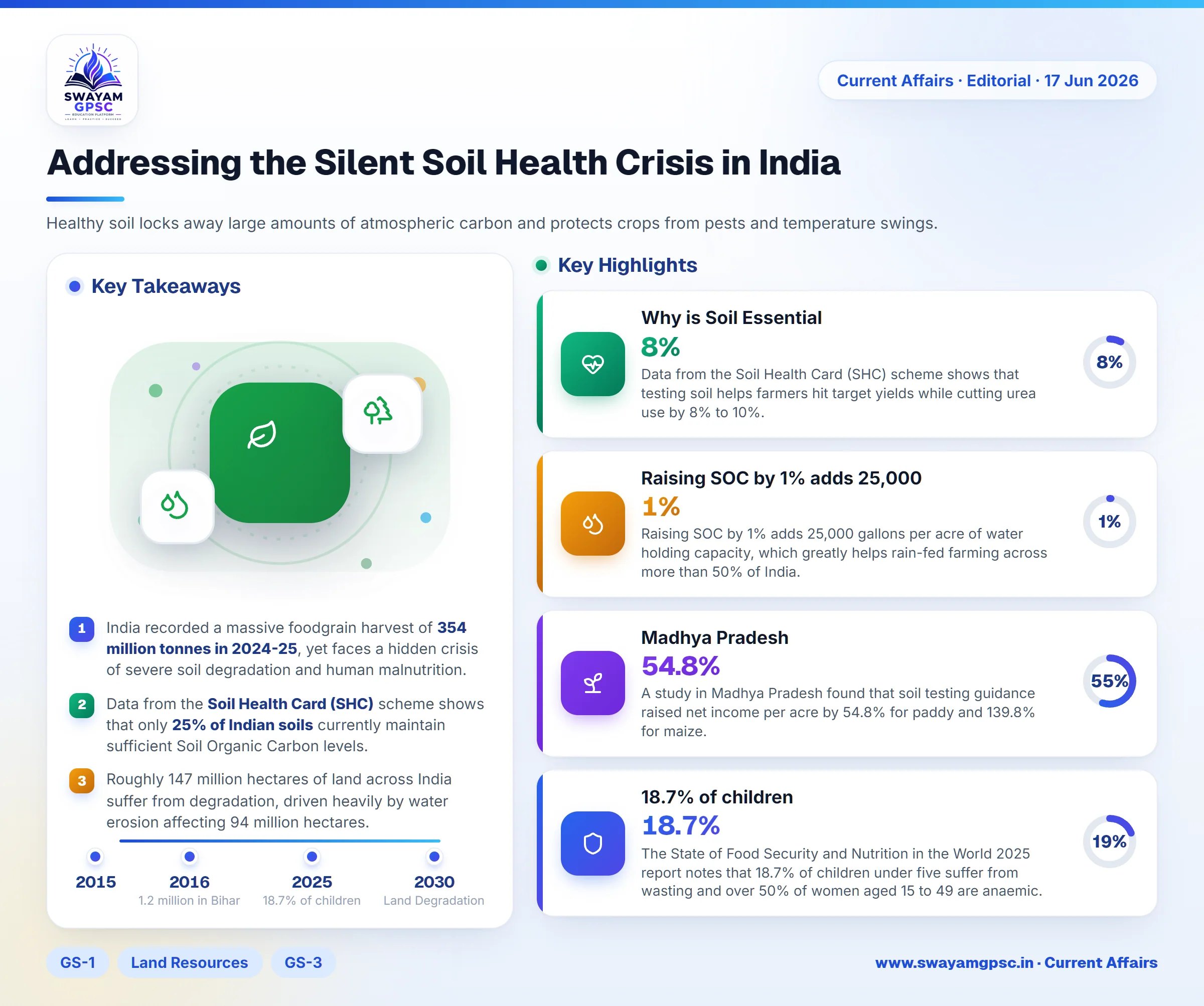
- India recorded a massive foodgrain harvest of 354 million tonnes in 2024-25, yet faces a hidden crisis of severe soil degradation and human malnutrition.
- Data from the Soil Health Card (SHC) scheme shows that only 25% of Indian soils currently maintain sufficient Soil Organic Carbon levels.
- Roughly 147 million hectares of land across India suffer from degradation, driven heavily by water erosion affecting 94 million hectares.
- Groundwater arsenic contamination poses immediate health risks to millions, with West Bengal, Bihar, and Assam holding 92% of the affected population.
Why is Soil Essential
- Healthy soil lets farmers apply exact amounts of nutrients, which makes fertilizers work much better.
- Data from the Soil Health Card (SHC) scheme shows that testing soil helps farmers hit target yields while cutting urea use by 8% to 10%.
- Soil Organic Carbon (SOC) acts as a natural sponge and is the main driver of water retention in agricultural land.
- Raising SOC by 1% adds 25,000 gallons per acre of water holding capacity, which greatly helps rain-fed farming across more than 50% of India.
- Biodiverse soil acts as a strong buffer against extreme weather events like severe heatwaves and heavy unseasonal rains.
- Healthy soil locks away large amounts of atmospheric carbon and protects crops from pests and temperature swings.
- The rhizosphere relies on a rich microbial community near plant roots to help absorb nutrients naturally.
- Good microbes dissolve phosphorus and fix nitrogen in the air, lowering the need for artificial chemicals.
- Adding organic matter like Farm Yard Manure (FYM) boosts this microbe activity and helps high yielding crop varieties reach their full genetic potential.
- Treating soil health as a long term asset lowers chemical costs and brings stable incomes to rural households.
- A study in Madhya Pradesh found that soil testing guidance raised net income per acre by 54.8% for paddy and 139.8% for maize.
- Soil quality directly affects the nutrient levels in food crops, and poor soil leads to hidden hunger in the population.
- The State of Food Security and Nutrition in the World 2025 report notes that 18.7% of children under five suffer from wasting and over 50% of women aged 15 to 49 are anaemic.
- India signed the United Nations Convention to Combat Desertification (UNCCD) and aims to reach Land Degradation Neutrality by 2030.
- A strong soil system stops land degradation by improving structural stability and resisting erosion during droughts.
Challenges
- India gives heavy urea subsidies, which pushes farmers to use too much nitrogen instead of other important minerals.
- This habit has ruined the ideal NPK ratio of 4:2:1, making it worse than 7:3:1 in several farming areas.
- High-yielding variety seeds constantly pull nutrients out of the earth without getting enough back, leading to a yearly deficit of 8 to 10 million tonnes of NPK.
- The rice-wheat cropping system from the Green Revolution has caused heavy soil fatigue and ruined natural soil recovery cycles.
- A Soil Health Card (SHC) assessment for 2024-25 reveals that less than 10% of Indian soils have high nitrogen, while only 45% have enough phosphorus and 32% have potassium.
- Bad irrigation management, especially flood irrigation in canal zones, causes waterlogging and secondary salinization.
- Around 8.5 million hectares of Indian land suffer from salinity and alkalinity, which hurts root growth and ruins productivity.
- Using heavy machinery for deep tillage compacts the top 20 to 50 cm of soil.
- Soil compaction blocks air flow and water movement, which breaks down soil aggregates and causes serious erosion.
- Soil Organic Carbon (SOC) holds soil particles together, but the 2024-25 SHC assessment shows that only 25% of Indian soils have enough SOC.
- In Punjab and Haryana, SOC has dropped dangerously to just 0.2 to 0.4% in multiple places.
- Farmers burn roughly 100 million tonnes of crop residue every year, which destroys organic matter and dries out the soil.
- Nearly 147 million hectares of land in India suffer from degradation, with 94 million hectares damaged by water erosion and 9 million hectares by wind erosion.
- Deforestation and the loss of grazing lands leave soil exposed to heavy monsoon rains.
- Grasslands shrank by 31% in just one decade, dropping from 18 million hectares to 12.3 million hectares between 2005 and 2015.
- Urban growth and industrial waste bring dangerous heavy metals like lead, cadmium, and arsenic into farm soils.
- Data from 2016 shows that arsenic in groundwater put 9.6 million people in West Bengal, 1.6 million in Assam, 1.2 million in Bihar, 500,000 in Uttar Pradesh, and 13,000 in Jharkhand at immediate risk.
- West Bengal, Bihar, and Assam currently contain about 92% of the population affected by arsenic in groundwater.
- Climate change makes things worse by causing erratic rainfall and heatwaves that break down organic matter too fast.
- The UNCCD states that droughts hit nearly 36.8% of India's land, which stops soil from recovering after damage.
Way Forward
- Using zero-till seed drills lets farmers plant seeds directly into old stubble without disturbing the soil or losing organic carbon.
- Applying a protective layer of straw or leaves called mulching shields the soil from heavy rain, keeps temperatures down, and stops weeds from growing.
- Adding pulses and legumes to crop rotations fixes nitrogen naturally and lowers the reliance on synthetic fertilizers.
- Promoting diverse crops breaks the life cycles of pests and builds natural biodiversity in the soil.
- Farmers should use a balanced mix of bio-fertilizers, green manures, and compost instead of relying entirely on chemicals.
- The Right Source, Right Rate, Right Time, and Right Place framework stops nutrient runoff and prevents soil acidification.
- Replacing flood irrigation with drip and sprinkler systems stops waterlogging and keeps salt buildup away.
- Building contours, bunds, and terraces on slopes slows down water runoff and traps valuable topsoil.
- Adding trees to farms through agroforestry acts as a permanent carbon sink and uses deep roots to pull nutrients back to the top.
- Training programs must teach local communities to protect beneficial earthworms and microbes that drive nutrient cycles.
- Creating organic farming clusters helps farmers share traditional wisdom and modern tricks through peer learning.
- Giving financial rewards and carbon credits to farmers who store carbon in their soil opens up new income streams.
- Branding and certifying chemical-free crops lets growers sell items at higher prices and covers early transition costs.
- Using local soil sensors and spraying drones gives real-time data so farmers can fix issues before land degradation happens.