Addressing India's Education and Job Crisis
#GS-2 #GS-3 #Governance & Social Justice #Education #Economy #Employment #Mobilization of Resources #National
Key takeaways
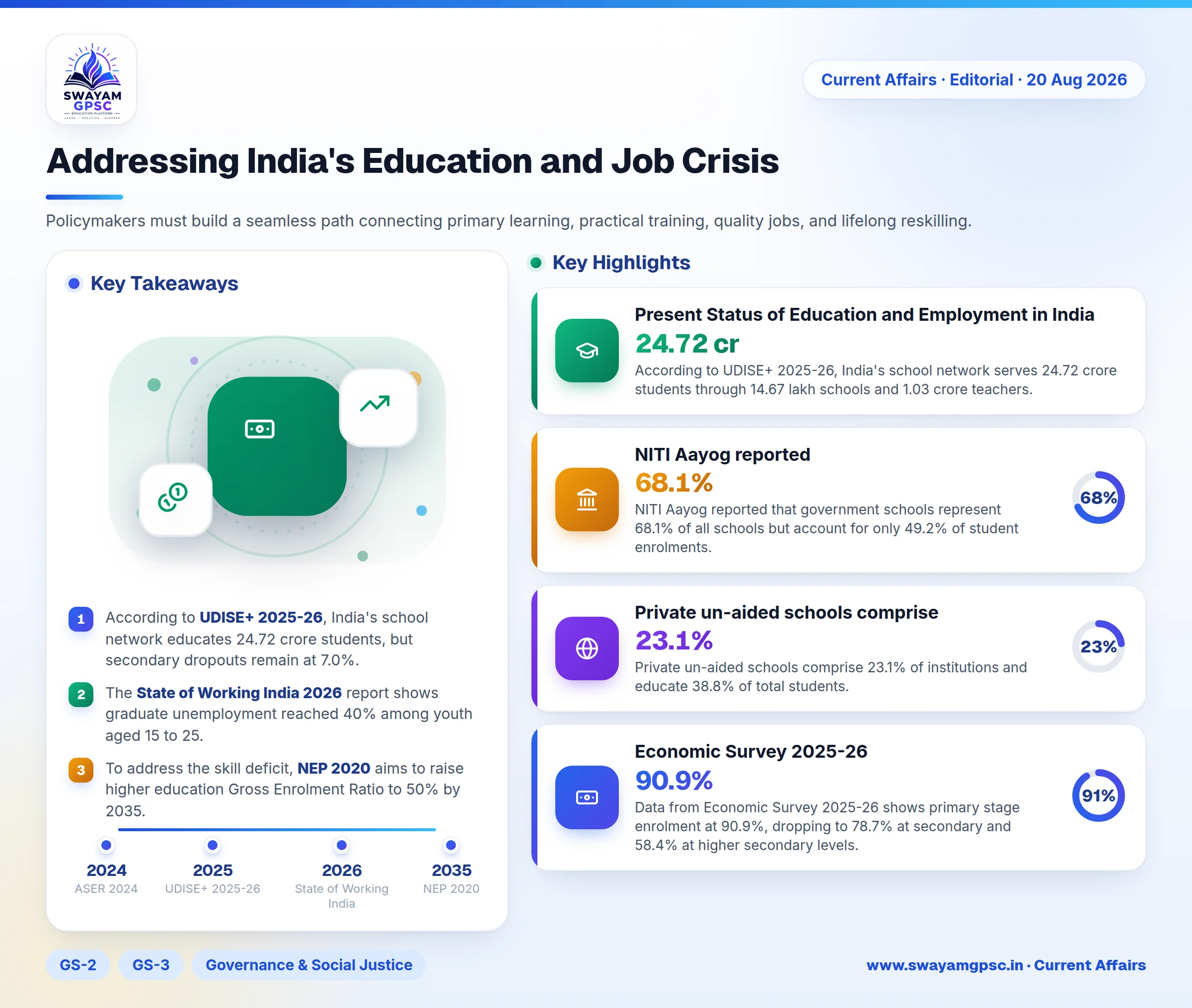
- According to UDISE+ 2025-26, India's school network educates 24.72 crore students, but secondary dropouts remain at 7.0%.
- The State of Working India 2026 report shows graduate unemployment reached 40% among youth aged 15 to 25.
- To address the skill deficit, NEP 2020 aims to raise higher education Gross Enrolment Ratio to 50% by 2035.
- The government created the Anusandhan National Research Foundation with a ₹50,000 crore budget under the ANRF Act, 2023.
Why in News
- India expanded school and higher education rapidly, creating a massive pool of educated young individuals.
- Low learning outcomes and skill shortages prevent many young graduates from securing suitable jobs.
- Without structural reforms, India risks turning its demographic dividend into economic and social instability.
- Policymakers must build a seamless path connecting primary learning, practical training, quality jobs, and lifelong reskilling.
Present Status of Education and Employment in India
- According to UDISE+ 2025-26, India's school network serves 24.72 crore students through 14.67 lakh schools and 1.03 crore teachers.
- The national average Pupil-Teacher Ratio in schools currently stands at 24:1.
- NITI Aayog reported that government schools represent 68.1% of all schools but account for only 49.2% of student enrolments.
- Private un-aided schools comprise 23.1% of institutions and educate 38.8% of total students.
- Data from Economic Survey 2025-26 shows primary stage enrolment at 90.9%, dropping to 78.7% at secondary and 58.4% at higher secondary levels.
- Under NEP 2020 tracking, dropout rates in 2025-26 were 1.8% in primary, 3.6% in middle school, and 7.0% in secondary grades.
- The AISHE 2023-24 report shows higher education enrolment grew by 31.5% since 2014-15 to reach 4.50 crore students.
- The Gross Enrolment Ratio in higher education reached 30% overall, with female participation rising to 31.2%.
- Female student enrolment in higher education increased by 42.2% over nine years, reaching 2.24 crore.
- The State of Working India 2026 report shows graduate unemployment at 40% among youth aged 15 to 25.
- The PLFS Annual Report 2025 recorded an overall youth unemployment rate of 9.9% for individuals aged 15 to 29.
- Low overall jobless statistics coexist with high graduate unemployment because low-income workers cannot afford to stay unemployed and accept low-paying informal jobs.
Role of Education in Harnessing India's Demographic Dividend
- Quality education builds fundamental reading, math, and thinking skills necessary for economic growth.
- India's large graduate talent pool generated a USD 250 billion IT export sector and over 2,100 Global Capability Centres.
- Programs like NIPUN Bharat Mission and PM POSHAN represent vital workforce investments rather than basic welfare spending.
- Education enables workers to move away from low-income agriculture into formal manufacturing and service jobs.
- Schemes such as Samagra Shiksha and Skill India Mission connect school classrooms directly with practical workplace requirements.
- Targeted training initiatives like FutureSkills PRIME prepare young workers for artificial intelligence, robotics, and cybersecurity jobs.
- Higher education raises worker productivity, enabling farmers to use precision technology and digital market platforms.
- Technical institutes supply skilled workers for national industrial programs like Make in India and the Production-Linked Incentive scheme.
- Educating young women creates multi-fold benefits by raising household income, delaying marriage, and enhancing children's education.
- Initiatives like Beti Bachao Beti Padhao and specialized STEM mentoring programs strengthen economic participation for women.
- Entrepreneurship training builds risk-taking ability and commercial skills required to turn technical knowledge into profitable businesses.
- University research parks, like the IIT-Madras Research Park, combine academic studies and industry capital to launch new ventures.
- Programs such as Startup India and Atal Incubation Centres bridge educational institutions with the broader startup ecosystem.
- Targeted scholarships and residential schools prevent social inequality from turning into long-term economic disadvantage.
- Specialized schemes like Eklavya Model Residential Schools and PM-USHA expand educational access in remote areas.
- Flexible credit programs like the Academic Bank of Credits allow adult workers to re-enter education and reskill continuously.
- Education forms responsible citizens who display higher civic awareness, financial literacy, and constitutional commitment.
Challenges
- The ASER 2024 study revealed that only 27% of rural Grade 3 children can read Grade 2 text, highlighting severe foundational learning deficits.
- Student participation drops sharply after elementary school, leading to a high dropout rate of 14.1% at the secondary level.
- The country faces localized teacher shortages, unbalanced rural-urban staff deployment, and heavy non-teaching administrative burdens.
- Central government expenditure on education dropped from 3.7% of the total budget in 2016-17 down to 2.4% in 2024-25.
- Inadequate public school quality forces nearly half of urban senior secondary students to rely on paid private tuition.
- A severe digital divide persists, as only 69.9% of schools have computers and 67.4% have functional internet connections.
- An overemphasis on board exams and entrance tests creates high mental stress and fuels commercial coaching hubs in cities like Kota.
- A weak connection between university curricula and corporate needs creates widespread graduate unemployability and skill shortages.
- Rapid technological progress outpaces standard academic courses, while automation threatens entry-level training jobs.
Government Initiatives to Reform Education
- The NEP 2020 policy implemented the 5+3+3+4 school system and set a 50% higher education GER target by 2035.
- The Samagra Shiksha scheme allocated ₹2.94 lakh crore for 2021-26 to improve school facilities and teacher training.
- The NIPUN Bharat mission aims to achieve universal foundational reading and math skills in primary schools by 2026-27.
- The PM SHRI Schools initiative earmarked ₹27,360 crore to convert over 14,500 government institutions into modern model schools.
- The DIKSHA digital portal offers multi-lingual learning resources in 135 languages to support students and teachers.
- The PM eVIDYA platform provides broad distance learning through 200 DTH television channels and 400 radio channels.
- The PARAKH organization creates uniform evaluation standards across state and central examination boards.
- The National Curriculum Framework promotes practical, multi-disciplinary learning to reduce dependency on rote memorization.
- The SWAYAM platform provides online courses with transferable college credits to over 6.1 crore registered users.
- The Academic Bank of Credits digitally records student credits to support smooth transfers between different universities.
- The PM-USHA scheme allocated ₹12,926.10 crore to upgrade state university infrastructure and research facilities.
- The National Apprenticeship Promotion Scheme offers direct financial support up to ₹1,500 per month to young apprentices.
- The Skill India Digital Hub unifies vocational courses, digital certificates, and employment opportunities on a single portal.
- The Anusandhan National Research Foundation was created under the ANRF Act, 2023 with ₹50,000 crore funding to advance research.
Way Forward
- State governments should build model degree colleges and satellite campuses in underdeveloped districts using a hub-and-spoke model.
- Universities must convert affiliated colleges into autonomous institutions or cluster universities as envisioned under NEP 2020.
- Higher education institutes should adopt digital recruitment portals like CU-Chayan for rapid, transparent teacher hiring.
- Colleges must implement the National Credit Framework to offer flexible study options without causing early dropouts.
- Universities should form Sector Skill Advisory Boards with industry experts to update course content regularly.
- Academic institutions must integrate practical artificial intelligence literacy and clear ethics policies into all degree programs.
- Governments should grant administrative autonomy to top colleges while using transparent outcome metrics to hold them accountable.