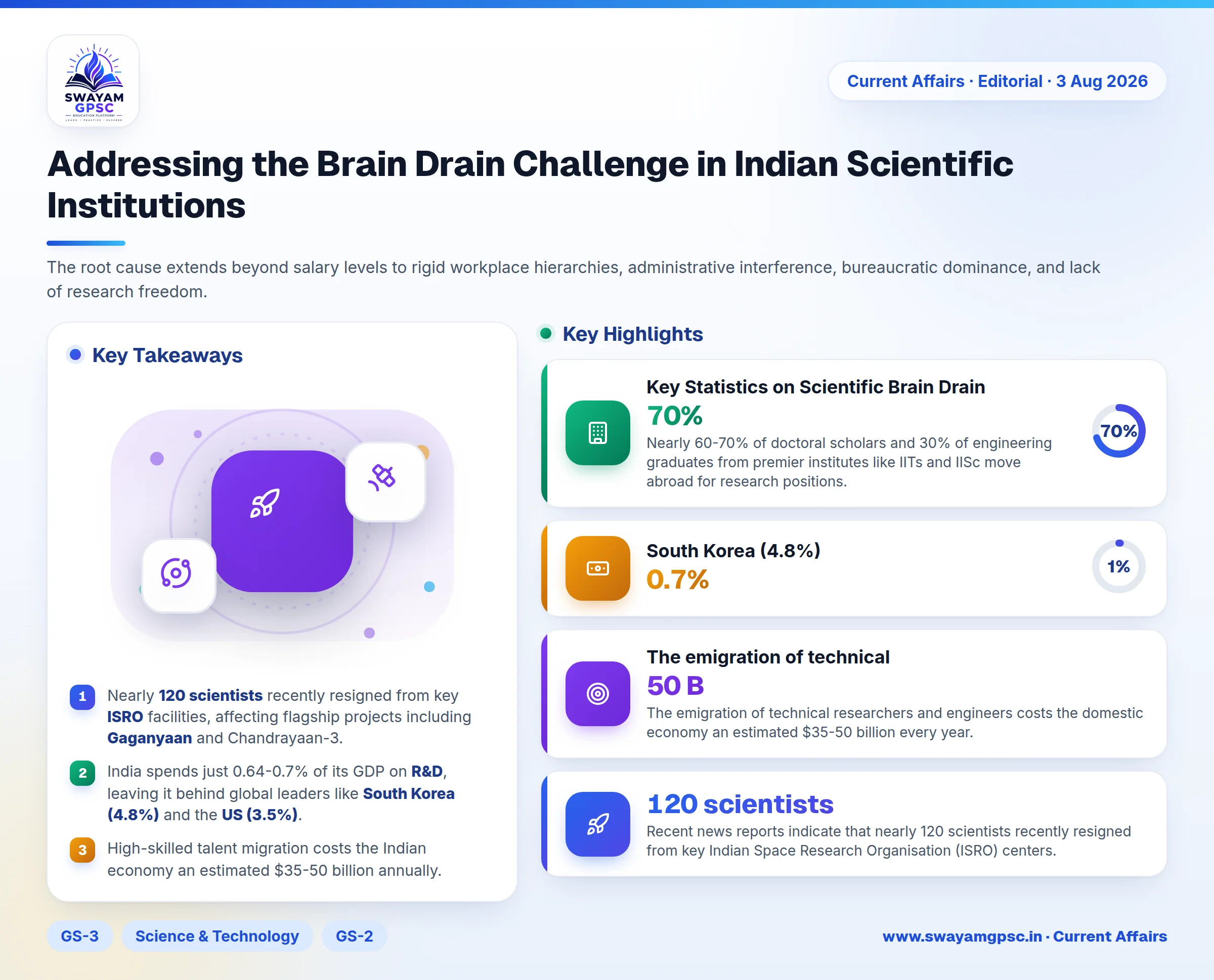
Addressing the Brain Drain Challenge in Indian Scientific Institutions
#GS-3 #Science & Technology #GS-2 #Governance & Social Justice #Brain Drain #R&D #ISRO #Human Capital
Key takeaways
- Nearly 120 scientists recently resigned from key ISRO facilities, affecting flagship projects including Gaganyaan and Chandrayaan-3.
- India spends just 0.64-0.7% of its GDP on R&D, leaving it behind global leaders like South Korea (4.8%) and the US (3.5%).
- High-skilled talent migration costs the Indian economy an estimated $35-50 billion annually.
- Up to 70% of doctoral graduates from top institutes like IITs and IISc leave India due to rigid workplace hierarchies and low autonomy.
Why in News
- Recent news reports indicate that nearly 120 scientists recently resigned from key Indian Space Research Organisation (ISRO) centers.
- These departures specifically impacted critical facilities, including the UR Rao Satellite Centre (URSC) and the Vikram Sarabhai Space Centre (VSSC).
Understanding the Scientific Retention Challenge
- Indian universities produce top-tier research minds, but state-run laboratories struggle to hold onto senior scientists over time.
- The root cause extends beyond salary levels to rigid workplace hierarchies, administrative interference, bureaucratic dominance, and lack of research freedom.
Key Statistics on Scientific Brain Drain
- Around 100-120 senior researchers resigned from ISRO, including 80 from URSC and 20 from VSSC, directly affecting missions like Gaganyaan, SpaDeX, and Chandrayaan-3.
- Nearly 60-70% of doctoral scholars and 30% of engineering graduates from premier institutes like IITs and IISc move abroad for research positions.
- India spends only 0.64-0.7% of its GDP on Gross Expenditure on Research and Development (GERD), compared to South Korea (4.8%), Israel (5.6%), and the United States (3.5%).
- The emigration of technical researchers and engineers costs the domestic economy an estimated $35-50 billion every year.
Factors Driving Scientific Exodus
- Colonial administrative habits give bureaucratic managers authority over scientific experts, turning open questioning into a career risk.
- Rigid workplace structures demand deference to official positions rather than merit, preventing young researchers from challenging existing theories.
- Class divisions like VIP seating and separate dining facilities during academic gatherings hinder open scientific discussion among colleagues.
- Absence of transparent complaint mechanisms leaves scientists afraid to raise workplace issues, fearing harm to peer reviews and research grants.
- External opportunities in private firms, deep-tech startups, global businesses, and foreign universities attract talent with higher professional freedom.
Impact of Losing Senior Talent
- Losing experienced project leaders destroys institutional knowledge gathered over decades of working on strategic national missions.
- Departures of senior scholars disrupt mentorship systems, leaving early-career researchers without guidance and professional growth.
- Unplanned resignations create operational risks in strategic fields like human spaceflight, artificial intelligence, quantum computing, and semiconductors.
Way Forward
- Government institutions must transfer administrative control to active scientists, granting primary investigators genuine authority over lab management.
- Research facilities must eliminate formal rank protocols at conferences to build egalitarian working environments between junior and senior staff.
- Institutions should establish independent complaint boards to handle workplace harassment, administrative overreach, and promotion disputes.
- Scientific agencies should provide lab directors with leadership training focused on modern team management rather than administrative control.
- Public sector laboratories must combine funding increases with workplace dignity, merit-based advancement, and creative autonomy.
Conclusion
- Constructing modern laboratories and funding ambitious space missions cannot deliver long-term success without a supportive working atmosphere.
- Retaining Indian talent requires swapping rigid administrative hierarchies for creative autonomy, open debate, and meritocracy.
- Allowing skilled researchers to flourish within national laboratories is essential to maintaining technological self-reliance and innovation.