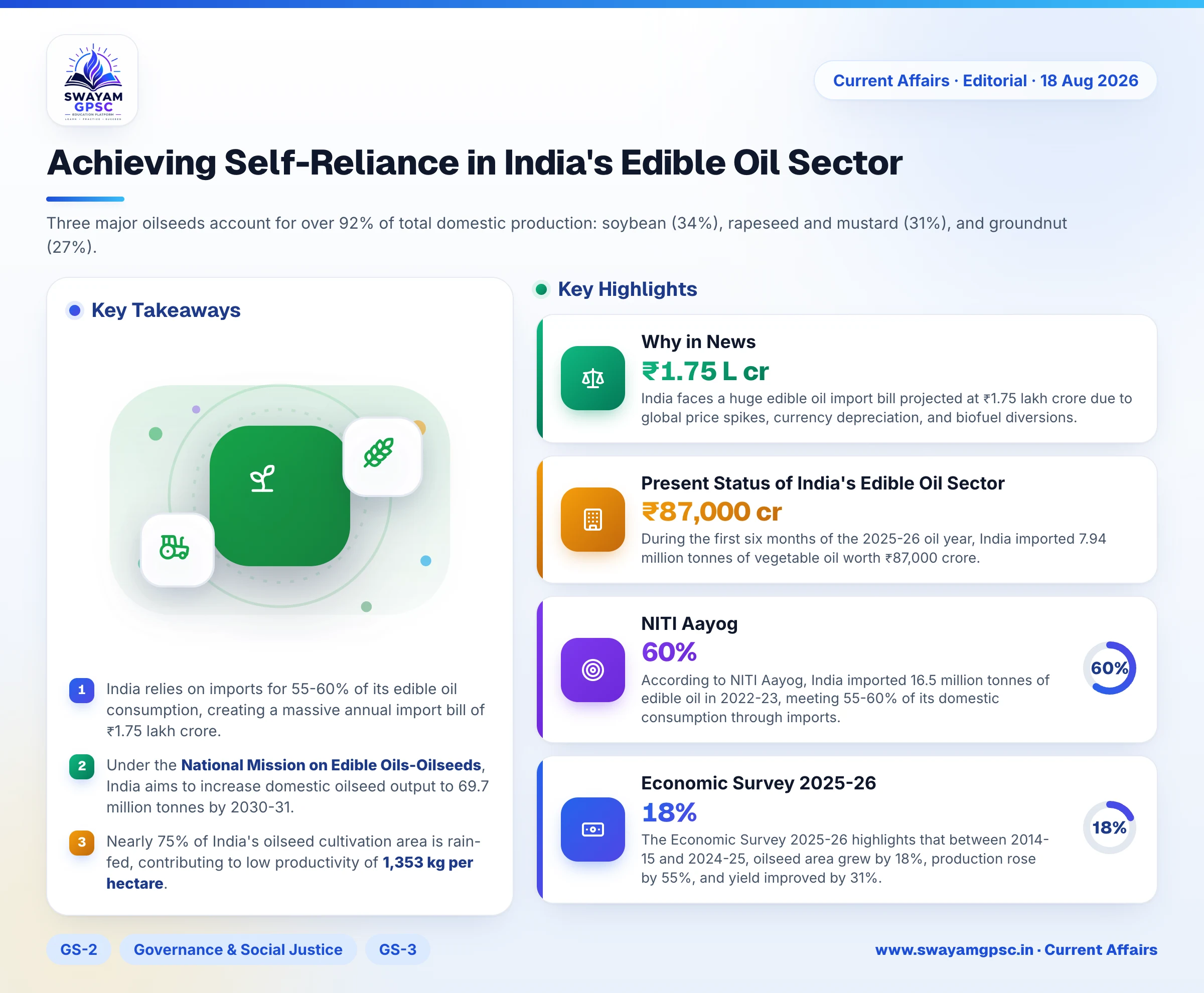
Achieving Self-Reliance in India's Edible Oil Sector
#GS-2 #Governance & Social Justice #GS-3 #Economy #Agriculture #Food Security #Government Policies & Interventions #Agricultural Marketing
Key takeaways
- India relies on imports for 55-60% of its edible oil consumption, creating a massive annual import bill of ₹1.75 lakh crore.
- Under the National Mission on Edible Oils-Oilseeds, India aims to increase domestic oilseed output to 69.7 million tonnes by 2030-31.
- Nearly 75% of India's oilseed cultivation area is rain-fed, contributing to low productivity of 1,353 kg per hectare.
- Three main oilseeds account for over 92% of total domestic output: soybean (34%), rapeseed and mustard (31%), and groundnut (27%).
Why in News
- India faces a huge edible oil import bill projected at ₹1.75 lakh crore due to global price spikes, currency depreciation, and biofuel diversions.
- Despite several government missions, structural problems like low farm productivity, rain-fed reliance, and weak procurement still slow down self-reliance efforts.
Present Status of India's Edible Oil Sector
- India ranks among the top oilseed producers worldwide, but it remains the largest global importer of edible oils.
- During the first six months of the 2025-26 oil year, India imported 7.94 million tonnes of vegetable oil worth ₹87,000 crore.
- According to NITI Aayog, India imported 16.5 million tonnes of edible oil in 2022-23, meeting 55-60% of its domestic consumption through imports.
- The Economic Survey 2025-26 highlights that between 2014-15 and 2024-25, oilseed area grew by 18%, production rose by 55%, and yield improved by 31%.
- Despite these domestic production gains, demand growth for cooking oil continues to outpace total farm output.
- Three major oilseeds account for over 92% of total domestic production: soybean (34%), rapeseed and mustard (31%), and groundnut (27%).
- India also relies on secondary sources like cottonseed, rice bran, and maize germ, along with tree-borne seeds like mahua and neem.
Reasons for Edible Oil Import Dependence
- Cooking oil demand is rising faster than production due to growing population, higher family incomes, rapid urbanisation, and changing eating habits.
- Domestic oilseed productivity remains far below its true potential and well behind yield levels in top producing countries.
- The government aims to raise average oilseed yield from 1,353 kg per hectare in 2022-23 to 2,112 kg per hectare by 2030-31, requiring a 56% increase.
- Nearly 75% of India's oilseed land lacks irrigation, leaving crops vulnerable to unpredictable monsoons and dry spells.
- Farmers often prefer growing rice, wheat, or sugarcane over oilseeds because those staple crops offer assured government purchase and stable profits.
- Government procurement for oilseeds under the Price Support Scheme remains limited and unpredictable compared to staple food grains.
- Cheap imported palm oil from Indonesia and Malaysia often undercuts local prices, especially when import tariffs are lowered.
- A weak seed supply chain prevents farmers from getting adequate quantities of high-yielding and disease-resistant seed varieties.
- Processing facilities use outdated technology, which leads to lower oil extraction rates and high post-harvest losses.
- Cultivation of minor oilseeds like sunflower, safflower, and niger has declined sharply due to poor market prices and high labour requirements.
Government Initiatives to Promote Self-Reliance
- The government launched the National Mission on Edible Oils-Oilseeds to boost domestic oilseed production through improved technology and seeds.
- The National Mission on Edible Oils-Oil Palm focuses on expanding oil palm plantation areas to reduce palm oil import reliance.
- The Price Support Scheme protects farmers from sudden price falls by purchasing oilseeds when market rates fall below support levels.
- The government announces Minimum Support Prices annually for major oilseeds to encourage farmers to expand crop acreage.
Challenges in Achieving Self-Reliance
- Raising oilseed production from 39 million tonnes to 69.7 million tonnes by 2030-31 requires an ambitious 79% jump in output.
- Policymakers face a tough choice between keeping import duties high to help farmers or keeping duties low to control consumer inflation.
- Climate change poses severe risks to rain-fed oilseed fields through delayed rains, heatwaves, and unseasonal harvest rain.
- Lab research on high-yielding seed varieties takes too long to reach actual farming fields and widespread adoption.
- Expanding oil palm plantations raises severe environmental concerns regarding heavy water usage, soil degradation, and loss of biodiversity.
- Oilseed production remains concentrated in a few states like Madhya Pradesh, Maharashtra, Gujarat, and Rajasthan, creating vulnerability to local weather shocks.
- Low market demand for oilcake reduces profits for processors, which ultimately lowers the prices offered to oilseed farmers.
Way Forward
- The government should create transparent price bands and predictable import duty rules to protect local farmers during harvest periods.
- Agencies like NAFED must expand physical procurement centres and make quick payments to build farmer trust.
- Policy targets should focus on actual oil yield per hectare rather than just raw crop weight.
- Developing regional oilseed clusters can link Farmer Producer Organisations (FPOs) directly with modern processing units and testing labs.
- Agricultural institutes must supply high-yield seed varieties, while state governments expand micro-irrigation in rain-fed districts.
- Farmers should plant short-duration oilseeds in vacant rice fields and adopt intercropping with major food crops.
- The country must modernise rice mills and crushing units to extract more oil from rice bran, cottonseed, and maize germ.
- Oil palm cultivation must expand strictly on identified water-secure lands without damaging natural forests.
- Public campaigns by institutes like ICMR-NIN should promote balanced cooking oil use while an empowered Edible-Oil Board oversees national policy.
Conclusion
- Achieving self-reliance in edible oils requires assured price protections, improved seed technology, expanded irrigation, and coherent trade policies to support both farmers and consumers.