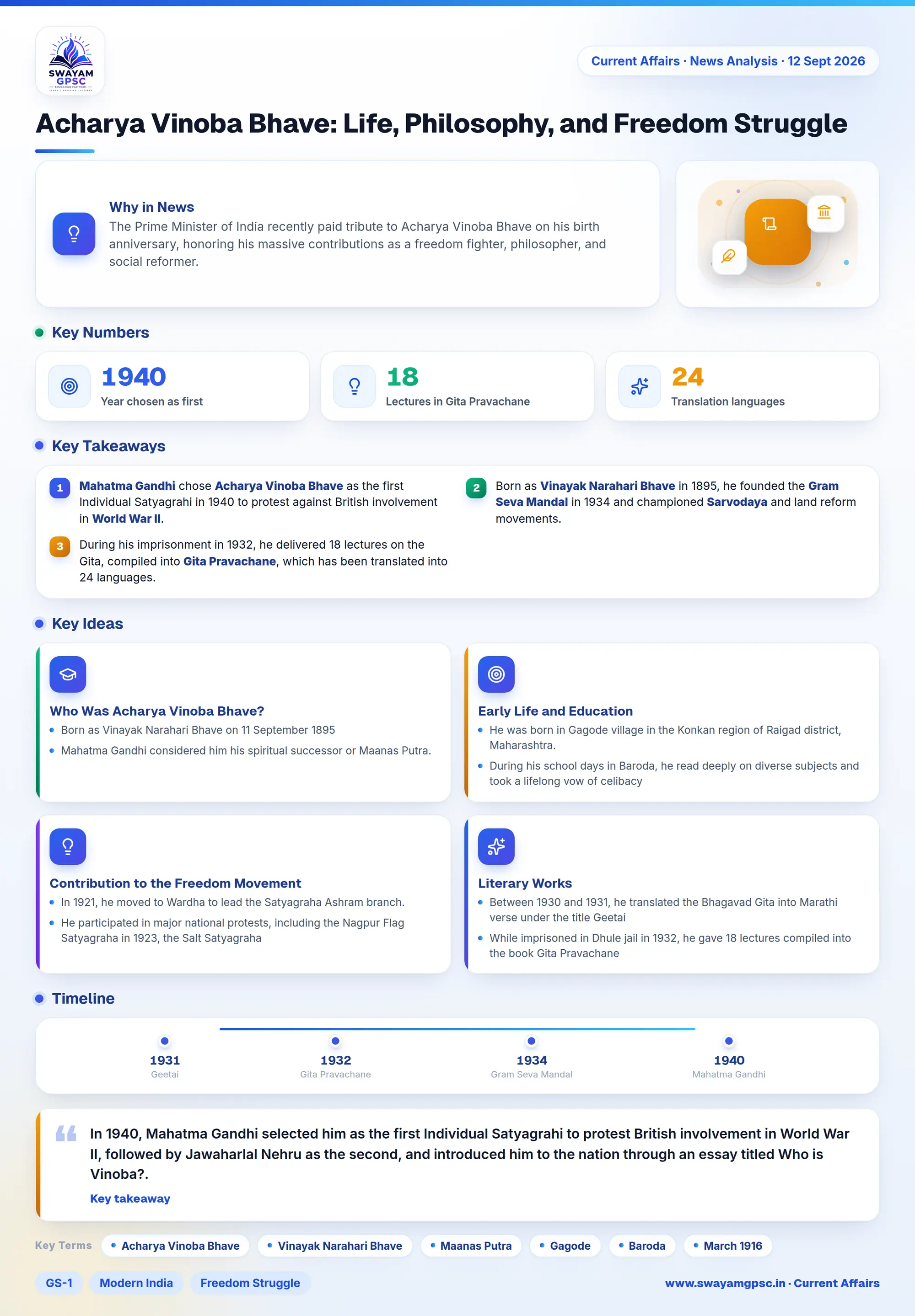
Acharya Vinoba Bhave: Life, Philosophy, and Freedom Struggle
#GS-1 #Modern India #Freedom Struggle #Gandhian Thought #GS-2 #National #Acharya Vinoba Bhave #Individual Satyagraha
Key takeaways
- Mahatma Gandhi chose Acharya Vinoba Bhave as the first Individual Satyagrahi in 1940 to protest against British involvement in World War II.
- Born as Vinayak Narahari Bhave in 1895, he founded the Gram Seva Mandal in 1934 and championed Sarvodaya and land reform movements.
- During his imprisonment in 1932, he delivered 18 lectures on the Gita, compiled into Gita Pravachane, which has been translated into 24 languages.
Why in News
- The Prime Minister of India recently paid tribute to Acharya Vinoba Bhave on his birth anniversary, honoring his massive contributions as a freedom fighter, philosopher, and social reformer.
Who Was Acharya Vinoba Bhave?
- Born as Vinayak Narahari Bhave on 11 September 1895, he lived until 15 November 1982 and established himself as an eminent philosopher, scholar, educationist, and social activist.
- Mahatma Gandhi considered him his spiritual successor or Maanas Putra. He passionately advocated non-violence, Sarvodaya, and land reforms, which earned him the title of National Teacher of India.
Early Life and Education
- He was born in Gagode village in the Konkan region of Raigad district, Maharashtra. His mother Rukmini Devi shaped his spiritual devotion, while his father gave him a scientific outlook.
- During his school days in Baroda, he read deeply on diverse subjects and took a lifelong vow of celibacy (Brahmacharya).
- In March 1916, he quit formal college, burned his certificates, and moved to Varanasi to search for truth. Inspired by Mahatma Gandhi, he met him in Ahmedabad on 7 June 1916 and joined his constructive programs.
- Gandhi affectionately named him Vinoba, placing him in the tradition of saint-poets from Maharashtra like Jnanoba and Tukoba.
Contribution to the Freedom Movement
- In 1921, he moved to Wardha to lead the Satyagraha Ashram branch. He later established the Gram Seva Mandal in 1934 and promoted village sanitation, basic education (Nai Talim), and Khadi spinning.
- He participated in major national protests, including the Nagpur Flag Satyagraha in 1923, the Salt Satyagraha, and civil disobedience drives, facing multiple imprisonments.
- In 1940, Mahatma Gandhi selected him as the first Individual Satyagrahi to protest British involvement in World War II, followed by Jawaharlal Nehru as the second, and introduced him to the nation through an essay titled Who is Vinoba?.
Literary Works
- Between 1930 and 1931, he translated the Bhagavad Gita into Marathi verse under the title Geetai, which became popular and sold millions of copies.
- While imprisoned in Dhule jail in 1932, he gave 18 lectures compiled into the book Gita Pravachane, which scholars translated into 24 languages across the world.
- He wrote key philosophical books including Sthitaprajna-Darshan, Swarajya-Shastra, Vichar-Pothi, and Ishavasya-Vrutti, while also summarizing core teachings from Christianity, Islam, and Buddhism (Dhammapada).