India's E20 Ethanol Blending Mandate: Evaluating Economic and Environmental Impacts
#GS-3 #Economy #Infrastructure #Agriculture #Environment #Climate Change #Sustainable Development #Science & Technology #Energy #Ethanol Blending #E20 Petrol #Fuel Policy
Key takeaways
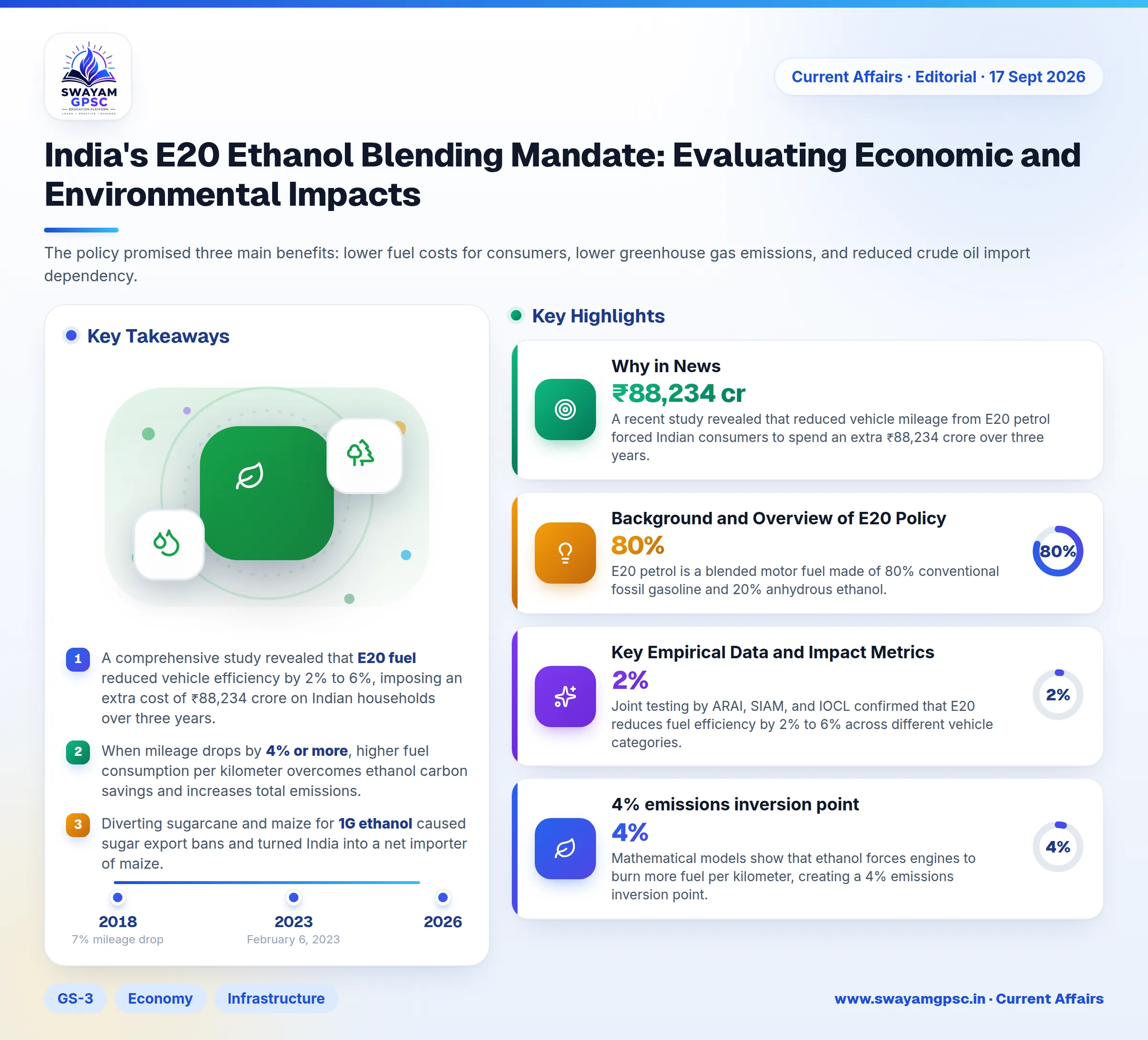
- A comprehensive study revealed that E20 fuel reduced vehicle efficiency by 2% to 6%, imposing an extra cost of ₹88,234 crore on Indian households over three years.
- When mileage drops by 4% or more, higher fuel consumption per kilometer overcomes ethanol carbon savings and increases total emissions.
- Diverting sugarcane and maize for 1G ethanol caused sugar export bans and turned India into a net importer of maize.
- The Chief Economic Adviser (CEA) recommended offering dedicated E10 nozzles alongside E20 dispensers to protect legacy vehicles.
Why in News
- A recent study revealed that reduced vehicle mileage from E20 petrol forced Indian consumers to spend an extra ₹88,234 crore over three years.
- The study raised serious doubts about whether the policy truly delivers promised carbon emission cuts and foreign exchange savings.
Background and Overview of E20 Policy
- E20 petrol is a blended motor fuel made of 80% conventional fossil gasoline and 20% anhydrous ethanol.
- Public sector Oil Marketing Companies (OMCs) launched E20 commercially on February 6, 2023, and expanded it under the Ethanol Blended Petrol (EBP) Programme.
- The government introduced this policy as an import-substitution strategy to protect the economy against global crude oil price spikes.
- The policy promised three main benefits: lower fuel costs for consumers, lower greenhouse gas emissions, and reduced crude oil import dependency.
Key Empirical Data and Impact Metrics
- Joint testing by ARAI, SIAM, and IOCL confirmed that E20 reduces fuel efficiency by 2% to 6% across different vehicle categories.
- For example, a standard 110cc motorcycle that runs 50 kilometers per liter on pure petrol drops to roughly 47 or 48 kilometers per liter on E20.
- Because ethanol contains less energy per liter, Indian households spent a total extra amount of ₹88,234 crore over three years.
- Mathematical models show that ethanol forces engines to burn more fuel per kilometer, creating a 4% emissions inversion point.
- If the mileage drop stays below 4%, net per-kilometer emissions decrease as intended.
- If the mileage drop reaches 4% to 6%, higher fuel burning overcomes ethanol carbon benefits, causing net tailpipe and lifecycle emissions to rise.
- Vehicles built before 2023 face accelerated fuel tank corrosion, damaged rubber lines, and mileage losses exceeding 6%.
- Diverting sugarcane juice to ethanol forced export bans in 2023 and 2026, which eliminated major foreign currency inflows.
- Grain distilleries used massive domestic maize supplies, which destroyed export revenues and turned India into a net importer of maize.
Core Fallacies in E20 Claims
- While blended fuel costs less to produce than imported crude, fuel companies kept pump prices identical, creating an implicit fuel surcharge for buyers.
- For example, a driver spending ₹100 to cover 15 kilometers on E10 must spend about ₹106 on E20 for the exact same distance.
- Higher fuel burn in older or unoptimized engines cancels out the carbon reduction benefit of pure ethanol.
- For example, a 2018 car with a 7% mileage drop on E20 burns more total fuel per 100 kilometers, producing higher net carbon emissions than on E10.
- Foreign currency saved on crude oil imports was completely offset by lost agricultural export revenues and new grain import bills.
- For instance, crude import savings were directly countered by lost sugar export receipts and funds spent to import feed-grade maize.
- Using first-generation 1G grain feedstocks directly increased food prices across the country.
- For example, diverting maize to ethanol distilleries increased feed costs for poultry and dairy farms, raising retail prices of eggs and milk.
Challenges
- Fuel companies replaced E10 with E20 across retail stations without offering dual dispensers, forcing older vehicle owners to buy non-compliant fuel.
- Ethanol absorbs moisture from the air and corrodes metal and rubber components inside vehicle engines.
- Moisture accumulation inside pre-2023 metal tanks creates rust that clogs fuel injectors, while standard rubber gaskets swell and crack.
- Biofuel crop cultivation places severe pressure on regional groundwater reserves.
- Sugarcane farming in dry belts of Maharashtra and Karnataka requires 2,000 to 3,000 liters of water per kilogram of sugar, worsening water depletion.
Way Forward
- Follow the recommendation of the Chief Economic Adviser (CEA) to mandate dedicated E10 nozzles alongside E20 dispensers at all fuel pumps.
- Reduce E20 retail prices by 3% to 6% compared to E10 to compensate motorists for real mileage losses.
- Shift government subsidies away from edible food grains toward non-food biomass and second-generation 2G biofuels.
- For example, using paddy straw from Punjab and Haryana as feedstock solves food security issues while reducing seasonal farm fires.
- Apply cuts in central excise duty during crude price spikes instead of relying only on aggressive blending targets to manage inflation.
- Direct long-term subsidies toward electric public transit to address urban air quality at the source.
Conclusion
- India's E20 mandate shows how biofuel targets can cause unintended economic and environmental harm when implementation moves faster than vehicle readiness.
- Re-evaluating blending targets, providing retail fuel choices, and prioritizing second-generation feedstocks will ensure a fair energy transition.