Powering India's Manufacturing Sector
#GS-3 #Economy #Growth #Infrastructure #Employment #Industrial Policy
Key takeaways
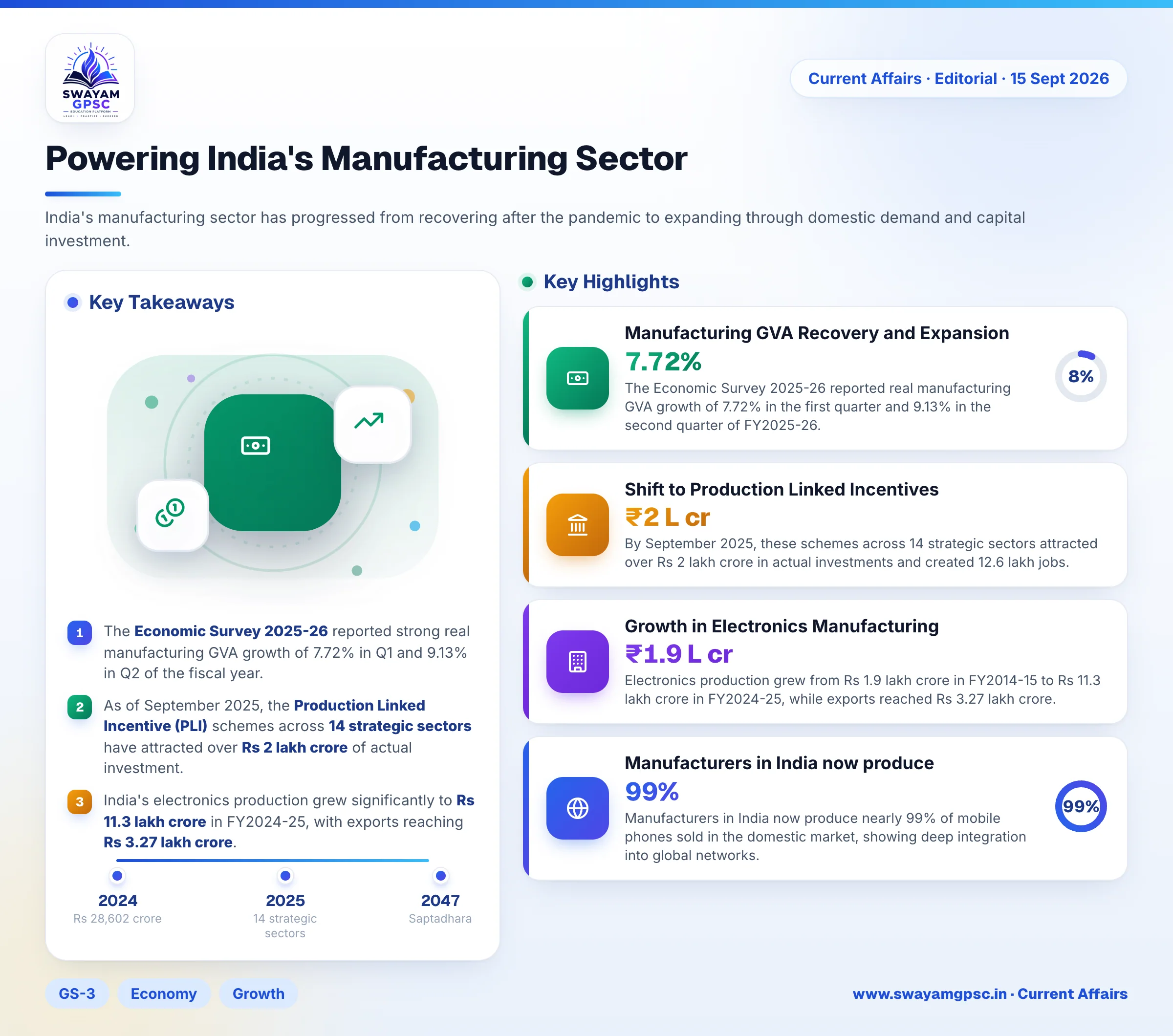
- The Economic Survey 2025-26 reported strong real manufacturing GVA growth of 7.72% in Q1 and 9.13% in Q2 of the fiscal year.
- As of September 2025, the Production Linked Incentive (PLI) schemes across 14 strategic sectors have attracted over Rs 2 lakh crore of actual investment.
- India's electronics production grew significantly to Rs 11.3 lakh crore in FY2024-25, with exports reaching Rs 3.27 lakh crore.
- Manufacturing employs only 12.1% of India's workforce compared to 43% in agriculture, showing the need for a balanced employment strategy.
- India's research and development spending remains low at 0.6% to 0.7% of GDP, which limits local technological innovation.
Why in News
- India's Prime Minister identified manufacturing power as one of the seven pillars, or Saptadhara, to achieve a developed nation status by 2047.
- India needs a balanced strategy that supports advanced sectors like semiconductors and AI while boosting job-creating sectors like textiles.
- Reaching the USD 100-billion textile export target requires building highly competitive local production ecosystems.
Manufacturing GVA Recovery and Expansion
- India's manufacturing sector has progressed from recovering after the pandemic to expanding through domestic demand and capital investment.
- The Economic Survey 2025-26 reported real manufacturing GVA growth of 7.72% in the first quarter and 9.13% in the second quarter of FY2025-26.
- Rising capacity use and strong demand for automobiles, construction materials, and consumer goods have driven this industrial growth.
Shift to Production Linked Incentives
- The government now ties financial support to actual increases in production and investment through the Production Linked Incentive (PLI) schemes.
- By September 2025, these schemes across 14 strategic sectors attracted over Rs 2 lakh crore in actual investments and created 12.6 lakh jobs.
- The National Manufacturing Mission coordinates efforts to improve the ease of doing business, adopt clean technology, and build future-ready skills.
Growth in Electronics Manufacturing
- India has transformed into a global electronics hub, and policy is now focusing on increasing domestic value addition rather than just assembly.
- Electronics production grew from Rs 1.9 lakh crore in FY2014-15 to Rs 11.3 lakh crore in FY2024-25, while exports reached Rs 3.27 lakh crore.
- Manufacturers in India now produce nearly 99% of mobile phones sold in the domestic market, showing deep integration into global networks.
- The Electronics Components Manufacturing Scheme supports local production of key components like camera modules, display assemblies, and lithium-ion cells.
Transition to Advanced Electric Mobility
- The Indian automotive sector is shifting from traditional combustion engines to electric vehicles, advanced battery systems, and hydrogen mobility.
- The Automobile and Auto-Component PLI Scheme encourages companies to manufacture zero-emission vehicles and advanced automotive technologies locally.
- The Advanced Chemistry Cell PLI scheme aims to build 50 GWh of local battery capacity to reduce import dependence.
- This shift is helping modernize established automotive hubs in cities like Chennai, Pune, Sanand, and Hosur.
Strategic Defence Indigenisation
- Defence manufacturing is moving away from licensed assembly toward domestic design, private sector participation, and export growth.
- India recorded defence production of Rs 1.51 lakh crore in FY2024-25, which is nearly 90% higher than in FY2019-20.
- Defence exports reached a historic high of Rs 23,622 crore in FY2024-25, compared to just Rs 686 crore in FY2013-14.
- Modern platforms like the Tejas aircraft, Prachand helicopter, BrahMos missiles, and INS Vikrant demonstrate India's expanding defence capabilities.
- Initiatives like Positive Indigenisation Lists and the iDEX start-up platform connect public defence units with private innovators.
Expansion of Clean Technology Manufacturing
- India is rapidly building local capacity for solar panels, green hydrogen equipment, and energy-efficient appliances to support its net-zero goals.
- Solar PV module capacity under the approved list of models rose from 2.3 GW in 2014 to over 100 GW in 2025.
- The SIGHT programme under the National Green Hydrogen Mission supports local manufacturing of electrolysers and integrated solar modules.
Plug and Play Industrial Clusters
- The government is organizing manufacturing around smart industrial corridors and multimodal logistics to reduce factory-to-port transport costs.
- In 2024, the Union Cabinet approved 12 industrial smart-city projects across ten states with an estimated investment of Rs 28,602 crore.
- Connecting these projects with PM Gati Shakti and Dedicated Freight Corridors helps build integrated manufacturing ecosystems.
Formalisation and Digitalisation of MSMEs
- The manufacturing ecosystem is becoming more formal and digital through platforms like Udyam, GST, and electronic invoicing.
- Over 6.8 crore enterprises registered on the Udyam platform by December 2025, which improved their access to formal credit.
- Schemes like SAMARTH Udyog Bharat 4.0 and the ZED Certification help small businesses adopt robotics, digital tools, and clean production methods.
Pharmaceutical and Biopharma Expansion
- India is the 3rd largest pharmaceutical producer by volume globally, exporting drugs worth USD 30 billion in FY2024-25.
- The pharmaceutical PLI schemes encourage local production of active pharmaceutical ingredients and advanced, innovative medicines.
- The Biopharma SHAKTI mission helps India transition from volume-based generic drugs to high-value, innovation-led biomanufacturing.
Challenges
- Incomplete Structural Transformation: Manufacturing still employs only 12.1% of India's workforce, while low-productivity agriculture employs around 43%.
- Shallow Domestic Value Addition: India remains highly dependent on foreign imports for advanced components, industrial machinery, and critical raw materials.
- Missing Middle and Financial Stress: Delayed payments of nearly Rs 8.1 lakh crore lock up vital working capital for small MSMEs.
- Low Research Intensity: India spends only 0.6% to 0.7% of GDP on research and development, which is far below the global average.
- Low Productivity and Slow Industry 4.0 Adoption: India's robot density is only 5 to 7 robots per 10,000 workers, compared to the global average of 162.
- Skill Mismatch: Only 4.9% of Indian youth aged 15-29 years have received formal technical or vocational training.
- High Factor Costs: High costs of rail freight, electricity, land, and complex regulatory compliance reduce the global competitiveness of Indian factories.
- Carbon-Intensive Production: Indian steel plants emit 2.65 tonnes of CO2 per tonne of steel, which is 32% higher than the global average.
Way Forward
- Employment-Focused Incentives: India should link industrial incentives directly to formal job creation and local value addition rather than just sales volume.
- Support Medium Enterprises: The government should set up a Scale-Up Manufacturing Fund and use automatic escrow systems to prevent delayed payments.
- Build Local Component Supply Chains: Policymakers should design target policies for high-value components and establish critical raw material reserves.
- Establish Technology Extension Networks: District-level centers should help MSMEs adopt modern technologies like robotics and industrial internet of things.
- Promote Mission-Oriented Innovation: Government should launch grand challenges for advanced technologies and act as the first buyer for local innovations.
- Implement Dual Apprenticeship Systems: Industry clusters should run training academies where students split time between classrooms and actual factory floors.
- Develop Green Manufacturing Hubs: Exporters need product carbon passports to match international standards like the EU's CBAM regulations.
Conclusion
- Achieving a developed India by 2047 requires balancing advanced high-tech capabilities with job-rich sectors like textiles to create inclusive growth.
- The ultimate success of India's manufacturing sector lies in transforming informal workers into formal, socially protected citizens.