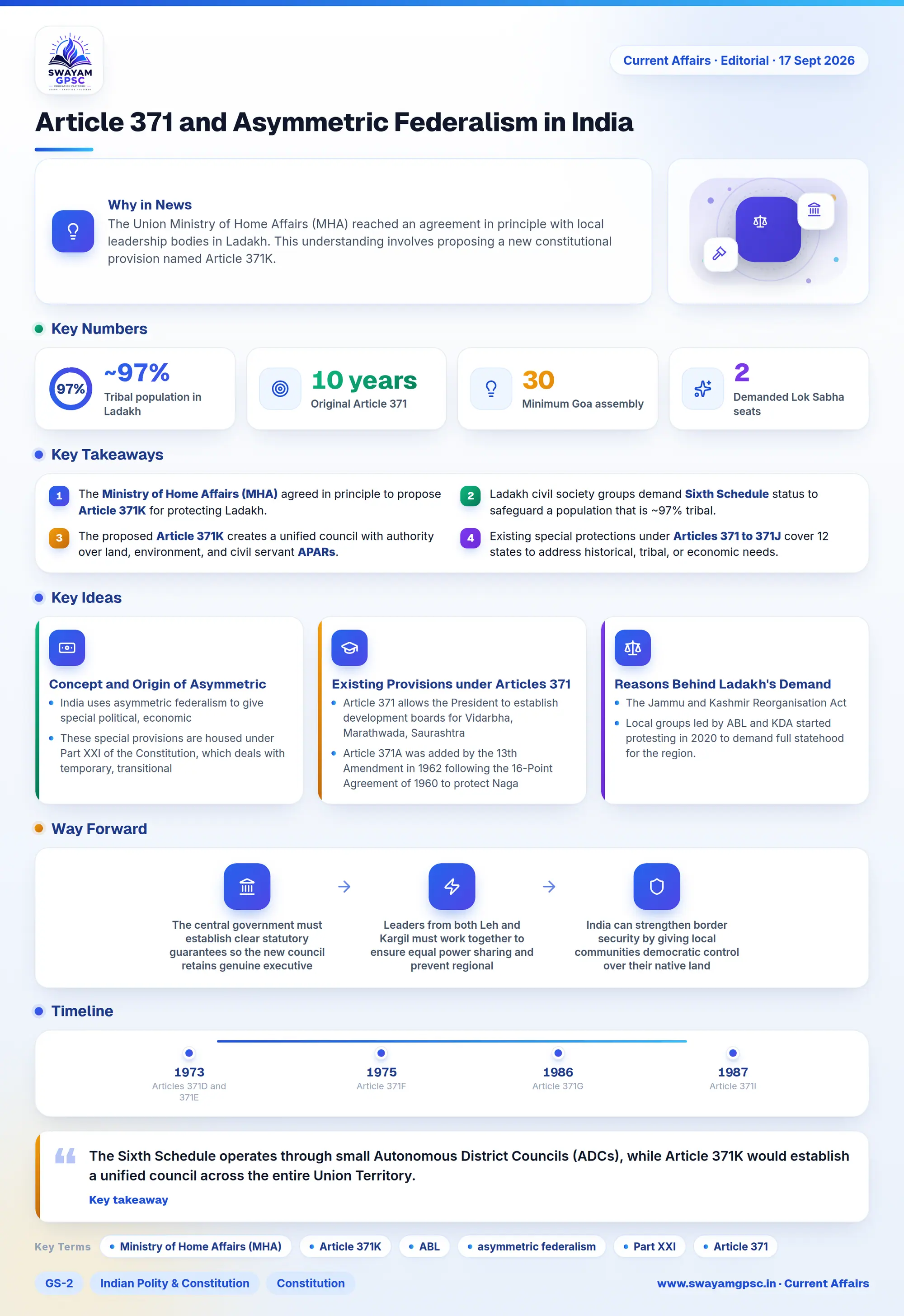
Article 371 and Asymmetric Federalism in India
#GS-2 #Indian Polity & Constitution #Constitution #Federalism #Asymmetric Federalism #Article 371 #Ladakh #Sixth Schedule
Key takeaways
- The Ministry of Home Affairs (MHA) agreed in principle to propose Article 371K for protecting Ladakh.
- Ladakh civil society groups demand Sixth Schedule status to safeguard a population that is ~97% tribal.
- The proposed Article 371K creates a unified council with authority over land, environment, and civil servant APARs.
- Existing special protections under Articles 371 to 371J cover 12 states to address historical, tribal, or economic needs.
Why in News
- The Union Ministry of Home Affairs (MHA) reached an agreement in principle with local leadership bodies in Ladakh.
- This understanding involves proposing a new constitutional provision named Article 371K.
- The proposal comes after negotiations with the Apex Body, Leh (ABL) and the Kargil Democratic Alliance (KDA).
Concept and Origin of Asymmetric Federalism
- India uses asymmetric federalism to give special political, economic, and administrative rights to specific regions based on historical or ethnic needs.
- These special provisions are housed under Part XXI of the Constitution, which deals with temporary, transitional, and special provisions.
- In 1950, the original Article 371 put former princely states known as Part B States under presidential supervision for 10 years.
- The 7th Constitutional Amendment Act (1956) removed state categories and redirected Article 371 to create development boards in Maharashtra and Gujarat.
- Over time, Parliament added Articles 371A to 371J to protect tribal rights, resolve ethnic conflicts, and reduce regional economic gaps.
Existing Provisions under Articles 371 to 371J
- Article 371 allows the President to establish development boards for Vidarbha, Marathwada, Saurashtra, and Kutch to balance regional growth and education quotas.
- Article 371A was added by the 13th Amendment in 1962 following the 16-Point Agreement of 1960 to protect Naga customary laws and land rights.
- Article 371B was created by the 22nd Amendment in 1969 to establish a special committee in the Assam assembly for tribal areas.
- Article 371C came through the 27th Amendment in 1971 to set up a Hill Areas Committee in Manipur with mandatory annual reports by the Governor.
- Articles 371D and 371E were inserted by the 32nd Amendment in 1973 under the Six-Point Formula to balance employment and education opportunities in Andhra Pradesh and Telangana.
- Article 371F was created by the 36th Amendment in 1975 to protect local laws and assembly seats when Sikkim joined India.
- Article 371G was added by the 53rd Amendment in 1986 following the Mizo Peace Accord to shield Mizo social customs and land ownership.
- Article 371H came through the 55th Amendment in 1986 and gives the Governor of Arunachal Pradesh special authority over law and order.
- Article 371I was added by the 56th Amendment in 1987 to fix the minimum assembly size of Goa at 30 members.
- Article 371J was introduced by the 98th Amendment in 2012 to offer education and employment quotas for the backward Kalyana-Karnataka region.
Reasons Behind Ladakh's Demand for Constitutional Safeguards
- The Jammu and Kashmir Reorganisation Act, 2019 turned Ladakh into a Union Territory without an elected legislative assembly.
- Local groups led by ABL and KDA started protesting in 2020 to demand full statehood for the region.
- They want protection under the Sixth Schedule (Articles 244(2) and 275(1)) because nearly ~97% of the local population is tribal.
- Protesters are demanding a separate Public Service Commission (PSC) to secure jobs for local youth.
- They are also asking for two separate Lok Sabha seats so that Leh and Kargil each get dedicated representation in Parliament.
Unique Features of Proposed Article 371K
- Proposed Article 371K would create an elected council in a Union Territory that lacks its own state assembly.
- The new body would hold direct authority over land, cultural heritage, forests, and local natural resources under Article 240.
- Elected representatives would gain administrative oversight over officer transfers, postings, and performance reports (APARs).
- Unlike Article 371H, the proposed council in Ladakh wants direct control over public order instead of leaving authority with the Governor.
- Central laws regarding land acquisition would require approval from the local council before taking effect in Ladakh.
Comparative Analysis: Sixth Schedule versus Proposed Article 371K
- The Sixth Schedule operates through small Autonomous District Councils (ADCs), while Article 371K would establish a unified council across the entire Union Territory.
- Legislative power under the Sixth Schedule remains limited to local subjects, whereas Article 371K offers wider authority over environment, minerals, and administration.
- District councils under the Sixth Schedule hold little control over civil servants, but Article 371K grants elected leaders direct supervision over deputed officers.
Major Governance and Political Challenges Ahead
- Ladakh lies along sensitive borders with China at the Line of Actual Control and Pakistan at the Line of Control, requiring careful coordination between defense needs and local land rules.
- Policy makers must balance political representation fairly between the Buddhist majority in Leh and the Muslim majority in Kargil.
- Creating this special framework might lead other Union Territories like Puducherry or the Andaman and Nicobar Islands to demand similar powers.
- Advisory bodies can easily lose influence without statutory backing, as seen with the Hill Areas Committee under Article 371C in Manipur.
Way Forward
- The central government must establish clear statutory guarantees so the new council retains genuine executive authority.
- Leaders from both Leh and Kargil must work together to ensure equal power sharing and prevent regional friction.
- India can strengthen border security by giving local communities democratic control over their native land and resources.